

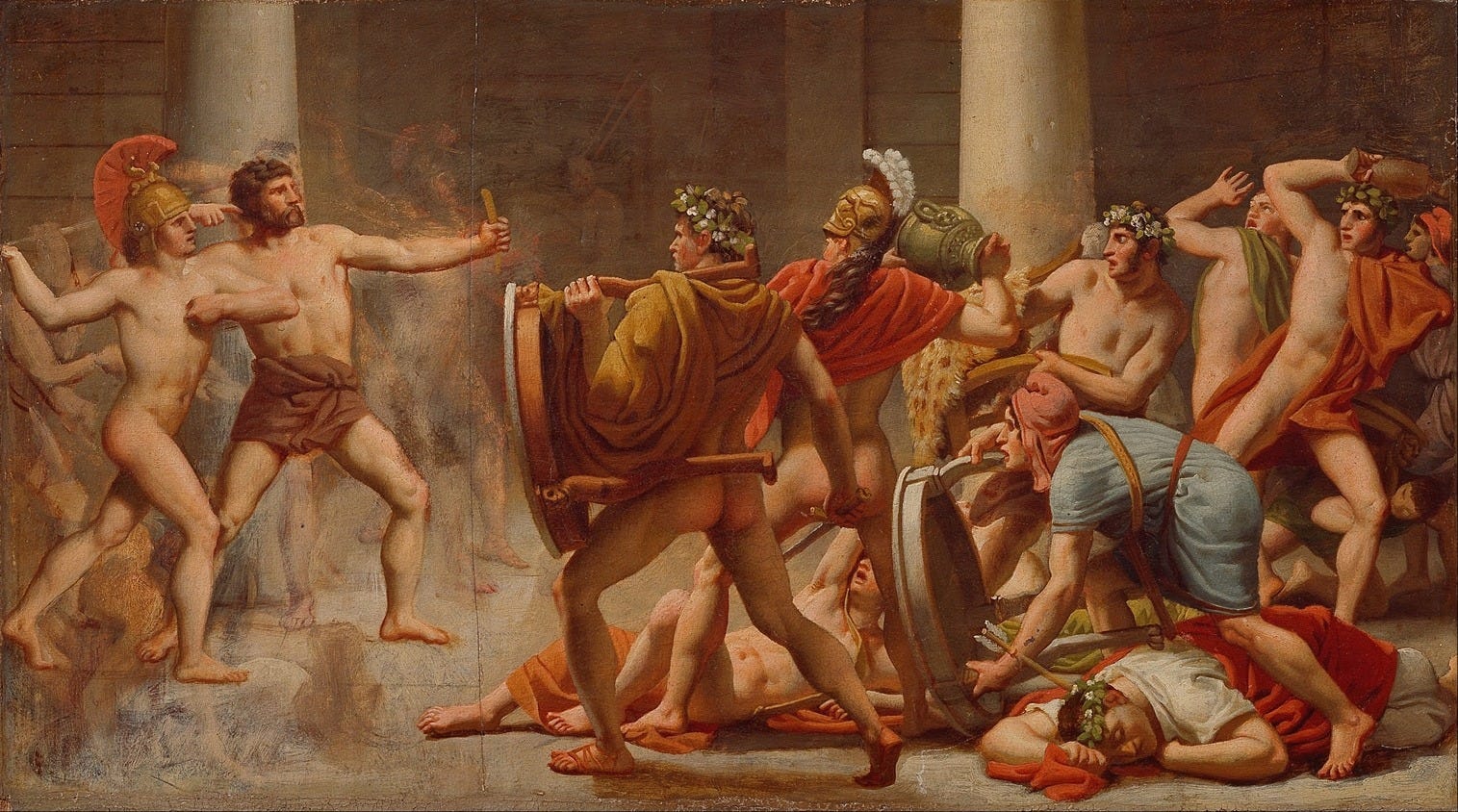
Equal-Mind, son of Well-Persuaded, is the boldest of them, and the first to die. He is lifting a golden cup to his lips when the arrow goes through his throat. He dies kicking the table over, spilling bread and roasted meat onto the dirt.
The hall erupts. A hundred young men spring to their feet, groping for weapons on walls where there are none.
In the doorway stands the old beggar they have been mocking for three days. He’s holding a bow.
He’s no beggar. The master of the house has returned.
Wide-Fight tries to reason with him.
“It was all Equal-Mind’s doing,” he says. “But the guilty man is dead. We’ll pay you back twenty oxen each, for what we’ve eaten and drunk here, and gold and bronze besides.”
The second arrow takes Wide-Fight in the chest. He doubles over the table and dies without a fight, wide or otherwise.
Dwelling-Around draws his sword and charges. He gets a spear between the shoulders from Far-Fight, the master’s son.
Then, chaos. Arrows. Spears. Men scrambling behind overturned benches until, at last, the survivors rally at the far end of the hall.
Their names read like the roster of a war band: Army-Leader, Wide-Ranging, Ruling-Around, People’s-War, Man-Persuader, Rich-in-Cattle.
But they are no war band. They are simply men who have eaten too much of their neighbour’s cattle, and made themselves too friendly with their neighbour’s wife.
An old serving woman named Wide-Fame comes in, sees the men dead who had dishonoured her master’s house for so long, and opens her mouth to raise a cry of victory. But the master stops her.
“Be joyful in your heart,” he says, “but keep silent. It is not right to boast over the slain.”
By nightfall, the hall is quiet. The bodies are stacked on the porch like a fisherman’s catch. By morning, nothing is left of them but their names.
You’re reading The Dead Language Society, where 75,000+ readers explore the hidden history of the English language. I’m Colin Gorrie: PhD linguist and your guide through 1,500 years of linguistic history.
I publish every Wednesday. Paid subscribers get every issue, the full archive, and my most in-depth work, including longer essays that trace the mysteries of English to their source, practical guides to reading historical texts yourself, and live book clubs where we read texts like Beowulf and Sir Gawain and the Green Knight.
What you just read is a loose adaptation of Odysseus’s fight against the suitors from Book 22 of the Odyssey, with one odd choice: I translated the Greek names literally.
So Antinous, the chief suitor, becomes Equal-Mind, Eurymachus becomes Wide-Fight, and Demoptolemus becomes People’s-War.
So too does Odysseus’ son Telemachus become Far-Fight. The master of the house is, of course, Odysseus himself, although I left Odysseus untranslated and unnamed. His name is different from the rest: first, no one really knows where Odysseus comes from.1 But, more importantly, it can’t be broken down into two parts like the other names.
It’s this two-part structure of names that I want to talk about today. It’s not just something you find in Homer. In fact, your name has a good chance of breaking down into two parts in exactly the same way as a Homeric hero’s, especially if you’re a George, Philip, Richard, or Roger.
This pattern, grafting two meaningful elements together, is extremely ancient, and extremely widespread: you see the same pattern not only in Ancient Greek names like Tele-machus ‘Far-Fight’ but also in medieval Germanic names like Æþel-stān ‘Noble-Stone’. It shows up in Celtic and Slavic languages too, as in Gaulish Catu-rix ‘Battle-King’ and Vladi-slav ‘Power-Glory’.
It lies behind some of the most famous names of history, such as Old Persian Xšaya-ṛšā ‘Ruling-Heroes’, which you probably know better from its Greek version: Xerxes. If you’ve read Indian epics such as Mahabharata or Ramayana, you may recognize names like Yudhi-shthira ‘Battle-Steady’ or Shatru-ghna ‘Enemy-Slayer’.
Even more interesting, the elements that make up these two-part names are often the same in these different languages and traditions. You see the same kinds of words over and over again: words meaning ‘fight’, ‘battle’, ‘glory’, ‘fame’, ‘man’, ‘hero’, ‘ruler’, ‘king’, etc.
In many cases you could translate a name from one of these languages to another and it would sound completely natural: the Greek name Theodoros means ‘God-Gift’, as does the Sanskrit Devadatta, and the Old English Godġiefu.
These names are so similar they come from one single naming tradition, inherited by all of these diverse languages and cultures. In fact, the English names we use today inherit this tradition too, even though two-part names are now just one kind among many others.
The key to this tradition is that names meant something. And not just any old something, but something grand and impressive.
And yet, if you ask a hundred Richards or Audreys what their names mean, you’ll be lucky to find one who knows. Somewhere between the Bronze Age and the modern birth certificate, the system broke down.
The names survived, but their meanings were lost. Although not forever. With a little etymological know-how we can reconstruct this ancient naming tradition, and see just how many of our own names are part of it today.
