

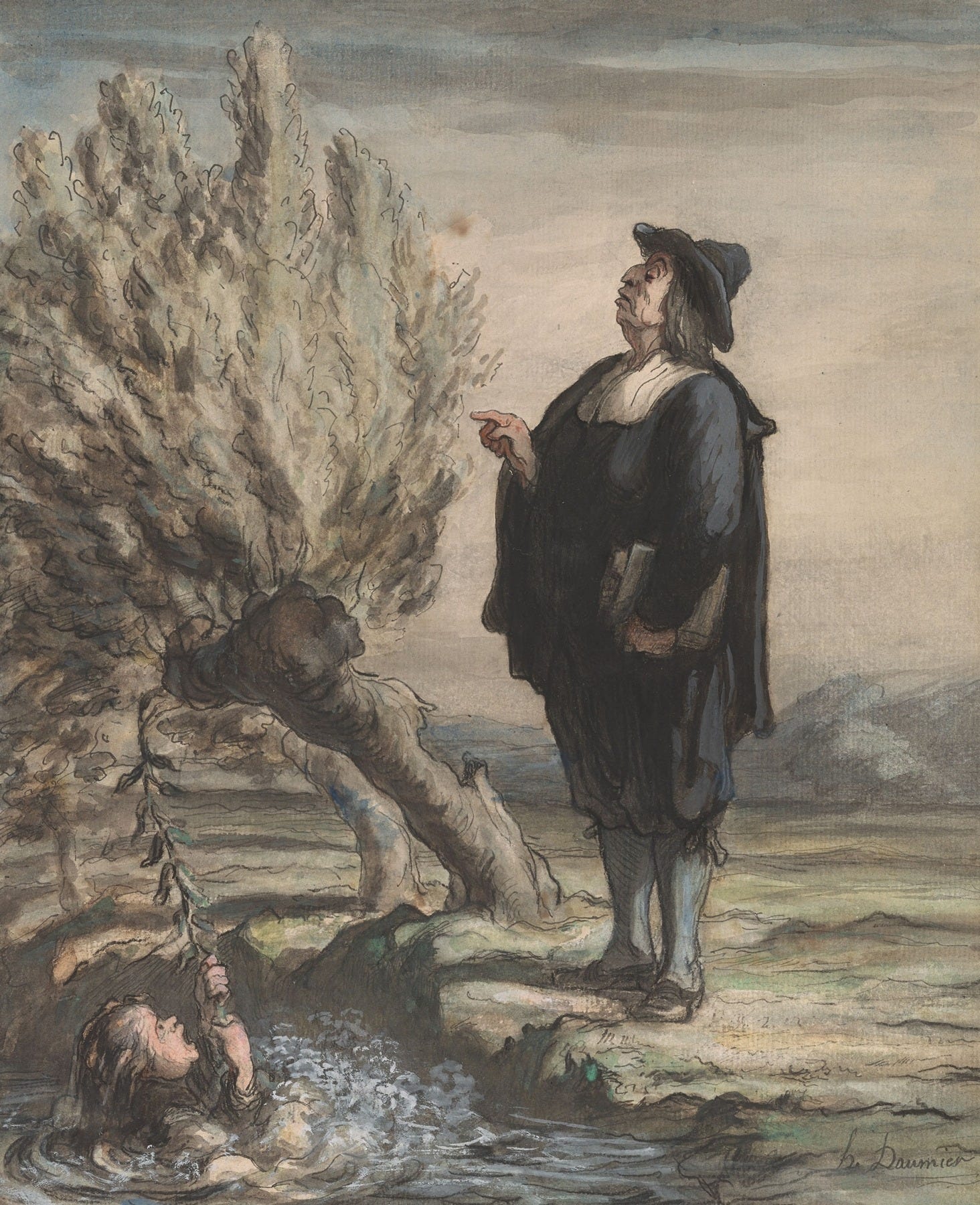
It was upon a morning of uncommon brilliance, in the Year of Grace one thousand eight hundred and eighty-seven — a date, dear reader, which shall presently disclose its peculiar significance — that an Englishman of the better sort ventures forth to take the air.
Our Englishman is, you must understand, one of those gentlemen so very emblematic of this our Victorian Era, secure in the conviction that, in taking his constitutional, he is rendering some small service to the Empire. Her Majesty has need of healthy tailors, barristers, sea captains, and the like.
On such a day as this, nothing can disturb his equanimity. Or so it appears to our Englishman, until he passes by a small but uncommonly deep pool, of the kind often to be found in the English countryside, wherein he espies a man thrashing about.
A damnable fuss, thinks our Englishman, the fellow is making. He walks on, quickening his pace somewhat, the better to pass the pool with dispatch.
But the man flailing in the pool catches sight of the Englishman, and cries out, “I will drown! I will drown!”
The Englishman can discern from the drowning man’s accent that he is a Frenchman. Or a German. Some manner of foreigner, at any event.
Our Englishman hesitates. The matter does appear to be of some seriousness. Nevertheless, presently, after a moment’s reflection, he walks on.
“I will drown!” calls the man in the pool a third time. “I will drown, and no one shall save me!”
The Englishman pauses at the side of the pool, an inward conflict stirring within his breast. Ought he to save the man in the pool? After what seems an eternity, the Englishman arrives at a decision. He walks on, and leaves the man to drown.
Later that same evening, the Englishman recounts his encounter with the Frenchman of the pool to his friends at the club, satisfied in the knowledge that he has acted rightly. He is, after all, nothing if not a respecter of persons.
One of his friends, a Scotsman, is astonished. “How could you leave a man to drown, even if he be a Frenchman?”
The Englishman, with great solemnity, returns, “It was no easy matter. Indeed, I was obliged to overrule every natural inclination of brotherhood to do so. But I could not but respect his wishes. As the man himself declared, ‘I will drown. No one shall save me.’”
“But why,” rejoins the Scotsman, with the bluff directness of his race, “did you not heed his petition? Was he not, in plain terms, asking for aid?”
“Certainly not,” observed the Englishman. “As the eminent Bishop Lowth has plainly laid down in his Grammar, will, when predicated of the first person, as in I will, indicates desire. Shall, when predicated of the third person, denotes command or injunction. The Frenchman’s express desire was to drown, and his command to me was precisely that I do nothing. Though it pained me as an Englishman, I was compelled to obey.”
The Scotsman is dumbfounded, and later lays the matter before the local constabulary, who, having weighed the particulars with due gravity, are pleased to certify that no wrongdoing whatsoever has been committed.
You’re reading The Dead Language Society, where 50,000+ readers explore the hidden history of the English language. I’m Colin Gorrie: PhD linguist and your guide through 1,500 years of linguistic history.
I publish every Wednesday. Paid subscribers get every issue, the full archive, and the content I’m most proud of: practical guides to reading historical texts yourself, honest takes on how language really works, and live book clubs where we read texts like Beowulf and (currently) Sir Gawain and the Green Knight.
A joke like this is first recorded in 1804, mocking the rather bizarre state of affairs that once prevailed in English — or, more correctly, in particular kinds of English of southern England — regarding the use of the words will and shall.
Some of you may have even been exposed to memories of learning a will/shall rule, a bit of prescriptive grammar requiring you to use shall to express future time in the first person (with I and we), and will otherwise. As our Englishman explained, using will in the first person indicated a wish, and use of shall outside of the first person meant a command or prohibition.
This rule, which I believe is moribund today if not utterly dead, caused grief to generations of schoolchildren and learners of English as a second language due to its counterintuitive nature.
That it was equally vexing to everyone can be seen from the fact that the identity of the drowning man differs from telling to telling. Sometimes he’s French, sometimes German, and sometimes even Scottish.
I, for one, do not lament the loss of the will/shall rule, at least in my capacity as a writer and speaker of English.
But, as a linguist, I’ve always found it fascinating. It could only have arisen at a very particular point in the history of the English language, when two different verbs were competing to serve as the substitute for English’s missing future tense.
If it seems strange that I’m saying English has no future tense after about 700 words of discussing will and shall, let me clarify that I mean that English has no single verb form associated with future time, nothing equivalent to the past tense forms was, sang, or waited. The past is a proper tense in English, as is the present. The future is not.
That’s not to say English has no way of expressing the meaning of future time. In fact, it has several: besides the bare present — the verb without any ending at all — such as in we leave at daybreak, we can also use modal verbs such as will and, less often, shall.
Modal verbs, by the way, are verbs like will, shall, can, must, and friends: they express notions of possibility and necessity rather than describing actions or states. They have many special properties, among which is the fact that they never take -s (He sing-s but He can sing; never ❌He cans sing)
There are other options for marking future time in English beyond modal verbs. Probably the most common is the going to construction, as in I’m going to leave at daybreak.
There are some subtle differences between these various ways of marking future time, and restrictions on when each can be used. If you’re a native speaker of English, you instinctively know all this already, even if you don’t know you do.
Future time can be indicated with:
The present tense, along with explicit time marking: We leave at daybreak. The sun sets at 7:30pm tonight.
The present tense, in a subordinate clause: If you see her there, say hello for me. I’ll leave when I’m ready.
The present progressive, along with explicit time marking: I’m actually seeing that movie later today.
The modal will, especially when you’re talking about a plan you’re making in the moment: You know what? I will have the cheesecake.
The going to construction, especially when describing plans made earlier: I’m going to stop by the supermarket later; do you need anything?
To make matters more complicated, many of these strategies also have other uses. For example, the bare present is also used for habitual action (He smokes.) or proverbial statements (Birds of a feather flock together.) The modal will is also used for suppositions (That’ll be Emma at the door.) or for proverbial statements (Boys will be boys.).
And then there’s the modal shall, which seems at once roughly synonymous with will, yet differing in formality or the precise situations in which it’s used, not to mention the will/shall rule that caused so much grief to our poor German/Frenchman in the pool above.
It’s all a very strange state of affairs. Why did English develop such a baroque system for pointing out when an action has yet to happen?
As is so often the case, this weirdness is a family affair. In fact, we can learn a lot about why English is so strange by looking at its relatives, both near and far. Germanic languages all developed remarkably similar strategies for marking the future.
What’s strange is that they all did so separately, as if each language had been acted on by some outside force, compelling it to come up with a way to express future time. In fact, that is likely exactly what happened.
