

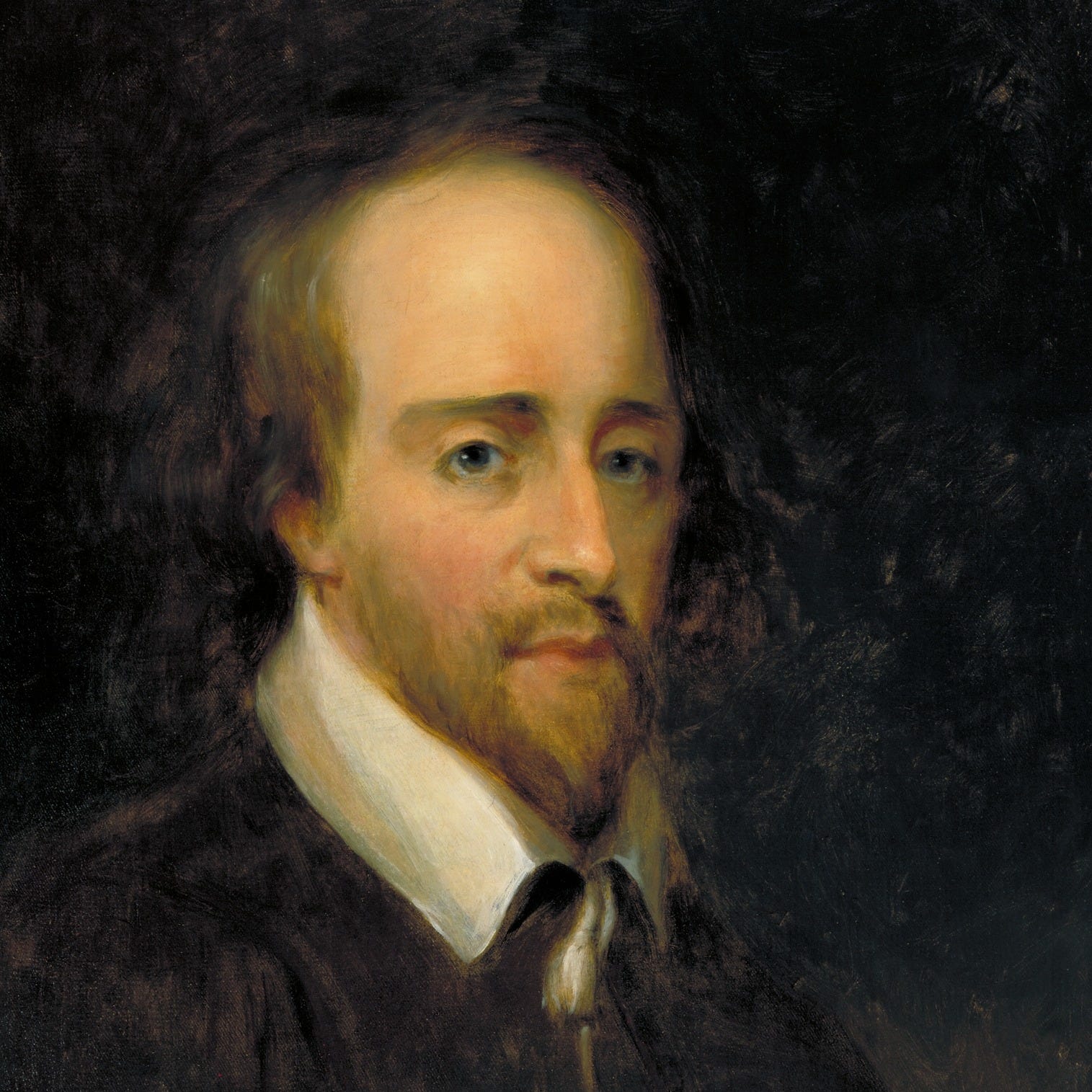
I had a wonderful Grade 8 English teacher. To protect her identity, I’ll call her Mrs. L. Without her, I think it’s safe to say that the Dead Language Society would not exist.
Mrs. L was the one who first introduced me to the history of the English language through the glorious trilogy of Beowulf, The Canterbury Tales, and Hamlet.
How many hours I spent in that classroom, reading for the first time the stories I’d come back to again and again. And yet it’s funny: I don’t remember much about the classroom itself.
Decades later, the only things I can still recall are the posters.
Every classroom, I think, has its posters. The science classroom might have a poster about the water cycle or the various parts of a cell. The French class might have a stern poster warning Ici on parle français! ‘Here one speaks French,’ as mine did.
Our English classroom, on the other hand, had a poster I remember well.
Its title was “Words invented by William Shakespeare,” and the rest of the poster was taken up by hundreds and hundreds of words in small type, giving the impression that Shakespeare was so prolific a wordsmith that to enumerate all his creations, you’d need far more than a single poster.
So, how many words did Shakespeare coin?
If you examine posters in English classrooms around the world, watch documentaries, or even ask Google, you’ll probably get an answer like “around 1,700.”
These same sources will usually mention that Shakespeare’s words have had staying power: he’s the reason we have the words assassination, eyeball, obscene, and uncomfortable, among many more.
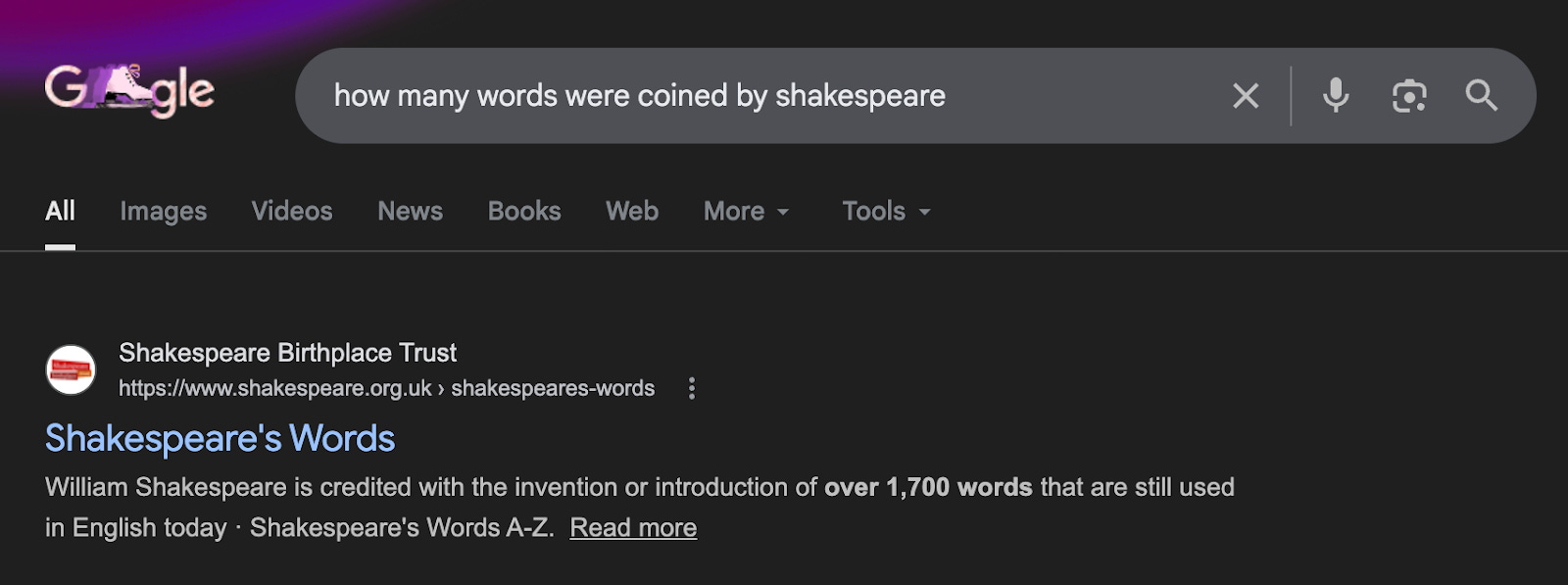
Shakespeare didn’t merely master the English language, or so the story goes. He had a large hand in building it.
It’s a lovely story. But it’s mostly false.
Take the word assassination. Shakespeare first used assassination in Macbeth (c. 1606). But the diplomat Sir Thomas Smith had already used the word thirty-four years earlier, in a letter in 1572.
The first use of eyeball was once attributed to The Tempest (c. 1611). But the historian William Patten wrote it in his Calender (sic) of Scripture in 1575, more than thirty-five years before Shakespeare’s play.
The word obscene was thought to appear first in Love’s Labour’s Lost (c. 1595). But the humanist scholar Edward Grant used it in a translation in 1571, nearly a quarter century earlier.
And uncomfortable — which is a perennial favourite on lists of words Shakespeare invented — appears in a letter by George Talbot, Earl of Shrewsbury, in 1534. Shakespeare wasn’t even born until thirty years later!1
Lest you think these are cherry-picked examples, I could name a few more from the list of famous Shakespearean words: generous, bedazzle, hurry, frugal, bold-faced all appeared on that poster back in my Grade 8 English class, and all were attested in print before Shakespeare put pen to immortal paper.2
All this raises the question: If Shakespeare didn’t invent these words, why do so many people think he did?
You’re reading The Dead Language Society, where 45,000+ readers explore the hidden history of the English language. I’m Colin Gorrie: PhD linguist and your guide through 1,500 years of linguistic history.
I publish every Wednesday. Paid subscribers get every issue, the full archive, and the content I’m most proud of: practical guides to reading historical texts yourself, honest takes on how language really works, and live book clubs where we read texts like Beowulf and (up next!) Sir Gawain and the Green Knight.
Three little words
The ultimate source of the claim that Shakespeare invented around 1,700 words is the Oxford English Dictionary, or OED for short.
According to one influential analysis of the OED, Shakespeare is the earliest known source for anywhere between 1,700–2,000 words, depending on how you count.3
The problem with that story starts with three words: first attested use.
What the OED records is not the first time a word was used by anyone ever. That would be first use. Given that words are often coined in speech before they are ever written down, it would be effectively impossible to pinpoint the true moment of birth of most words.
Instead, the OED records something that we can know a lot more clearly: the earliest written example of the word. That’s first attested use.
These can be very different things: first use is a claim about origins; first attested use is a claim about documentation.
To make matters worse, the editors of the OED don’t have access to every text ever written by anyone. They only have access to what happened to survive. (We’ll return to this point shortly.)
Even so, that’s a lot of text, especially after the introduction of the printing press. So the editors of the OED have to sample from the vast pool of English literature, hunting for first attested uses.
This means that dates of first attested use are entirely dependent on what the OED editors happened to read. And not every author got their equal attention.
A Victorian head start
To understand why the OED is so filled with Shakespearean citations, it helps to know a little about how the OED was put together.
Work began in the late 1850s on a project with enormous ambitions: to document every English word ever coined, with dated quotations tracing how every single one had been used across the centuries.
To gather these quotations, the editors recruited hundreds of volunteer readers who combed through texts and mailed in millions of handwritten slips, each recording a word, its context, and the source they had taken it from.
It was one of the great intellectual achievements of the Victorian age, or of any age. But it was inevitably uneven. Readers didn’t cover everything equally, and Shakespeare had an advantage that no other writer could match: a Complete Concordance, such as the one published in 1845 by Mary Cowden Clarke.
A concordance is an index of the words in a text (or a collection of texts). Unlike the index in the back of a book, a concordance displays every occurrence of a word alongside its immediate context.
Here’s what Cowden Clarke’s looked like:
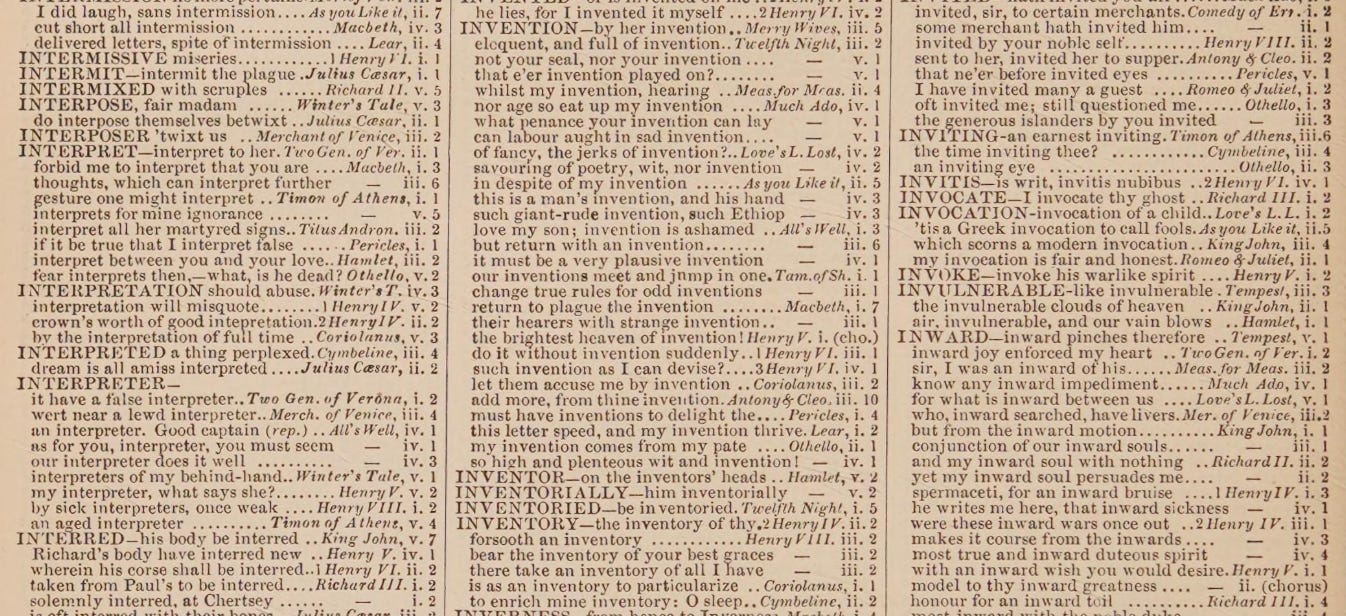
This tool made searching through Shakespeare’s works much easier than searching the works of any other author. No such tool existed for Shakespeare’s contemporaries, such as Thomas Nashe, Christopher Marlowe, John Lyly, Robert Greene, Thomas Lodge, or other writers of the period.
Their works had to be read the old-fashioned way, that is, the hard way. As a result, they weren’t combed through quite as carefully as Shakespeare was.
Shakespeare received roughly 33,000 quotations in the first edition of the OED, many more than any other individual author,4 primarily because his works had been the most convenient to search thoroughly.
Have you heard the one about the drunk searching for his keys under a streetlight? It’s not because that’s where he dropped them, but because that’s where the light is.
This joke gives the name to the bias we’re seeing here: the streetlight effect. It’s the tendency to search for evidence where it’s easiest to look, rather than where it’s most representative.
What would happen if Shakespeare’s contemporaries had been searched with the same rigour? Would the Bard still reign supreme as the word coiner par excellence?
One writer, fifty words
In 1980, a German scholar named Jürgen Schäfer decided to find out.
He picked a single Elizabethan prose writer, Thomas Nashe (1567–1601). Nashe was a pamphleteer and satirist who also tried his hand at poetry and works for the stage. Crucially, Nashe’s works had been read for the OED, though far less thoroughly than Shakespeare’s.5
Schäfer went through Nashe’s works meticulously, looking to see how many of Shakespeare’s credited “first attested uses” Nashe could beat.
The answer was over fifty. One writer, working at the same time as Shakespeare (1564–1616), was able to knock dozens of first attested uses off Shakespeare’s list.
If a single under-read author could displace fifty or so first attributions, what would happen if we examined the works of every poet, preacher, and pamphleteer? The total number of false credits to Shakespeare’s account must be far larger than fifty.
And so it is. The OED’s ongoing third edition has been revising entries as it goes. In one sample of 117 words once credited to Shakespeare, nearly half (57/117) have now been superseded by an earlier attestation.6
But the OED editors’ reading list is only part of the problem. The deeper issue has to do with what happened to Elizabethan works before the dictionary’s editors ever had a chance to read them.
What the fire took
Even if those involved in producing the OED had tried to read every bit of Elizabethan English they could get their hands on, they’d still have missed most of it.
Scholars estimate that about 3,000 plays were written for London’s public theatres between 1567 and 1642. Of these, only 543 survive: that’s about 18%. Around 1,800 (60%) are so thoroughly lost to history that we don’t even know their titles.7
Plays, at least, were sometimes printed. But for other forms of text, the picture is even worse.
Nearly half of all printed editions from before 1642 have vanished entirely, with not even a single copy reaching a modern library.
Broadside ballads (the pop songs of the era) survive at a rate of well under 1%. Pamphlets, primers, chapbooks — cheap print — were published in great quantities. And almost all of it is gone.8
When we turn to the everyday written language of ordinary people, as we’d see recorded in personal letters, almost nothing survives at all. And, of course, in an era before audio recording, spoken language, where most words actually begin their lives, left no trace whatsoever.
This is survivorship bias. Our conclusions are drawn from what survived, and we’re blind to everything that didn’t.
Shakespeare’s 1,700 words owe more to uneven documentation and catastrophic textual loss than to individual genius — though genius he certainly had.
Scholars have known this for decades. But the correction hasn’t reached the places where most people learn about language.
A better story than the truth
In The Mother Tongue, Bill Bryson states without qualification: Shakespeare “coined some 2,000 words — an astonishing number.”9 Mrs. L’s classroom posters say the same. Google goes with 1,700.
The “Shakespeare invented 1,700 (or 2,000) words” myth tells a story we seem to want to hear: that language is shaped by individual genius. It’s the Great Man Theory of history applied to language.10
The reality is messier. Most Elizabethan vocabulary innovation wasn’t the work of one solitary genius, as romantic as that story may be.
Across London, writers and translators were coining and borrowing at furious rates, drawing on Latin, French, and the native resources of English to furnish the language with new compounds and derivations.11
What made Shakespeare’s use of the English language special had nothing to do with coining words. But that’s a story for next time.
Shakespeare was part of the collective churn going on in Elizabethan England. He worked with the same raw materials as his contemporaries, and often came up with similar results, at least as far as word coinages are concerned. The difference is that we can’t — or can’t be bothered to — check the work of his fellow writers.
This pattern of over-attribution isn’t unique to Shakespeare, by the way. Any writer whose works survived intact and got read carefully will be over-cited. Shakespeare is just the most extreme case.
What’s left?
So what’s left of Shakespeare’s linguistic creativity? Was the Bard just a hack, using other people’s words?
Far from it.
Even after all the false attributions are stripped away, Shakespeare still emerges as a prolific coiner of words. Just not a superhuman one.
The real number is likely well below 1,700. Just how far below is unclear, but it’s likely to keep falling, as the OED’s third edition continues to find earlier sources for words once credited to Shakespeare. But many words remain, for now at least: Laughable is one. Lonely may be another.
Shakespeare produced over 800,000 words of published text.12 It would be weird if he hadn’t coined anything. But any number published today will almost certainly shrink tomorrow, as more early modern texts are digitized and searched with more ease than ever before.
What we’re left with is a writer who used a large vocabulary — David Crystal puts it at about 20,000 words — with extraordinary skill.13 Shakespeare’s genius is not diminished by the loss of the “greatest inventor” myth.
Plenty of people coin words. But almost none of them did what Shakespeare did, wherever his words came from.
Let’s return to the word we began with: assassination. Here’s the passage from Macbeth where it appears:
If it were done when ‘tis done, then ‘twere well
It were done quickly: if the assassination
Could trammel up the consequence, and catch
With his surcease success… (Macbeth 1.7.1–4)
We know now that Shakespeare didn’t invent the word assassination. Sir Thomas Smith used it 34 years before Macbeth was written.
But the word assassination isn’t what makes that passage special.
Instead, it’s the language coiling around itself, the way the word done is emphasized differently with each repetition, how the repeating s-sounds make the sentence seem to struggle against its own frantic momentum.
Whatever greatness is incarnated in this passage, it’s not the greatness of having coined a new word by sticking the suffix -ion onto the pre-existing verb assassinate.
Any English speaker could have done that. It should take more than this to get a poster in your honour in Mrs. L’s classroom.
If we want to understand Shakespeare’s true linguistic greatness, we need to do more than count words. We need to see what Shakespeare did with his words.
And that’s what we’ll do next week, in Part 2 of this short series exploring how Shakespeare used the English language.
Works Cited
Bailey, Richard W. (1985). “Charles C. Fries and the Early Modern English Dictionary.” In Fries, P. H., and Nancy M. Fries, eds. Towards an Understanding of Language: Charles C. Fries in Perspective.
Barber, Charles (1997). Early Modern English.
Brewer, Charlotte (2012). “Shakespeare, Word-Coining, and the OED.” Shakespeare Survey.
Bryson, Bill (1990). The Mother Tongue: English and How It Got That Way.
Crystal, David (2004). The Stories of English.
Crystal, David (2008). Think on My Words: Exploring Shakespeare’s Language.
Goodland, Giles (2011). “Strange Deliveries: Contextualizing Shakespeare’s First Citations in the OED.” In Ravassat, Mireille, and Jonathan Culpeper, eds. Stylistics and Shakespeare’s Language.
McKenzie, D. F. (2002). Making Meaning: “Printers of the Mind” and Other Essays.
McInnis, David, and Matthew Steggle, eds. (2014). Lost Plays in Shakespeare’s England.
Raymond, Joad (2003). Pamphlets and Pamphleteering in Early Modern Britain.
Schäfer, Jürgen (1980). Documentation in the O.E.D.: Shakespeare and Nashe as Test Cases.
Spevack, Marvin (1968–1980). A Complete and Systematic Concordance to the Works of Shakespeare.
Watt, Tessa (1991). Cheap Print and Popular Piety, 1550–1640.
Wiggins, Martin (2012–2019). British Drama 1533–1642: A Catalogue.
The revised dating of uncomfortable is mentioned by Merriam-Webster, but not by the Oxford English Dictionary, which has not yet fully revised the entry.
Generous appears in a work by translator Edward Hellowes in 1574, twenty years before it first appears in Shakespeare’s corpus, in Love’s Labour’s Lost. Frugal goes back to an English translation of Erasmus in 1542, again, before Shakespeare was born. Merriam-Webster maintains a list of words Shakespeare didn’t invent, and it’s worth a few minutes of your time.
David Crystal counted roughly 2,035 words for which Shakespeare was the earliest recorded user in the OED‘s electronic second edition. He then estimated that about 1,392 of those were plausible coinages, filtering out words that appeared in other writers within 25 years of Shakespeare’s use. The 1,700 number comes from splitting the difference between 1,392 and 2,035, although Crystal mentions that it is not far from previous estimates. Crystal’s methodology is interesting, and does address some of the problems we’ll be discussing today, but not all of them (Crystal 2004: 320–326; Brewer 2012: 348–49).
It’s not even particularly close. The runner-up is Sir Walter Scott, at just over 15,000 quotations. Milton and Chaucer follow at 11,000–12,000 each (Brewer 2012: 347).
Schäfer (1980).
The sample, covering the range P–Ra, was studied by Giles Goodland, an OED lexicographer (Goodland 2011: 8–33).
Wiggins (2012–2019); McInnis and Steggle (2014). The 18% survival rate is for public theatres. Private performances would push the percentage of surviving plays even lower.
Some early printed texts survive only because they were cut up and used as binding material for more expensive books. For printed book survival rates, see McKenzie (2002) and Raymond (2003). For broadside ballad survival rates, see Watt, Tessa (1991). Cheap Print and Popular Piety, 1550–1640.
Bryson (1990: 64)
As the linguist Richard Bailey pointed out, “the growth spurt in the English vocabulary centered on 1600 is almost certainly an artifact of the method used by the OED rather than a historical fact.” (Bailey 1985: 210 n.6)
Barber (1997: ch. 6).
The complete works total 884,647 words (Spevack 1968).
Crystal (2008). Next week we’ll revisit the question of the size of Shakespeare’s vocabulary.
This was great. I was always skeptical of those claims because it seemed like it would be hard for the audience to understand his plays if so many of the words were brand new to them. I loved reading the details about the OED. And that concordance. That had to be quite the labor of love.
Fantastic piece! Have you ever seen Upstart Crow? This forms the basis for one of the recurring gags in it (Will hears a word or phrase and says, "That's one of mine, isn't it?" and his companions all groan and say, no, people were saying that before you were born).