

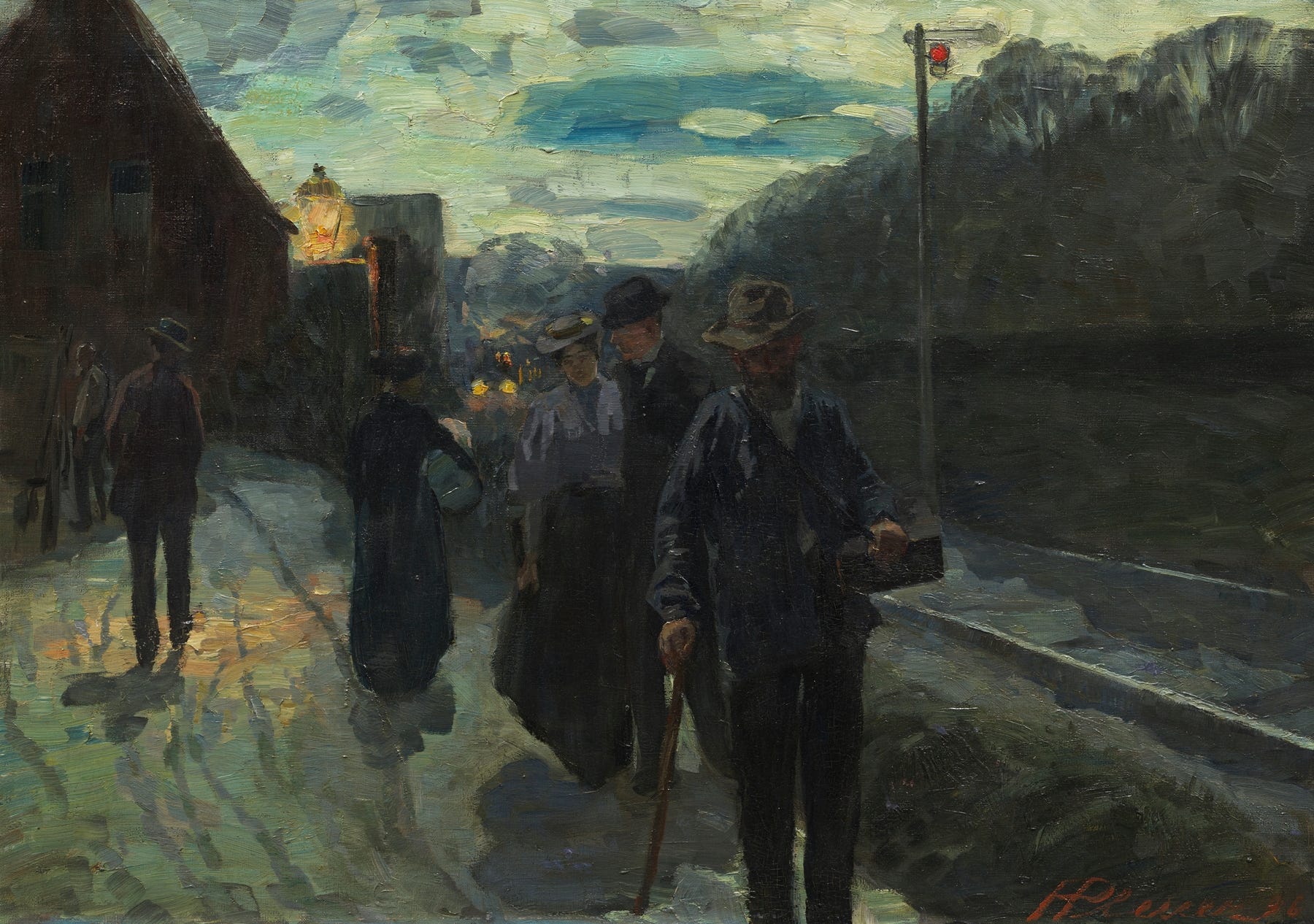
It’s raining. I shouldn’t be surprised. It’s April in England.
Around me on the platform the commuters are assembling for the 7:42 train. The man in the grey hoodie has been pacing for twenty minutes, explaining his startup idea. The young woman next to the bin is recording something which I assume is destined for TikTok.
I can see the barista who made it through the window of the station café. I think his nose ring might violate some sort of health code. Beside me, someone in a Lululemon gilet is telling a woman I’m sure he literally just met all about his morning routine. He’s really into cold plunge and morning pages.
Better her than me.
I look down at my phone. I’m reading Chaucer.
Whan that Aprill with his shoures soote...
I look up from the screen at the dreary weather. This Aprill‘s shoures don’t feel quite so soote — that is, sweet — to me.
I return to my screen and read on. The crowd around me grows thicker. I try to ignore them and focus on what I’m reading. This is a great part of the Tales, where Chaucer starts to describe the condicioun and degree of the company of pilgrims he’s found himself in: the prioress, the merchant, the cook, the pardoner.
If you haven’t read The Canterbury Tales, this all might sound a bit strange. Who is the prioress? Who is the merchant? Who — and what — is a pardoner? Don’t these people have names?
Some of them do, but Chaucer doesn’t really care about their names. These characters aren’t individuals, but types. Each one stands for a whole category of people that you’d run into in 14th-century England.
The Canterbury Tales is a masterpiece of world literature in part because of the satirical portraits it paints of these typical specimens of late medieval English life. Often, Chaucer seems to praise them, but the little details give away that we’re not entirely meant to approve of these characters: the judge whose best talent is making himself look busy, the monk who enjoys hunting and eating more than the simple life, or the doctor who thought gold (given to him) was the best medicine.
But who was this Geoffrey Chaucer, apart from a keen observer of human nature? He was an English poet, diplomat, and civil servant whose career spanned the late 1300s.
He was an English poet in two senses: one, he was himself English, and he wrote his poetry in English. The second sense is the significant one. He wrote in English at a time when English had, for centuries, been a language of relatively low prestige.1
French was spoken at court, and Latin was the language of scholarship. It was Chaucer’s English-language works that showed that English was a language fit for serious literature, and none more so than The Canterbury Tales.
Chaucer wrote The Canterbury Tales as a collection of stories within a frame story: a collection of pilgrims gathered at the Tabard Inn in Southwark, just south of London. They are bound for Canterbury, and in particular, to the shrine of Thomas Becket, also known as Saint Thomas of Canterbury. The shrine was a major destination for pilgrims in late medieval England.
Canterbury is about 60 miles (96 km) from London. Today, that’s a train ride of just over an hour. But in Chaucer’s day it would have been a journey of three to four days.
To pass the time on their journey, the company of pilgrims gathered at the Tabard decided to tell stories. These stories are the Tales themselves. But, before the tales proper, Chaucer spends some time introducing each of the pilgrims. This part is called the General Prologue and it’s the source of the character portraits that Chaucer became famous for.
The cast of characters that Chaucer lampooned in the 1300s are still with us today. Some of the surface details have changed, but human nature has not.
If Chaucer were with us today, what would he make of these modern-day pilgrims, waiting on the platform of the commuter train? Would he see the Prioress live on in the influencer filming for Tiktok? Would he be able to look at the startup founder in the hoodie and see the spiritual descendant of the Merchant in his beaver cap?
You’re reading The Dead Language Society, where 50,000+ readers explore the hidden history of the English language. I’m Colin Gorrie: PhD linguist and your guide through 1,500 years of linguistic history.
I publish every Wednesday. Paid subscribers get every issue, the full archive, and the content I’m most proud of: practical guides to reading historical texts yourself, honest takes on how language really works, and live book clubs where we read texts like Beowulf and (starting next week!) Sir Gawain and the Green Knight.
I think he might. So I rewrote Chaucer’s General Prologue, this time adapted for the 7:42 train. I wrote it in Chaucer’s Middle English, with Modern English translation alongside. Read whichever version you want, or both: but don’t be afraid of the Middle English. You’ll understand more than you might expect. If you want to read aloud, I wrote up a guide for pronouncing Middle English last week.
I’ll begin as Chaucer did, with a reverdie, that is, a piece of verse celebrating of the return of spring. You can read Chaucer’s here.
His is sophisticated: he begins with an elaborate sentence cataloguing the effects of the season on plants, animals, and human beings, full of references to astrology, mythology, and the latest advances in 14th-century botany.
Mine begins rather more humbly, with a complaint about the English weather:
Whan that Aprill with his morwes colde
When April, with its cold mornings,Hath dryuen folk from bed, though noon be bolde,
has driven people from bed, though none are bold,And every wight moot risen vp bitime
and every person must get up on timeThe trayn to kacche er it hath rong his chime,
to catch the train before it rings its chime,Than longen folk to coffey and to bedde
then people long for coffee and for bed,But stonden in the stacioun in stedde,
but stand in the station instead.And pilgrimes been alle, that moten fare
And pilgrims they all are, who must travelToward hire offices with heuy care.
toward their offices with heavy hearts.Bifel that as I waited in the reyn
It happened that, as I waited in the rainAt Caunterbury for the morwe trayn,
at Canterbury for the morning train,Ther was ycome into that weste place
there had come into that barren placeA compaignye of folk of sondry grace.
a company of people of various kinds.Ful twenty wightes preste for to wende
A full twenty souls, ready to travelTo Londoun Toune, and I shal comprehende
to London, and I shall describeOf ech the condicioun, and trewly telle
each one’s situation, and truly tellHir craft, hir cloth, hir chere, and eek hir spelle.
their craft, their clothes, their bearing, and also what they said.
Some fun Middle English words in this section:
wight. being, person.
moot/moten. must.
bitime. early.
sondry. various, different.
prest. ready, eager, prompt. (cf. French prêt ‘ready‘)
chere. face, expression, mood, behaviour. (cf. Spanish cara ‘face’; becomes Modern English cheer, as in good cheer)
spell. story, statement, conversation. (the source of -spel in Gospel, i.e. ‘good news’)
The Influenser
The Influencer is the modern equivalent of Chaucer’s Prioress. In the Prioress, Chaucer shows us a woman who is concerned with being seen correctly. The Prioress was a nun, but a rather worldly one: she kept pampered lapdogs and wore a brooch that read Amor vincit omnia, or “Love conquers all.” Her exquisite table manners came not from a monastic rule but from a courtly romance.
Today we’d call her “performative.” After six hundred years, the platform has changed, but the performance has not.
Ther was an INFLUENSER, fair and free,
There was an INFLUENCER, fair and gracious,That hadde ygadered folk in greet plentee;
who had gathered people in great abundance.Hir “folweres,” as men clepen hem, I gesse,
Her “followers,” as they’re called, I believe,Weren ten thousand, no more ne lesse,
were ten thousand, no more, no less,And yet she knew nat oon of hem by name,
and yet she didn’t know a single one of them by name,But louede hem alle, saide sche, the same.
but loved them, she said, all the same.Ful fetisly she coude hir mete arraye
Very elegantly she could arrange her foodUpon a plater, in a certeyn waye,
upon a plate, in a particular way,And take hir liknesse with mirour bright
and take her own likeness with a bright mirror(A thyng no gretter than hir hond, all light)
(a thing no bigger than her hand, all shining)And sende it forth into the worldes webbe
and send it forth into the world’s web,That alle myghten seen, and so wolde ebbe
so that everyone might see it, and so her lonelinessHir onlinesse a whil. For swich entente
might decrease for a while. For this was her intent:Had she: to seemen blisful and contente.
to seem happy and content.Hir clothes chaungen every wike, certeyn,
Her outfits changed every week, indeed,Sche nolde leten hem be twyes seyn.
she did not want them to be seen twice.The marchauntes sente hir robes, shoes, creeme,
The merchants sent her clothes, shoes, and creams,Withouten cost, for folk to hire streme,
free of charge, for people stream to her.And she hadde lerned wel this sotil art:
For she had learned well this subtle art:That alle wolden haue an otheres part.
that everyone wants to have another’s lot in life.
Vocabulary:
free. free; here gracious, noble.
clepen. call.
fetisly. skilfully, elegantly.
mete. food. (becomes Modern English meat)
onlinesse. loneliness.
swich. such.
certeyn. indeed.
part. part, allotted portion, lot.
The Foundour
The Founder is like Chaucer’s Merchant: loud, outwardly prosperous, and secretly drowning in debt. The Merchant spoke “sownynge alwey th’encrees of his wynnyng” (always concerning his winnings). He was, the narrator notes drily, “a worthy man with alle,” though Chaucer never could learn his name.
The modern version has a hoodie instead of a Flemish beaver hat, but the elevator pitch is the same.
A FOUNDOUR ther was, with no berde at alle,
A FOUNDER there was, with no beard at all,But smothe of cheke as maydenes in the halle,
but smooth of cheek as maidens in the hall,In robes graye of sotil cloth, ful fyne:
in fine grey robes of subtle cloth —A “hoodye,” as they seyen in his lyne.
a “hoodie,” as they say in his business.He spak ful loude of thynges yet to rise.
He spoke loudly of things yet to arise,And swoor he wolde chaunge al marchaundise.
and swore he would change all commerce.“Disrupcioun!” cryed he to ech he mette,
“Disruption!” he cried to everyone he met,And “Passioun!” and “Growthe!” — and yit his dette
and “Passion!” and “Growth!” — and yet his debtWas gretter than his gold withouten doute.
was greater than his gold, without a doubt.The investours, they folwed hym aboute
The investors followed him aroundAnd gaf hym gold upon his worde aloon,
and gave him gold on his word alone,For he had swich a fyr in euery boon
for he had such fire in every boneThat men bileeved he mighte do the dede,
that men believed he might accomplish the deed,Though noon might saye wherto it coud lede.
though none could say where it would lead.Vpon his flatte booke of glowynge light
Upon his flat book of glowing lightHe tappede from morwenyng to the nyght,
he tapped from morning until night,And every morwe roos er houre of pryme,
and every morning rose before the hour of prime (the first hour of daylight)To rede the wordes of the olde tyme,
to read the words of the old time,A book of “Habitz,” and to ronne faste,
a book of “Habits,” and to run fast,Demyng he sholde be firste, nat the laste.
believing he would be the first, not last.What was this grete thing he wroghte, his deed?
And what was this great thing he was building?Pardee! An “app” for folk to parten breed.
By God! An app for people to share bread.
Vocabulary:
lyne. line; here meaning class of persons.
pardee. by God! (cf. French par Dieu ‘by God’)
parten. share.
The Bariste
The Barista is the Cook, a genuine craftsman with real skill, undercut by a single deflating physical detail. Chaucer’s Cook could roast and boil and fry with the best of them, but… he had an open sore on his shin, which is mentioned right next to his finest dish, so you couldn’t eat without thinking of it.
The Barista’s nose ring does the same work: the narrator sees it on the train and can’t stop imagining what might fall on to the latte art. I still shudder to think of it.
A BARISTE ther was, of Southwerk toun,
A barista there was, from Southwark town,That served a drynke of derknes, thik and broun,
who served a drink of darkness, thick and brown,With swich a craft as nas yseen biforn:
with such craft as had never been seen before.He drew forth milk in leeves and in thorn
He drew forth milk in leaves and thornsUpon the face of every cuppe he wroghte —
upon the face of every cup he made —A roos, a herte, a fern — al com to noghte,
a rose, a heart, a fern — all came to nothing,For folk wolde drynke it up and nevere see
for people would drink it up and never seeThe werk of art that flotede so free.
the work of art that floated there so graciously.His armes were ypeynted and ful bare
His arms were painted and fully bare,With serpentes, ankres, and a hare:
with serpents, anchors, and a hunting hare —“Tattouwes,” the yonge folk hem knowe.
“tattoos,” as young folk know them.He knew the benes of the world, I trowe:
He knew the beans of the world, I believe:The hilles wher they be, the sonne and reyn,
the hills where they lie, the sun and the rain,The rostyng craft — and tolde this tale ageyn,
the roasting craft — and told this tale again,Ageyn, ageyn, to any wight he fond,
again, again, to any person he found,Withouten stynt. He tolde it in ech lond.
without ceasing. He told it in every land.He scorned the drynke of commoun folk ful soore
He scorned the drink of common folk deeplyAnd preised oonly that which coste the moore.
He scorned the drink of common folk deeplyA ryng he hadde thurgh his nose ypyght,
A ring he had pierced through his nose,That low it heng, ful hevy to my sight,
which hung low and heavy to my sight,Above the cuppe whil he wroghte his art,
above the cup while he worked his art,And droppede now and eft. For al his part,
and dripped now and then. Of this,I speke namore. Yet milk in leves ywroght,
I say no more. Yet milk drawn in leaves,Swiche as he made, nas bettre to be soght.
such as he made it, none better could be sought.
Vocabulary:
trowen. be of a certain opinion, believe, think.
stynt. pause.
ypyght. thrust, driven; from picchen. thrust, drive.
droppen. drip.
The Counsaillour of Lyf
The Life Coach is the Pardoner, probably the most devastating portrait in the Canterbury Tales. The Pardoner sold pig bones as holy relics and peddled false promises of forgiveness to people too frightened to question him. He was brilliant at it, and he knew it: he openly confessed his tricks to the other pilgrims before later trying to con them too. (It didn’t work.)
The Life Coach runs the same grift, just in a different register: he takes wisdom you already had, repackages it, and sells it back to you at five hundred pounds a year — a bargain, really.
A PARDONER — nay, a COUNSAILLOUR OF LYF,
A Pardoner — no, a Life Coach,For so he cleped hym, to man and wyf.
for so he called himself, to men and women alike.With golden heer and teeth of whitenes shene,
With golden hair and teeth of gleaming whiteness,And eyen brennyng with a fervour keene,
and eyes burning with a keen fervour,He preched to folk of “Myndesettes” and “Trouthe”
he preached to people about “Mindsets” and “Truth”And took ful many a pound of hire mouthe.
and took a good many pounds out of their mouths.He sayd that euery wight had might ful swete
He said that every person had great powerTo manifesten richesse at his feete,
to manifest riches at their feet,If oonly he wold risen at matyne
if only they would rise at matins (before dawn)And stare into the sonne, al divyne,
and stare into the sun, all divine,And thinke his thoughtes in a wey ful clere,
and think their thoughts in a very clear way,And paye him fyue hundred pounde a yere
and pay five hundred pounds to him a year,To telle hem thynges that they herde seye
to tell them things they already heardFrom moodres, wyues, and freendes, euery weye,
from mothers, wives, and friends, every way,But dressed in bright and shinyng wordes newe.
but dressed in bright and shining new words.For this was al his craft, and his vertu:
For this was all his craft, and all his virtue:To taken wisdom folk alredy knewe
to take wisdom people already knewAnd selle it eft in pakettes ful trewe.
and sell it back in packages all true.He bar a book he quod that he had writen —
He carried a book he said he had written —“Ten Steppes vnto Blis” — but he was smiten
“Ten Steps to Happiness” — but he himself was smittenWith derknes that he spek to noon alyue.
with a darkness he told to no one alive.Of charitee he kept nat oon in fyue.
Of what he earned, he kept less than a fifth for charity.
Vocabulary:
shene. beautiful. (cf. German schön ‘beautiful’)
matyne. Matins, the first canonical hour (in the early morning)
Eventually, the train pulls in. The Foundour gets on, still on his phone, promising something to someone. The Influenser snaps a selfie before boarding. The Counsaillour of Lyf looks to be moving on to fresh prey. I decide to get on another car.
Tomorrow morning we’ll do it again. The clothes will be different, as will the coffee orders, but the tales will remain the same.
Perhaps some Chaucer will be watching me as well. I can imagine it now:
A CLERK ther was of SUBSTACK, long of writ
There was a scholar of Substack, long-winded in his writing,That tolde the taals of wordes dede and dit…
who told the stories of words dead and done...
Chaucer likely wrote in French and Latin as well, but the only works that survive with secure attribution are written in English.
This was brilliant. "A drynke of derknes, thik and broun," is going to be my new name for coffee. XD
Cool. I kept wanting to stop reading and do something else, but I couldn't. Well done