

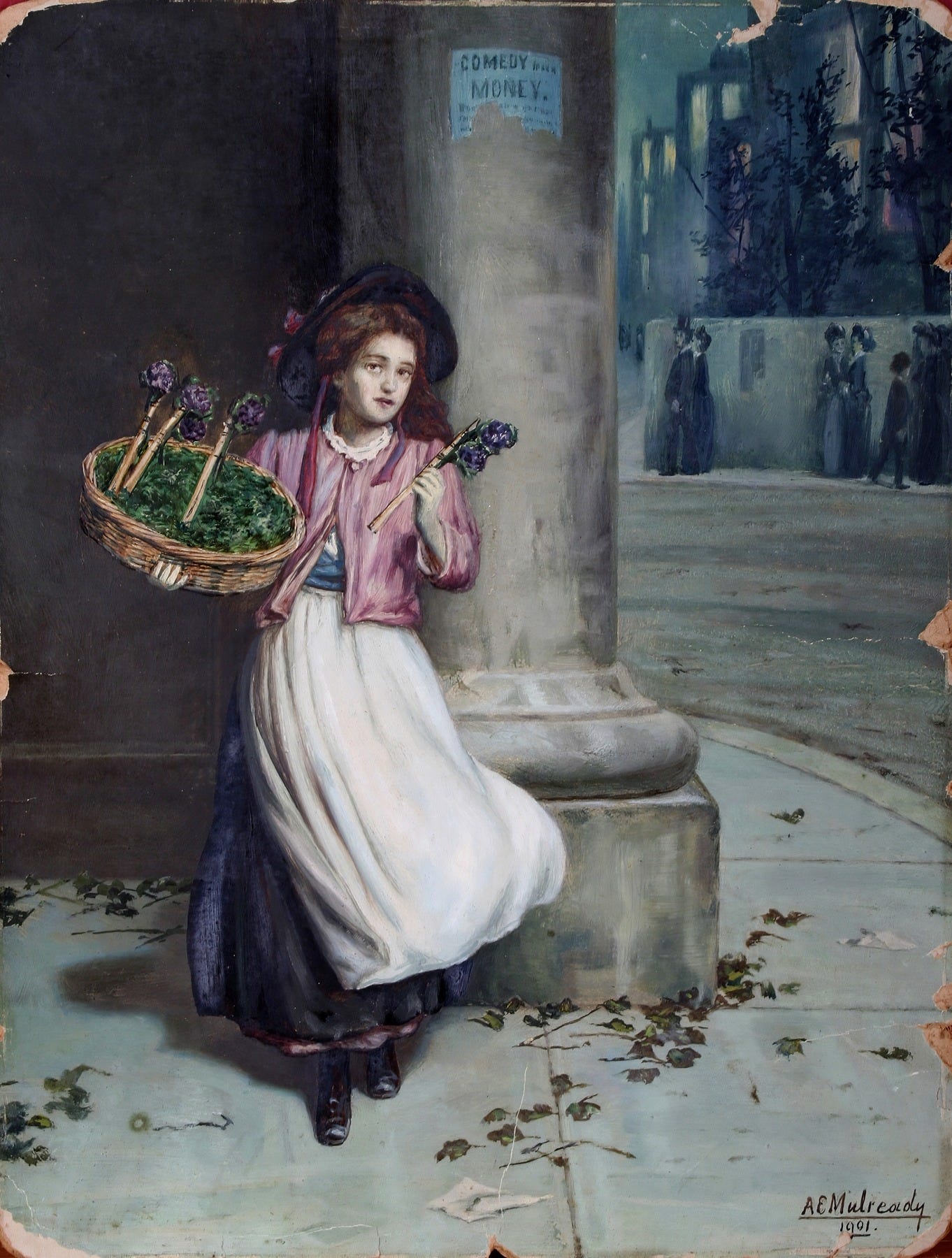
Has ever a letter been imbued with such significance as the humble h?
If you’ve seen the musical My Fair Lady — or read Pygmalion, the Shaw play it’s based on — you’ll know what I mean.
In both versions, our heroine, Eliza Doolittle, is a Cockney flower girl. Her opposite is Professor Henry Higgins, a phonetician who bets that he can pass Eliza off as a duchess simply by changing the way she speaks.
In order to achieve such a transformation, one of Henry’s most important tasks is to address Eliza’s complete lack of h-sounds. Eliza’s h-lessness is a major mark of her humble origins: they out her as a street merchant, rather than an heiress.
In the musical adaptation, the issue of h is even more prominent, using a song to dramatize the moment when Eliza finally acquires the upper-class accent Henry has been trying to instill in her.
The song is one of the most famous from the musical: The Rain in Spain. The lyrics consist mainly of phonetics drills, one of which shows that Eliza can now pronounce the h-sound:
HENRY: In Hertford, Hereford, and Hampshire…
ELIZA: …hurricanes hardly happen.
If you grew up in North America, where h-dropping is rare in most regions, My Fair Lady may have been your only encounter with this anxiety over h-dropping. But in England the pronunciation of your “aitches” was, and still is, a major social signal.1
And then there are the words that flip the association between h and “correct speech”: pronouncing the h in heir, hour, and honour shows that you’ve only ever seen the word written.
And no one would judge you for an honest day’s work — there, the use of an, rather than a, shows that the h of honest is silent. If anything, you’d get strange looks if you said a honest day’s work.
Some words are still live battlegrounds: is it an herb or a herb? a historic or an historic?
It’s small consolation, then, that the seeds of all this confusion and controversy were planted many centuries ago.
You’re reading The Dead Language Society, where 70,000+ readers explore the hidden history of the English language. I’m Colin Gorrie: PhD linguist and your guide through 1,500 years of linguistic history.
I publish every Wednesday. Paid subscribers get every issue, the full archive, and my most in-depth work, including longer essays that trace the mysteries of English to their source, practical guides to reading historical texts yourself, and live book clubs where we read texts like Beowulf and Sir Gawain and the Green Knight.
The h-sound is an ancient inheritance dating back to before English was even English. But the story of h-dropping is not as simple as the loss of that inheritance.
The h-sound has never been a normal part of English: it has been pronounced weakly, and inconsistently, throughout the entire history of the language.
That inconsistency shows up in unexpected ways. For example, many words which have an h today — at least, in the standard forms of English — got it only recently: words like humble, humour, and hospital were once said without the h-sounds they have today. And they were h-less in the mouths of all English speakers, regardless of their social standing.2
So why all this fuss over h in particular?
The answer begins long before English was English, and ends much more recently than you might imagine.
