

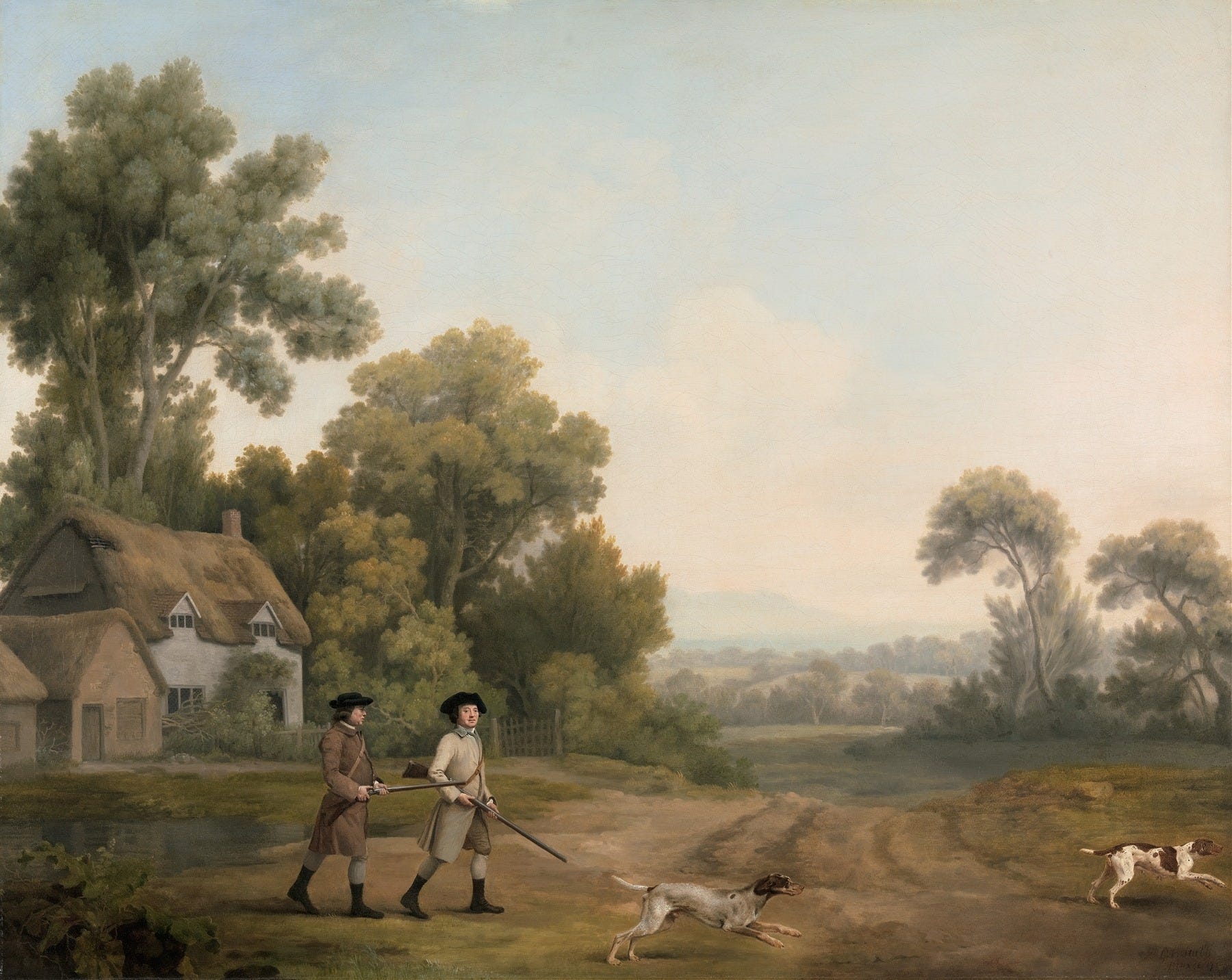
On the 3rd of June, we dined at the house of Mr. Uppington, a stationer lately removed to Cheapside, who had, by the enviable combination of industry and frugality, raised himself to a state of respectable ease, a circumstance which he took no small pains to let be known generally.
He had furnished his rooms with a great quantity of books, which he had arrayed, contrary to the usual practice, by the colour of their bindings.
Now there sat at the table, opposite our host, Dr. Barleygrow, whom I had brought thither at Mr. Uppington’s peculiar request, the latter having so long desired the acquaintance of so celebrated a scholar.
The conversation turning upon the education of his son, Mr. Uppington remarked that he had lately corrected the boy for saying I am goin’, and had instructed him that he must always say I am going, for that the termination -ing, being the participle in the present tense of the verb to go, contains three letters, each deserving of its full dignity, and that to leave any of them unpronounced was a vulgarism fit only for the unlettered.
Dr. Barleygrow had listened to our host’s lecture in silence, and at length delivered himself thus:
BARLEYGROW. Sir, you have laboured to plant in your son an error, and watered it with your paternal authority.
UPPINGTON. An error, Sir? Surely the rule, that the g of the termination ing ought to be pronounced according to its full virtue, is well established by the best grammarians.
BARLEYGROW. It is established, Sir, in the manner in which one who settles by intrusion is established upon another man’s land: by disordered habit and not by right. Speech is the master, Sir, and writing its loyal servant. For did not men speak long before any man scratched a mark to record their words?
UPPINGTON. Surely, Sir, but you must confess—
BARLEYGROW. Or are we to believe that there was a scrivener or amanuensis present in Paradise, when Adam named the beasts? Writing, Sir, has no other office than the noble task of recording what the tongue has uttered. Yet your grammarian would have it otherwise. He bids the living speech bow to the dead letter and correct itself by the rule of the page. It is a very Saturnalia of speech, Sir, wherein the master must wait at table upon his own footman, and call it good order.
UPPINGTON. Yet surely, Sir, you will grant that the dropping of the g, as when a man says huntin’ and fishin’ and shootin’, is the mark of low breeding, a condition out of which I am glad to have schooled myself.
BARLEYGROW. Then you have schooled yourself out of the company of dukes, Sir, to keep company with your grammarians. Your huntin’ and your shootin’ have been spoken in the best halls in England by men whose breeding no stationer of Cheapside ought to despise.
UPPINGTON. Can it be so?
BARLEYGROW. Indeed, Sir. The man secure in his station speaks as he pleases. It is the man too eager to improve himself who watches every syllable, as a servant new to a great house watches his feet upon the stair, lest a single slip prove his undoing.
Mr. Uppington confessed that he remained unconvinced. But I could not but observe that he did not, for the rest of the evening, utter a single word ending in -ing.
Excerpt from the Life of Barleygrow.1
You’re reading The Dead Language Society, where 57,000+ readers explore the hidden history of the English language. I’m Colin Gorrie: PhD linguist and your guide through 1,500 years of linguistic history.
I publish every Wednesday. Paid subscribers get every issue, the full archive, and my most in-depth work, including longer essays that trace the mysteries of English to their source, practical guides to reading historical texts yourself, and live book clubs where we read texts like Beowulf and (currently) Sir Gawain and the Green Knight.
An overworked suffix
The rest of the evening must have been jolly difficult for our dear Mr. Uppington — nigh on impossible, I imagine.
It’s hard to speak English without the suffix -ing, because it does so many jobs. Not only can it transform a verb into a noun, in the so-called gerund form (swimming is good exercise), but it can also turn a verb into a kind of adjective (the swimming boy), or pair up with to be to tell us what someone is doing right now (I am swimming).
Three jobs is a lot of work for a single suffix. But times are tough in the world of English grammar. Almost every suffix has had to take on multiple jobs, and -ing is no exception.
It wasn’t always like this though.
The three jobs performed by the suffix -ing used to be done by two wholly separate suffixes, with no relationship between them whatsoever.
One of these suffixes was the ancestor of -ing. The other — despite all appearances, entirely unrelated to -ing — was the distant ancestor of -in’, the g-dropping form that Uppington tried to rid from his son’s speech, and which generations of schoolteachers and grammar mavens have tried so hard to rid from the English language.
Ironically, when we say I’m goin’ or the swimmin’ boy, we’re using a form far more ancient than the one the sticklers prefer.
