


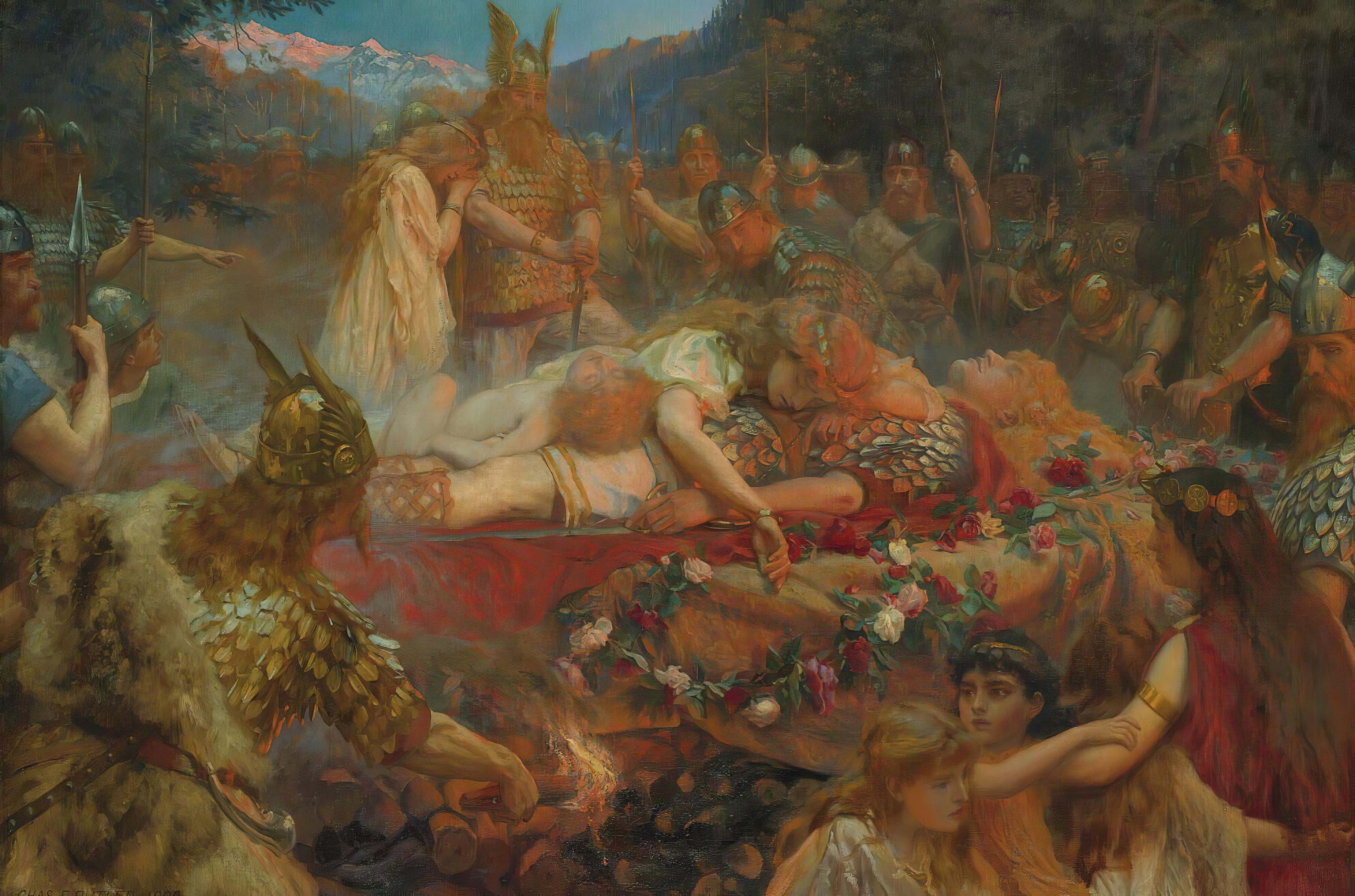
The hall smells of nothing more than smoke. It hangs briefly in the air around the men sitting around the fire before it travels up and out through the vents in the roof. Fire lights up their faces as they wait. Now the scop, the poet, stands up with harp in hand.
He strikes a note and everyone falls silent, the din of the day’s feasting giving way to something new. Now he speaks, and his speech is nothing like the language spoken in the kitchen or around the table. He begins:
Hwæt ic swefna cyst secgan wylle
hwæt me gemætte to midre nihte
“How I want to tell the best of dreams,
what appeared to me in the middle of the night” (Dream of the Rood 1–2)
The words pulse with a peculiar rhythm, each line breaking neatly in two, yet bound together by repeated sounds that strike the ear like hammer blows on an anvil: "swefna... secgan... ġemætte... midre."
This poetry works very differently from the rhyming verse of later centuries. This is alliterative verse, the poetic metre of the Anglo-Saxons.
The singing bones of English
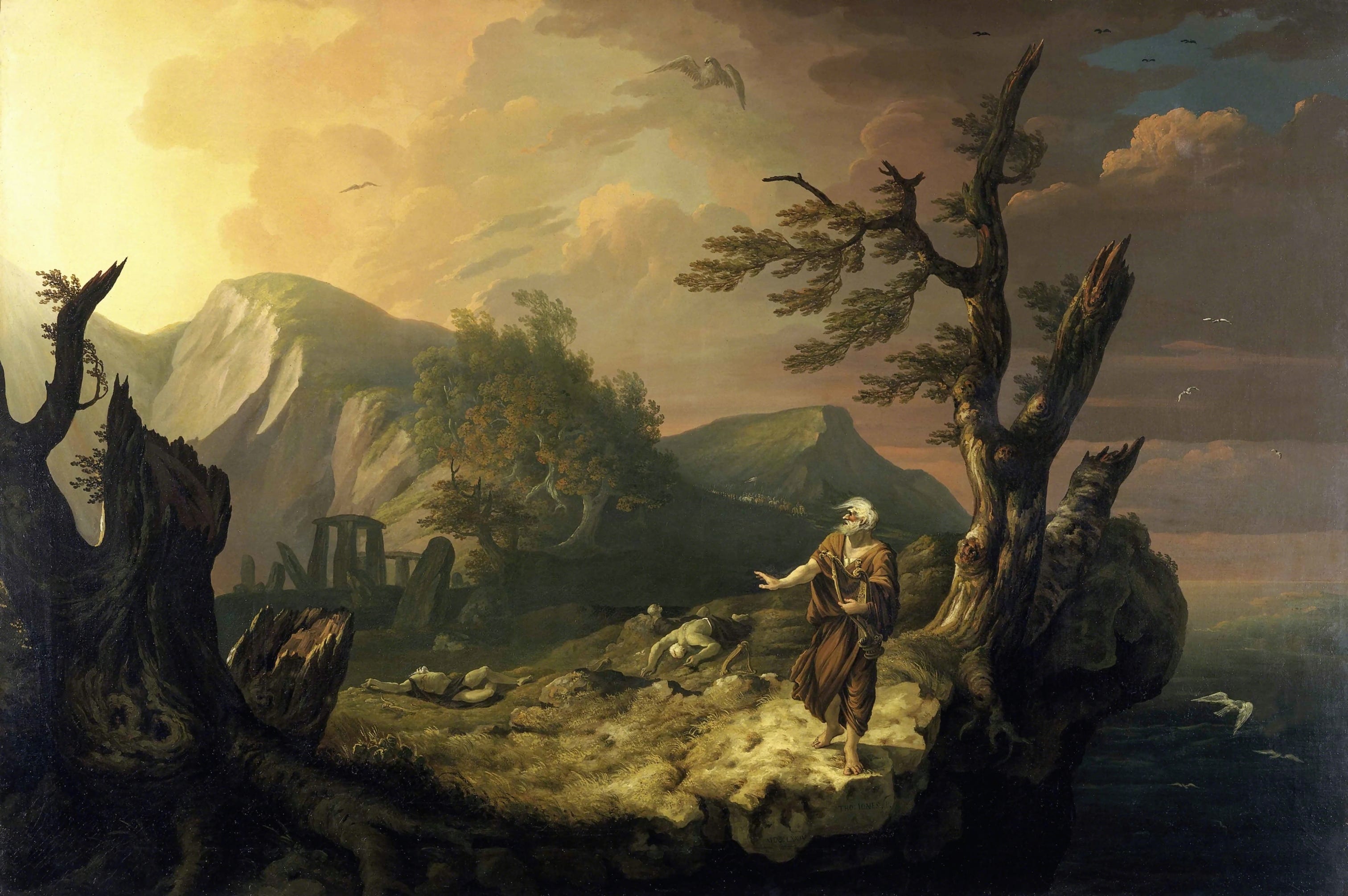
The form of poetry which dominated English literature from the late seventh century until the Norman invasion in 1066 — with echoes afterwards — is called alliterative verse.
Alliterative verse is poetry structured around the repetition of the initial sounds in words, rather than end-rhymes. When two syllables begin with the same sound, they are said to alliterate: for example, in “Good Golly, Miss Molly,” the words good and golly alliterate, as do Miss and Molly.
Poetry based on alliteration wasn’t merely one style among many in Anglo-Saxon England. It’s virtually synonymous with Anglo-Saxon poetry. And it was a key vessel of cultural memory in a society where literature was passed down orally, helped by the patterns of repeated sounds, which made stories easier to remember.
The corpus of surviving Anglo-Saxon poetry constitutes some 30,000 lines spread across 400 poems. But these are fragments of what must have been a much larger tradition. Most of the poems composed were likely never written down, living only in the memory of those who recited them.
What makes this form of poetry particularly interesting is that it was common to several Germanic cultures. Patterns similar to those found in Old English poetry appear also in poetry written in Old Norse, Old Saxon, and Old High German, which suggests a common poetic inheritance predating the separation of these peoples.
The heartbeat of the line
The foundation of Old English poetry lies in its complex structural patterns. At its foundation, however, is the single line of poetry, which is broken into two half-lines (called the on-verse and off-verse), separated by a pause known as the caesura.
The caesura isn’t always marked in modern printed editions of Old English poetry, but if we look at the opening lines of Beowulf with two lines (||) printed where the caesura falls, the pattern emerges:
Hwæt! We Gardena || in geardagum,
þeodcyninga || þrym gefrunon,
hu ða æþelingas || ellen fremedon.
“Lo, we have heard of the power
of the Danish kings in former days,
how the princes performed deeds of courage.” (Beowulf 1–3)
If there were nothing more to the poem than a caesura in the middle of the line, the two halves might feel disconnected. But this is precisely where alliteration comes to the rescue! Alliteration is the glue that binds the on-verse and the off-verse.
The typical pattern features two stressed syllables in the first half-line that share an initial sound with the first stressed syllable of the second half-line. Consider this line from Beowulf:
feasceaft funden. || He þæs frofre gebad
“(since he was first) found destitute; he had consolation for that.” (Beowulf 7)
Here, the ‘f’-sound links the key stressed syllables across the caesura, creating a sonic cohesion that pleases the ear and aids memorization.
The rules governing this alliteration are, ever so slightly, intricate. Consonants generally have to match exactly, although certain consonant clusters, namely “st-”, “sp-”, and “sc-”, alliterate only with themselves.
Vowels are bit easier: any vowel can alliterate with any other vowel. This is why the third line of Beowulf works: in hu ða æþelingas ellen fremedon, ‘æ’ and ‘e’ alliterate with each other, since they’re both vowels.
The rhythm which governs these lines follows such consistent patterns that the 19th-century German philologist Eduard Sievers was able to classify them into five basic types: unimaginatively, they’re called Type A, B, C, D, and E.
These patterns of stressed and unstressed syllables created a template that was flexible enough for narrative variety but structured enough to cohere as a system.
Echoes in Modern English
After the Norman Conquest in 1066, which dethroned Old English in favour of French as the language of the social élite, the use of alliterative verse declined.
In the 14th century, alliterative verse experienced a revival — or perhaps it was a continuation of the old traditions — in poems like Sir Gawain and the Green Knight, which adapted the old alliterative poetry into contemporary (for the later Middle Ages) English, which had changed a great deal since the days of Beowulf.
Though alliteration was eventually supplanted by rhyme as the primary way of writing poetry, it has never fully vanished from English verse. Instead, alliteration became a seasoning rather than the main dish — Shakespeare's “From forth the fatal loins of these two foes” employs it for emphasis, as does Coleridge's “furrow followed free.”
Even today, we instinctively respond to alliterative phrases in everything from advertising slogans (“maybe it’s Maybelline”, “melts in your mouth”) to political rhetoric (“strong and stable,” “build back better,” or even “make America great again” — alliteration cares about the stressed syllable of the word, which isn’t always the first one). Something about the repetition of these stressed sounds seems to call forth a strong response — positive or negative — from an unconscious part of the human mind.
But the most influential modern champion of alliterative verse was J.R.R. Tolkien. Apart from his own scholarly work on alliterative poems such as Sir Gawain and the Green Knight and Beowulf, Tolkien also kept the tradition alive in his own compositions. His poem, The Lay of the Children of Húrin, is written in exactly the same metre as Beowulf:
Lo! the golden dragon of the God of Hell,
the gloom of the woods of the world now gone,
the woes of Men, and weeping of Elves
fading faintly down forest pathways
Keen readers of Lord of the Rings and Tolkien’s other works will, no doubt, be able to give some more examples of Modern English alliterative verse!
Beyond the thousands of lines of poetry that have survived, the legacy of Old English alliterative verse lives on in the patterns that continue to move us when we hear them in English today.
We hear it, for example, in Gerard Manley Hopkins: “swift, slow; sweet, sour; adazzle, dim,” or in W.H. Auden’s The Age of Anxiety, with lines like “Doom is dark and deeper than any sea-dingle.” Prose can alliterate too, as in Nabokov’s “the tip of the tongue taking a trip of three steps down the palate to tap, at three, on the teeth.”
Each of these lines echoes, however faintly, the song of the Anglo-Saxon scop, as if he’s still speaking to us from the torch-lit hall across more than a thousand years of history.
I love writing and reading alliterative verse! Great post.
English nursery rhymes combine both alliteration and rhyme: Jack and Jill || Went up the hill or Hickory dickory dock || The mouse ran up the clock. Perhaps that is why these rhymes have endured for so long.