

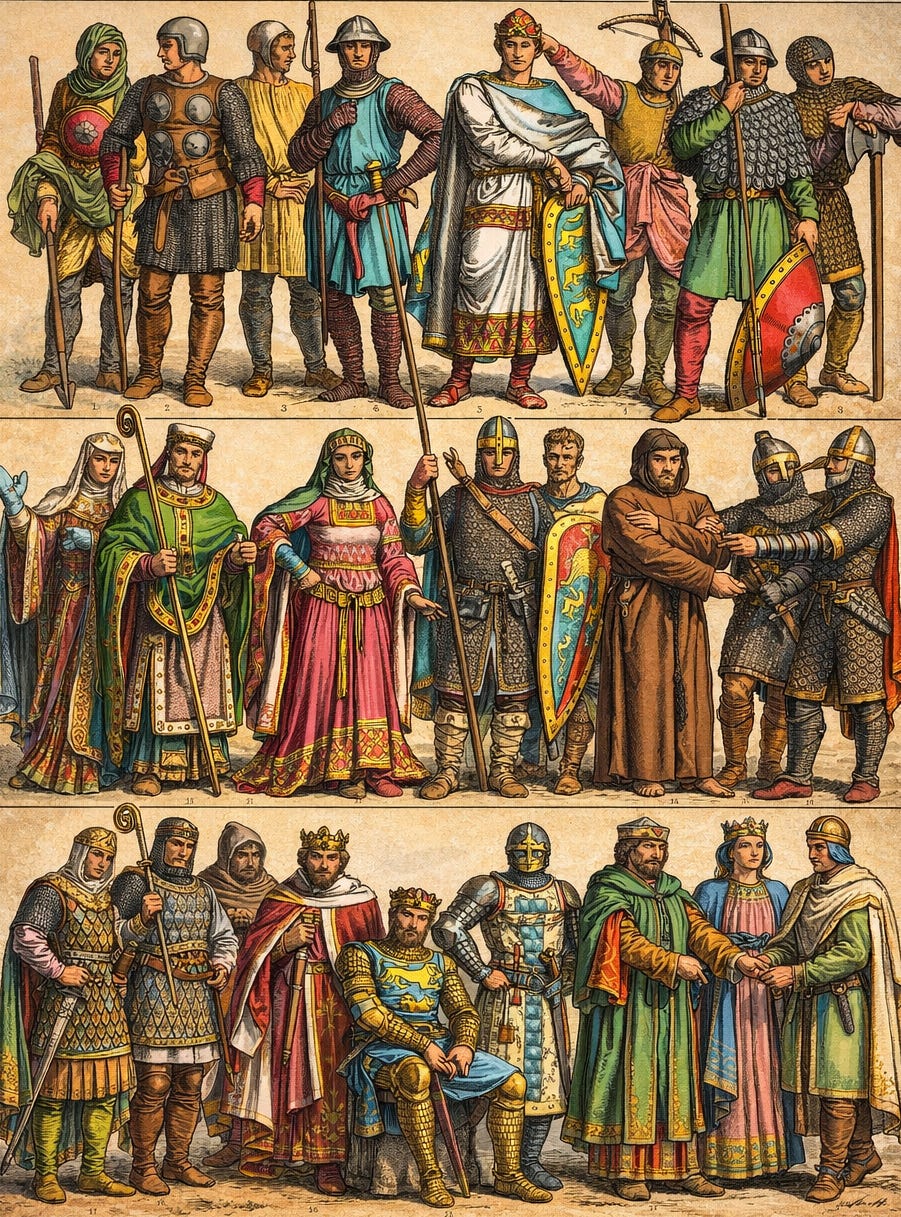
October 15, 1066. It’s a chilly autumn morning. Somewhere in the fields outside Winchester, a peasant goes about his day. He has no idea that, only yesterday, a hundred miles away, the king has fallen just outside the town of Hastings.
Our peasant — let’s call him Leofric — is equally unaware that the victor of that battle, William the Bastard, Duke of Normandy, will soon be crowned King of England under the name of William I, with the much-upgraded sobriquet of “the Conqueror.”
Leofric doesn’t know it yet, but his world has irrevocably changed. He has, you see, come under the Norman Yoke. And, worse than that, as any linguist would be able to tell him, his language is also about to change forever.
Soon, Leofric will live through a new period in the history of the English language: Middle English (1066–1450), in which English falls under the domination of French, birthing the bizarre situation where seemingly every word in the English language has a fancier, French counterpart.
Will Leofric need to go for French lessons? If Sir Walter Scott’s novel Ivanhoe (1819) is to be believed, our peasant hero will have to get to work on his bonjours and his s’il vous plaîts, and tout de suite!
Scott’s novel, which is set in England in the year 1194, levels the blame on the Normans for an infamous linguistic quirk of English: animals have Anglo-Saxon names when they’re alive and French names when they’re served at the table.
For example, a farmer raises a cow (Old English cū), but a nobleman asks for beef (French bœuf). Shepherds guard their flocks of sheep (Old English sċēap), but those same sheep become mutton (French mouton) when they find themselves in the lord’s stew.
You’ve probably heard this story before in a YouTube video or on a placemat at a medieval-themed restaurant. Is it true? We’ll return to that question later.
But first, I’d like to zoom out to discuss the larger question: how did the Norman Conquest actually affect the English language?
The Cambridge Encyclopedia of the English Language echoes most people’s understanding: “after the Norman Conquest” came an “influx of words from … French”.1
That’s not technically wrong: the influx did come after the Conquest. But it allows the reader to assume what almost everyone who hasn’t looked at the data assumes: that “after” means “shortly after,” and more specifically “as a direct result of.” In other words, we’re led to assume that the military conquest and the linguistic one were roughly simultaneous.
But this familiar story — English dethroned and forced to absorb massive quantities of the language of the oppressor — has a gaping hole.
There was no flood of French words into the English language, not until around 1250, a full 200 years after the Norman Conquest. Before then, the influx was more like an in-trickle. And, by 1250, the families that had first brought French to England were increasingly speaking English as their first language.
The French words in English were far from an imposition of a Norman aristocracy. Instead, they came just as French was beginning to lose its grip on the Normans themselves, or rather, their descendants.
You’re reading The Dead Language Society. I’m Colin Gorrie, linguist, ancient language teacher, and your guide through the history of the English language.
I publish every Wednesday. Free subscribers get every other issue; paid subscribers get them all. Upgrade for the full archive, deep-dives on skills and takes you won't find anywhere else, plus our live book clubs.
As French as the word very
If we had no historical records of the Norman Conquest, we’d have a hard time deducing it happened in 1066 just by looking at the language.
That’s a bit weird, right? A country gets taken over by a foreign élite and the language just… stays the same?
But it’s true: for the first 100 years after the Conquest, the English language showed very few signs of French influence of any kind. Leofric would never need French lessons. Neither would his kids. Neither would theirs.
If you were one of Leofric’s great-great-great-(etc.) grandchildren living in 1150, the only French words you might know would be things like war (first appeared in 1116), duke (1129), charity (1154), and nativity (1105). In other words, things that lords and priests talk about.2
Even accounting for the scarcity of written English in this period, loanwords from French barely show up at all. They form a tiny proportion of all new words first appearing in the language, dwarfed by words formed in other ways, for example, by compounding from pre-existing English words, as in birthday, composed of two ancient words, but first attested as a compound in 1384.3
A hundred years into Norman rule in England, the number of French loanwords began to increase in both relative and absolute terms, but it was a slow process.
Even by 1200, only about 10% of new words coming into the English language did so from French. Looking at texts from this period, such as Ormulum (a late 12th-century attempt at spelling reform), the overwhelming majority of the words would be recognizable to an 11th-century Anglo-Saxon.
In the century after the Conquest, French words trickled into English at a rate of about one every eight years. Then came 1250. And the rate increased roughly twentyfold, to nearly three per year.4
And many of the words that came in during this period aren’t the sophisticated language of noblemen or priests. They’re utterly common. For example, the intensifier very — a word so ingrained into English that almost no one realizes it’s an adaptation of French vrai ‘true’ — is first attested in 1384.5
Not what we would expect from the top-down imposition of a language on a conquered population. We need a better explanation for what happened in Middle English than simply appealing to the Norman Yoke.
It also means that Sir Walter Scott’s story, charming and memorable as it is, doesn’t hold up either. If the cow/beef and sheep/mutton split had come from Norman lords demanding meat from English peasants, why did the names for meat not show up in English until around 1300?6 It’s a neat story but it doesn’t survive contact with the chronology.
So here’s the real puzzle. The flood of French words into English didn’t come when French was at the height of its power in England. It came when French had started to lose its grip.
By 1250, the descendants of William the Conqueror’s companions had started speaking English at home, and their ancestral ties to Normandy had been severed for decades.
Why did French have its biggest impact on English just as its own dominance was waning?
