

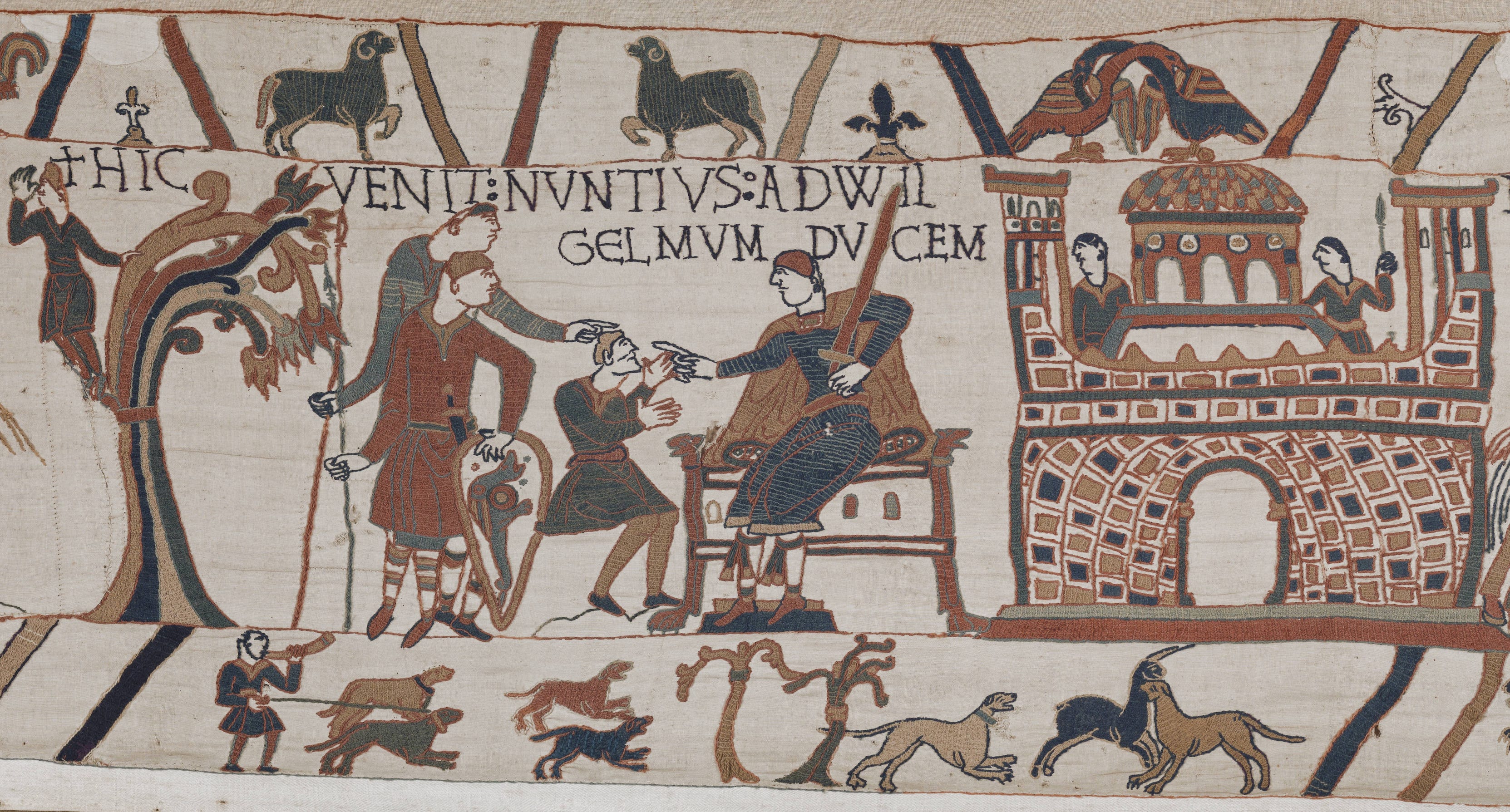
I’m not sure what your inbox looks like lately, but mine is stuffed full of reflections on the Bayeux Tapestry, which is now on display — but, alas, sold out for the time being — at the British Museum. This is the first time it has ever been shown outside of France.
The Bayeux Tapestry is 70 metres long and dates to the 11th century, shortly after the Norman Conquest of England in 1066.
Its subject matter is the Norman Conquest itself, and the surrounding events: the death of the heirless English king, Edward the Confessor; the invasion of William of Normandy, and William’s victory over his English rival Harold Godwinson at the Battle of Hastings.
In the standard biography of English, the Norman Conquest is the great dividing line in the language’s history, marking the end of the Old English period and the beginning of Middle English.
This is when the hitherto purely Germanic English language first fell under the influence of French, which had been brought over by the Norman conquerors.
You’re reading The Dead Language Society, where 86,000+ readers explore the hidden history of the English language. I’m Colin Gorrie: PhD linguist and your guide through 1,500 years of linguistic history.
I publish every Wednesday. Paid subscribers get every issue, the full archive, and my most in-depth work, including longer essays that trace the mysteries of English to their source, practical guides to reading historical texts yourself, and live book clubs where we read texts like Beowulf and Sir Gawain and the Green Knight.
I’ve complicated aspects of this history in earlier articles. For example, English had lots of Latin loanwords long before the Norman Conquest. And the Normans did bring French, but it took more than two centuries before French words started to appear en masse in the English language.1
These complications notwithstanding, the Norman Conquest was a big deal for the English language. If William the Conqueror had not won at Hastings, English would be a lot more like German: a language which has plenty of words from French, but comparatively little borrowed until around 1600.2
The French words in this alternate-history version of English would have been later, more transparently French borrowings. We’d still have words of obvious French origin, such as ballet, champagne, and souvenir, but we’d have missed out on words like cattle, warden, and faith — words that barely betray their French origins.
We owe this most ancient layer of French loanwords in English to the Normans. And some of their peculiar, not-so-French-looking characteristics are the result of their specifically Norman origins. Compared to the French spoken in Paris — the dialect that gave birth to French as we know it today — Norman French was different.
Just how different? And how did these differences affect English?
In other words, what have the Normans ever done for us?
