

Last week, I was writing the first draft of an article about Shakespeare’s linguistic creativity. You might imagine a writer at peace in such a state, furiously typing out his thoughts about particular turns of phrase in The Merry Wives of Windsor, and periodically consulting the Oxford English Dictionary for dates of words’ first attestation. Sounds like a dream, right?
But, as I wrote, I was troubled by a thought so troubling that it distracted me entirely from the Shakespeare article, which was meant to come out today — don’t worry, it’s still on its way — and set me to penning this piece instead.
Here’s what happened: I was revising a paragraph and I found myself looking twice at the em-dashes. These are the big long dashes (—) that Gen-Z apparently calls “the ChatGPT hyphen.” The name derives from the fact that the extensive use of this little bit of punctuation has become the most infamous of all the “AI tells.”
Mine, on the other hand, were good little em-dashes, doing the job they’re supposed to do: cracking open a window in the middle of a thought, letting you peer through it, and then closing it again.
Nevertheless, dear reader, I deleted them.
Not because there was anything wrong with my lovely little em-dashes, but because I was afraid that someone would spot them on the page and dismiss my article as nothing but “AI slop.”
The thing is, I’ve been using em-dashes since I was in graduate school back in 2008. I used them in my dissertation. I use them in birthday cards to friends and family. I’ve used them in many of the articles I’ve written for this newsletter.
But now, every time I write one, a small voice in my head whispers “Better get rid of it. People are going to think this is AI.” So it gets replaced with a semicolon, a colon, or a period.
I’ve lost my innocence with respect to em-dashes. I’ve eaten of the fruit of the tree of the knowledge of AI slop, and I’ll never again be able to deploy em-dashes with the youthful abandon I once enjoyed.
That is what bothered me when I was writing my Shakespeare piece. I felt my em-dash was the appropriate choice, but I was tempted to change my writing to something I thought was weaker just to satisfy the future critics I’d conjured up in my mind.
And I’m not the only one self-censoring like this. In an 18-month ethnographic study of professional writers, one participant described “deliberately choosing a less elegant sentence structure because I was worried the better version would make people suspicious.”1 Another participant described going through a piece of writing, and removing words associated with AI in the public consciousness, such as delve and tapestry.
If you write online, I’d wager these thoughts have run through your mind as well.
I’ve even heard of people deliberately leaving typos in their work, because mistakes are now apparently proof of hand-crafted artisanal prose. (I hope you’ll treat mine that way too.)
Something has gone badly wrong here. Anxiety about AI writing is, paradoxically, making us worse writers. We’re voluntarily surrendering the writerly tools we want to use — the ones that would be the best thing for the piece we’re writing — simply because machines have learned to imitate them.
It’s the literary equivalent of deciding that salt is poison because blanketing your food with salt is bad for your long-term health, and then policing anyone else who reaches for the shaker.
The impulse to blame the em-dash because you hate AI writing is curiously reminiscent of an older controversy. This isn’t the first time writers have panicked about the corruption of prose in the wake of a technological revolution. But I’ll come back to that.
What’s important is that people who quote a sentence with an em-dash and call it “AI slop” are aiming their criticism at the wrong thing.
You’re reading The Dead Language Society, where 40,000+ readers explore the hidden history of the English language. I’m Colin Gorrie: PhD linguist and your guide through 1,500 years of linguistic history.
I publish every Wednesday. Paid subscribers get every issue, the full archive, and the content I’m most proud of: practical guides to reading historical texts yourself, honest takes on how language really works, and live book clubs where we read texts like Beowulf and (up next!) Sir Gawain and the Green Knight.
Why AI prose is indigestible
Em-dashes aren’t the thing that makes AI writing bad. Nor is it any other now-infamous technique: not sentence-initial but, nor the corrective antithesis (it’s not X — it’s Y), nor even the ascending tricolon (lists of threes, where the longest item comes last).
The problem is something more diffuse: it’s what John Gallagher called “designer syntax without any content.” A colleague of his had an even better phrase: “haunting uniform polish.”
AI prose has no sense of proportion. It deploys the same level of special effects to every sentence regardless of importance. It’s just always on. And this makes reading it exhausting: it’s just one zinger declarative sentence after another, without a pause to let you digest.
Everything is designed for maximum effect. As a result, nothing ends up having any effect.
For example, if you asked me to opine about the importance of patience in language learning, I might say something like: “There’s no way around it: language learning takes a long time.”
There’s really not that much to say about it, since everyone knows it’s true.
But an AI would give you something like this: “Language learning isn’t a sprint — it’s a marathon. It demands not just memorization, but transformation. Not just patience, but persistence. And ultimately, not just knowledge, but the kind of wisdom only bilinguals have.”
It’s a bizarre mixture of Churchillian rhetoric and the verbal tics of a billboard advertisement. It’s a trite observation. Why belabour the point?
As many people have remarked, what AI writing lacks is taste: it has the ability to deploy techniques, but not the wisdom to know when to do so. But lack of taste is diffuse. It’s not the kind of thing you can find a single “gotcha” sentence for. So people reach for the tells they can spot — an em-dash here, a parallelism there — and a reasonable distaste for the style of AI-generated prose has hardened into an unreasonable suspicion of anything that even bears a family resemblance to that style.
In fact, many of AI’s compulsive quirks are ancient rhetorical techniques, the very things that make good writing good. But they’re all under suspicion now because a machine learned to write. And it writes well, from a certain point of view, but it writes without any sense of restraint.
AI’s favourite techniques aren’t the first good tools to be prosecuted with bad evidence. In fact, this phenomenon — where a change in writing style is denounced as an impurity — is about as old as the flushing toilet.
In defence of the em-dash
I’d like to focus on the em-dash in particular because it’s such a good example of how a perfectly good stylistic technique got picked up by AI, and, as a result of overuse, has become something that writers avoid when they want to prove their humanity.
But the em-dash is part of your heritage as a writer of the English language. Don’t let it be taken away from you!
The em-dash has its ultimate origin in the variety of horizontal strokes used for various purposes by medieval scribes. With the advent of printing, printers began to standardize the lengths of these lines, resulting in the difference between the hyphen (-), the en-dash (–), and the em-dash (—).2
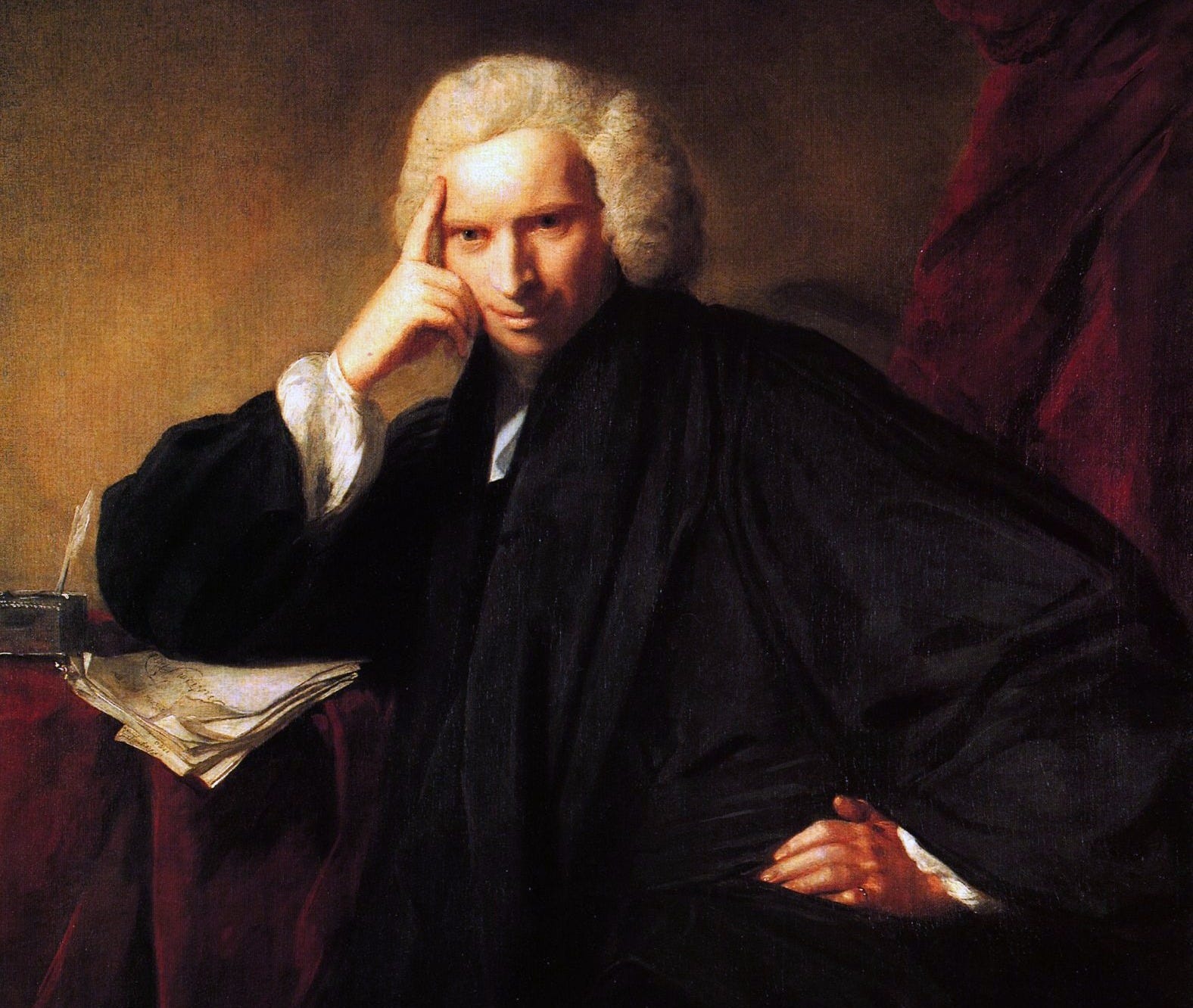
The first great champion of the em-dash was Laurence Sterne (1713–1768). In The Life and Opinions of Tristram Shandy, Gentleman (published serially, 1759–1767), Sterne turned the dash into something new: a typographic reflection of consciousness.
The narrator of Tristram Shandy, it seems, can’t get through a thought without interrupting himself. His sentences break apart in the middle of a clause, veering off into digressions, then circle back, only to be driven apart. The dashes are the straining seams of the mind of a man who has more to expound than English grammar will readily allow.
Witness, for example, this paragraph, which is also a single sentence:
I would sooner undertake to explain the hardest problem in geometry, than pretend to account for it, that a gentleman of my father’s great good sense,⸺knowing, as the reader must have observed him, and curious too in philosophy,—wise also in political reasoning,—and in polemical (as he will find) no way ignorant,—could be capable of entertaining a notion in his head, so out of the common track,—that I fear the reader, when I come to mention it to him, if he is the least of a cholerick temper, will immediately throw the book by; if mercurial, he will laugh most heartily at it;—and if he is of a grave and saturnine cast, he will, at first sight, absolutely condemn as fanciful and extravagant; and that was in respect to the choice and imposition of christian names, on which he thought a great deal more depended than what superficial minds were capable of conceiving. (Tristram Shandy, Vol. I, Ch. XIX)
Alongside the many commas, semicolons, and parentheses, Sterne uses the em-dash to make the page feel like thought, which is halting and self-interrupting.
Emily Dickinson (1830–1886) was another famous dash enthusiast. Her dashes do something different from Sterne’s. His dashes fragment a line of thought that is struggling to hold itself together, while Dickinson’s dashes seem to crack open a space for meaning. Take this, from poem 372, as an example:
After great pain, a formal feeling comes —
The Nerves sit ceremonious, like Tombs —
The stiff Heart questions ‘was it He, that bore,’
And ‘Yesterday, or Centuries before’?
The dash is doing something here that no other punctuation could do. A comma would keep you moving; a period would stop you in your tracks. The dash does something in between. Dickinson used so many of these dashes, and used them so distinctively, that scholars now call it the Dickinson dash.
It was good enough for James Joyce, Virginia Woolf, and David Foster Wallace as well. That’s two and a half centuries of English literature improved by a sometimes liberal application of the em-dash. So why has it become synonymous with AI slop?
The most likely explanation is prosaic: recent models were trained on large quantities of 19th-century prose, a period when writers were most enamoured of the em-dash.
As Brian Phillips wrote, “the prevalence of em dashes in AI-generated text is a sign of how reliant the AI companies are on the human writers they want to replace.”
Can writers overuse em-dashes? Of course. Any technique can be overused. But the cure for overuse is taste, not prohibition.
A strange sense of déja vu
Here’s what I find most striking about the AI writing panic: it’s following a script that English has already rehearsed all too well.
In the sixteenth century, a very similar panic emerged in English literary circles. It too was set off by a technological advance: the printing press, which had arrived in England in 1476.
When coupled with the revival of classical learning that had already been going on in continental Europe for quite some time — the Renaissance was one party England was late to — the printing press made it easy for humanists to spread their ideas far and wide. And with their new ideas came a new vocabulary.
The humanists introduced a large number of loanwords from Latin, words such as educate, celebrate, and illustrate. They weren’t popular with everyone. In fact, many writers denounced them as inkhorn terms,3 vocabulary only a scholar could love, and which had no place in proper English prose.
The details were different. Back then, writers weren’t worried about machines imitating their style. They were worried about foreign words flooding into the language, abetted by the ease of publishing books that the printing press brought. But the pattern was the same: a reasonable concern about excess hardened into an unreasonable prohibition.
In some cases, the imported words weren’t strictly necessary, but in many cases these words filled a genuine gap. English had only recently recovered its status as a language of prestige and power in the late Middle Ages, and the language simply lacked words for many of the new developments in technology and thought.
Some writers went so far as to coin elaborate made-in-England equivalents so that they wouldn’t have to employ a Latin word: gainrising instead of resurrection, foresayer instead of prophet, witcraft for logic and naysay instead of negation.4 These coinages tell us something important about what happens when the impulse to purify runs ahead of common sense.
Take as an example the word gainrising, meaning resurrection. Although this sounds more like something you’d do at the gym than coming back from the dead, this word is a straightforward calque — a translation of the parts of the word — of the Latin word resurrectio. Re- means ‘again’ (hence the gain) and surrectio means ‘rising.’ But gainrising never had a chance, because the word resurrection had already been a part of the English language since around the year 1300.
That’s over two hundred years of history. When the purists were removing foreign words from the language, the words were often so deeply embedded that the process was more like invasive surgery than a cosmetic procedure.
That’s not to say that the borrowers — or inkhornizers, as they were called — were models of restraint. Many Latin words were proposed when there were perfectly good English words for the job. We likely didn’t need latration to describe the barking of a dog, or condisciples for schoolmates. Often these words were put into early English dictionaries by mechanically anglicizing the words found in Latin dictionaries, and they stood very little chance of surviving outside the scholar’s study.
A reasonable concern about the value of these gratuitous borrowings is what first raised the ire of the purists in the first place. Both sides had a point, and both sides had their share of cranks.
Now, the AI panic and the inkhorn controversy aren’t perfect parallels. The inkhornizers were changing the language by grafting Latin onto it; AI is imitating techniques that have been around for a long time. But the panic takes the same course. In both cases, a reasonable distaste at overuse — of gratuitous Latinisms then, of relentless em-dashes now — mutated into a blanket suspicion of perfectly good tools.
The irony of it all is that the purists couldn’t even follow their own advice. As Manfred Görlach, a scholar of the period, has noted, none of the so-called purists was truly consistent. All borrowed more Latin words than their stated principles allowed. Sir John Cheke himself — the man who gave us gainrising — used dozens of Latin loanwords in his writings.
In the end, however, the purists lost. The Latin-loving scholars and their friends won, and English today is full of — or, I should say, replete with — Latin words.

If the purists had their way, the peculiar genius of English literature — the vast tonal range that springs from the mixing of Latin and Germanic layers — would never have flourished.
Consider Milton. The opening of Paradise Lost asks the Heav’nly Muse to sing of man’s first disobedience. But disobedience is Latin in origin, from dis- + oboedientia. So, in a purified English, Milton’s Muse (except she wouldn’t be a Muse, because that’s Greek — maybe some kind of valkyrie instead?) would have sung of man’s first unhearsomeness,5 or perhaps his gainstanding
She couldn’t have sung of the fruit of that forbidden tree, because fruit is a French word. It would have had to be the wastum of that forbidden tree, from the Old English wæstm ‘fruit.’
If you start pulling at the Latin threads, the whole tapestry — sorry, the whole weaving — comes apart.
Hamlet would have wondered, To be or not to be, that is the asking, since question comes from Latin quaestio. He’d have known nothing of questions. And he wouldn’t have been able to complain about the slings and arrows of outrageous fortune, because outrageous and fortune are both French words. Instead, he’d have had to rage against something like unmeetly weird, from Old English unġemetlīċ ‘immoderate’ and wyrd ‘fate.’6
And Jane Austen could never have written her most famous sentence. It is a truth universally acknowledged, that a single man in possession of a good fortune, must be in want of a wife. We’d need to lose universally, single, possession, and (once again) fortune. So: It is a truth acknowledged everywhere, that a onefold man in ownership of good wealth must be in want of a wife.
What a loss that would have been!
And this is what we risk now if we allow the comment section to have a heckler’s veto on perfectly legitimate techniques like parallelism, the corrective antithesis, and the almighty ascending tricolon.
Style policing is not inherently wrong. Everyone has opinions about how language should be used and this is never going to change.
But this particular kind of style policing is based on bad evidence and it punishes the wrong people.
The ones it punishes are the writers who are using the tools of classical rhetoric and those who want full freedom to use the punctuation that is the heritage of the English literary tradition.
So I went back to my Shakespeare article and I put those em-dashes back in. Every last one of them. They were, after all, good little em-dashes, doing the job they’re supposed to do: cracking open a window in the middle of a thought, letting you peer through it, and then closing it again.
Archana Raghavan, War of the Words, The Sociological Review, February 2026.
The terms en and em refer to units of measurement in typography. The en-dash is one en wide, and the em-dash is one em wide. It’s also often thought that the em and the en are the width of the letters m and n, respectively, although that’s not always the case in every typeface.
After the inkhorn, that is, an inkwell made of horn, and a stereotypical accoutrement of the scholar.
Gainrising and foresayer are from John Cheke’s Gospel of Matthew (c. 1550); witcraft and naysay are from Ralph Lever’s The Arte of Reason (1573). Naysay has survived, albeit more commonly as the derived noun naysayer.
Unhearsomeness continues the Old English unhīersumness, from the root hīeran ‘to hear.’ This parallels the etymology of the Latin oboedientia, which is itself ultimately from the root audire ‘to hear.’
Funnily enough, that line still works as iambic pentameter: the slings and arrows of unmeetly weird.
A question to consider about people who think em-dash use in a text means that an AI machine wrote the text:
Do such people even read much? Do they read much offline or read texts or books that were originally published offline or published years or decades ago or longer?
Lynne Truss' Eats, Shoots and Leaves tells us that the dash – I don't think she calls it the em-dash – is her favorite punctuation mark, because of its flexibility of use.