


Debt is old. It’s older than writing. The first writing system, Sumerian cuneiform, evolved out of marks used for accounting. From the beginning, writing was used to track who had what, and, crucially, who owed what to whom.
The influence of debt also extends to language more generally. In many languages, including English, the experiences of owing and being owed provided the blueprint for more abstract notions of duty, necessity, and obligation.
Words meaning ‘to owe’ developed into abstract expressions of obligation so often that it’s useful to have a name for the phenomenon. I call it the owe-to-ought pipeline, named after one of the clearest cases of this development. The word ought is, in fact, nothing but the old past tense form of owe.
This pipeline shows us something about how language changes and develops over time. First, it shows how easily words can slide from one meaning to another, although that’ll be no surprise to anyone who has watched the development of slang over a few decades.
The more important lesson owe-to-ought teaches us has to do with where grammar comes from. Wait, don’t run away! This isn’t a grammar lesson. What I want to show you is how languages create grammar — a collection of abstract meanings such as plurality and verb tense — out of the concrete realities of our shared human experience.
And what human experience is more common than debt?1
This is the story of three families of words: owe, should, and the word debt itself. Understand these three families, and you’ll understand how the English language built its way of expressing duty, necessity, and obligation — not to mention guilt and sin — out of the raw materials of accounting.
You’re reading The Dead Language Society. I’m Colin Gorrie, linguist, ancient language teacher, and your guide through the history of the English language and its relatives.
Subscribe for a free issue every other Wednesday, or upgrade to support my mission of bringing historical linguistics out of the ivory tower and receive two extra Saturday deep-dives per month. You’ll also get access to our book clubs (you can watch the recordings of the first series, a close reading of Beowulf), as well as the full back catalogue of paid articles.
Owing and owning
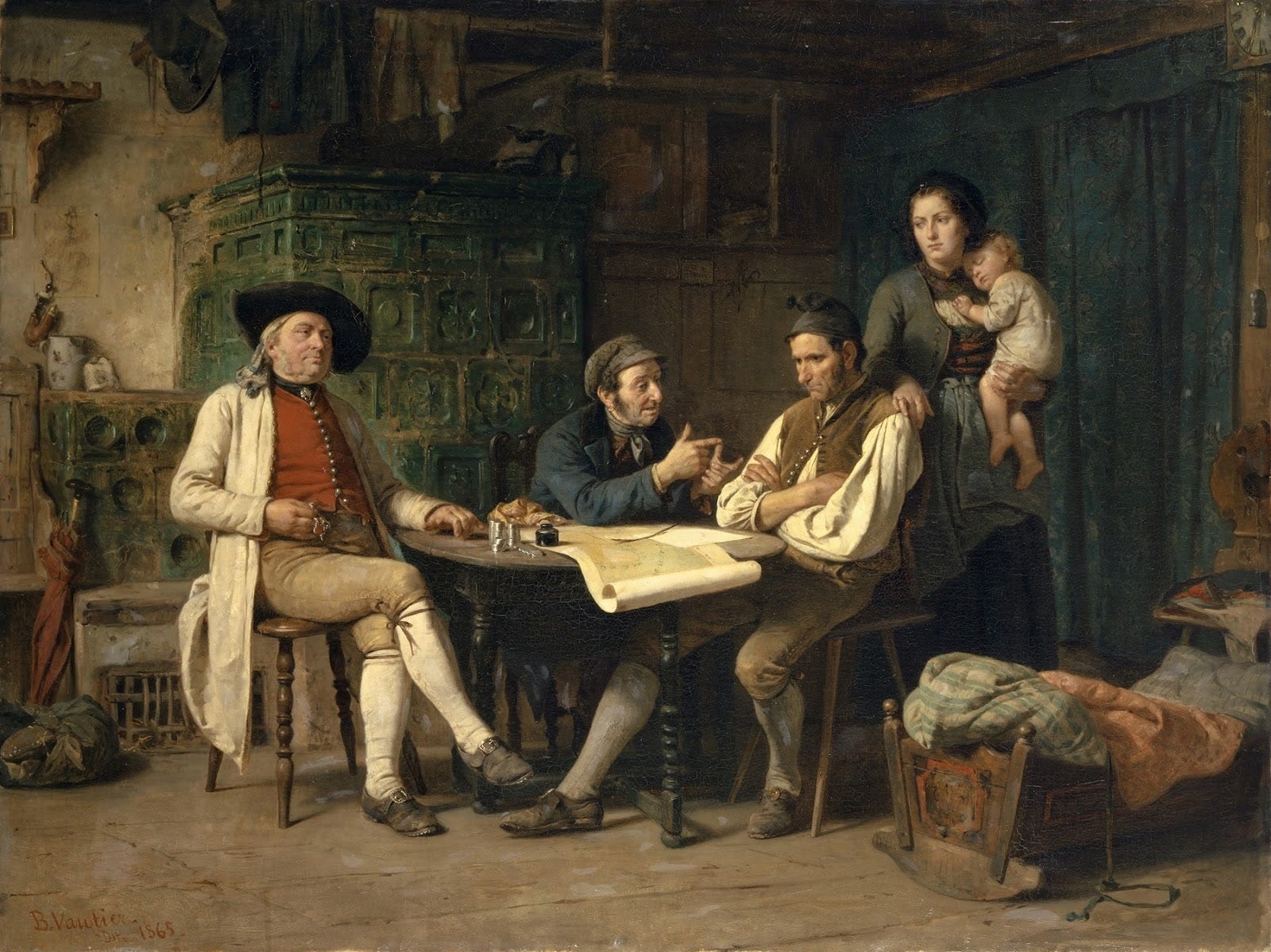
The clearest example of the owe-to-ought pipeline is, funnily enough, owe and ought.
So let’s start there, and use it to examine how words describing debt became abstracted over the centuries.
The word Ought has a bit of a strange history. It comes from the Old English verb āgan, which has given us not one but three Modern English verbs: owe, own, and ought.
The original meaning of the verb āgan in Old English was ‘to have, possess.’ This meaning is preserved in the Modern English word own.
se man… sylð eall þæt hē āh, and ġebiġþ þone æcer.
‘the man… sells all that he owns, and buys the field’
(Matthew 13:44, Wessex Gospels)
But the verb āgan developed another sense of ‘owe’ from its use2 in the phrase āgan tō ġieldenne, literally ‘to have (something) to pay.’
This phrase āgan tō ġieldenne first appears in the gloss3 of the Lindisfarne Gospels, where it translates the Latin word dēbēre ‘to owe.’
Redde quod debes
geld þæt ðū āht tō geldanne
‘Pay what you owe’ (lit. pay what you have to pay)
(Matthew 18:28, Lindisfarne Glosses)4
But it’s not only the Old English word āgan that has a relationship with having. The Latin equivalent dēbēre does too, originating as a combination of the prefix dē- ‘from’ and the verb habēre ‘to have.’ The idea is that, when you owe something, you have something that really belongs to someone else. It’s as if you’re holding it away from them.
The meaning ‘owe’ gradually came to be the primary meaning of the verb āgan, even when it was used alone, without the tō ġieldenne, which started happening in the 12th century. Once the verb āgan was understood as referring primarily to owing, it became increasingly rare to use it to mean ‘own’ (although this meaning remains in use in certain dialects even today).
While owe stopped being used to mean ‘own, possess,’ a related word picked up the slack: this is where we get the second word that derives from āgan, the verb own. Own doesn’t come directly from Old English āgan, but from the slightly different verb āgenian.5
It’s the third verb, ought, though, that has the most interesting story to tell us.
The form ought derives from the past tense of Old English āgan, namely āhte. Although the modern verb owe has a regular past tense owed, this is a comparatively recent development, dating from the late 14th century. Originally, the past tense of owe was ought.
Ought continued to function as the past tense of owe (and in some dialects still does) through the later Middle Ages. But ought developed another usage, or rather, its Old English ancestor āhte did.6 It became used to mean ‘should.’
The intuition behind this evolution is that a duty — a word also distantly descended from Latin dēbēre — is something you owe. So you can use a word meaning ‘to owe’ to express something you have a duty to do. Therefore ought ‘owed’ came to mean ought ‘should.’
This development had happened as early as Old English, but it wasn’t an isolated incident. The same thing was also happening to another Old English verb which we find in the gloss of a different copy of the Gospels.
In the Rushworth Gospels, the Latin word dēbēre is translated this time not as āgan but sċulan,7 another verb whose earliest meaning is ‘to owe.’
It’s this verb sċulan that gives us the Modern English verbs shall and should.
Shall we?

Shall and should are often considered separate verbs in Modern English, but they arise from a single verb in Old English. Shall comes from the present tense, spelled sċeal in Old English (but pronounced similarly to shall), and should comes from the past tense form sċolde.
But shall and should are weird verbs. They don’t work like other verbs. You can’t say to shall or to should, for instance.
And there are other differences: shall and should can be used directly with other verbs. For example, we say I should eat. But if we want to put try with another verb, to appears in the middle: I try to eat.
Shall and should also form questions differently from other verbs: they invert (should I?), rather than adding a dummy verb do (do I go?) Finally, shall and should don’t have the -(e)s ending that other verbs require after he, she, or it: consider it shall be done vs it comes and goes.
These facts are all related, but to explain why, I’ll need you to make a small investment in learning grammatical terminology. It’s only two terms, and your attention will be repaid with interest.
There are two types of verbs in English. One consists of verbs like shall and should. These are called the modal verbs. They are a small group of verbs used alongside other verbs to express things like possibility, probability, necessity, and obligation. Examples of modal verbs in Modern English are can, must, may, might, and, of course, shall and should.
The other kind of verb is the more prototypical sort of verb, for example, walk, eat, weigh, delay, encounter, investigate, to take a few that came to mind as I was writing this.
Since these verbs express actions or states of affairs, rather than the possibility, probability, etc. of states of affairs, they’re non-modal. But non-modal is a clunky term, so we’ll call these lexical verbs.
Ok! Thank you for your investment in light grammar education. Now let’s see how it pays off.
In Old English, you most often see sċulan used as a modal verb, just like its descendants shall and should. The meanings expressed by these uses are broad, encompassing obligation (like Modern English ought to, should) and necessity (like have to, must), among many other less common uses.
Hwȳ sċeall þonne ǣniġ mon bīon īdel, þæt hē ne wyrċe?
‘Why then should (moral obligation) anyone be idle, such that he not work?’
(Ælfred, Consolation of Philosophy 41.3)
Þonne sċealt þū nēde ġelēfan þæt sum ānweald sīe māra þonne his.
‘Then you will have to by necessity believe that there is a power greater than his.’
(Ælfred, Consolation of Philosophy 34.3)8
But sċulan was also used as a non-modal verb in Old English. And this is the usage we see in the glosses to the Rushworth Gospels, where it translates the Latin dēbēre ‘to owe.’
Redde quod debes
aġef þæt ðū sċealt
‘Pay what you owe’
(Matthew 18:28, Rushworth Glosses)
Which of these meanings came first? We can’t exactly tell from the texts themselves, but we can appeal to a general principle of language change: modal verbs tend to develop out of lexical verbs which have acquired some modal meanings. Since modal verbs are used so frequently, the modal meaning of the verb often takes over and all memory that the verb was ever a lexical verb vanishes.
There’s usually a logical relationship between the earlier, non-modal meaning of modal verbs and their later, modal meanings. It’s often tricky to unearth these older meanings, but in the case of sċulan, the older one is staring us in the face: ‘to owe.’
An additional source of evidence for ‘owe’ being the earlier meaning comes from parallel words relating to debt (or something more serious) in the distantly related Baltic languages: Lithuanian skelė́ti ‘to owe’ and Old Prussian skellants ‘guilty.’9
But even if we didn’t know about these Baltic languages, we’d be able to appeal to another source of evidence: related words within the language. We get hints about other modals in this way. For example, the modals may and might come from a verb magan, which originally meant ‘to be strong.’ This is why we have the related word might, as in ‘strength.’
Like sċulan, the verb magan developed the modal meaning ‘to be able — i.e. strong enough — to do something.’ Finally, the descendants of magan, that is may/might, ended up with the modern meanings ‘to be possible, allowed.’10
Now, there are no other words related to the verb sċulan, not in Modern English, anyway. But if we go back to Old English we find an excellent example.
The word is sċyld ‘debt; guilt, sin, crime.’ If you know German you won’t be shocked at this, since German retains the related word Schuld ‘guilt, fault; debt.’ The more moral meanings of sċyld, such as ‘sin’ and ‘guilt,’ likely arose from the fact that sin is compared frequently to debt in the Bible.11
Sċyld pops up all over the place in Old English religious writing with that more moral meaning ‘guilt’ or ‘sin,’ which is naturally a favourite topic of Christian writing. But sċyld also had more secular uses, as seen in King Alfred’s translation of the Pastoral Care, a work on how priests should behave:
justitiae debitum potius solvimus, quam misericordiae opera implemus
ryhtlīcor wē magon cweðan ðæt wē him ġielden scylde ðonne wē him mildheortnesse dōn
‘We can more rightly say that we are repaying a debt to him than doing him generosity’
(Alfred, Pastoral Care)12
As sċulan was used more and more as a modal verb, it gradually lost ground to āgan in its main verb use meaning ‘owe.’ By the end of the 15th century, sċulan (or its Middle English descendant) was used no more to mean ‘owe.’
The verb shall (past tense should) was by then thoroughly modal, and began to settle into its modern patterns of usage.13 And shall covered its tracks, since the related noun sċyld seems to have died out by the 12th century, at least as far as I can trace it in the Middle English Compendium. Curiously, even the Oxford English Dictionary seems to lack an entry for sċyld.14
We might be tempted to think that this pattern of evolution, from words talking about debt to modal verbs of obligation, was limited to English. But, in fact, it seems to have been a wider, European phenomenon. To see why, let’s turn to the word debt itself.
Debt and why this keeps happening
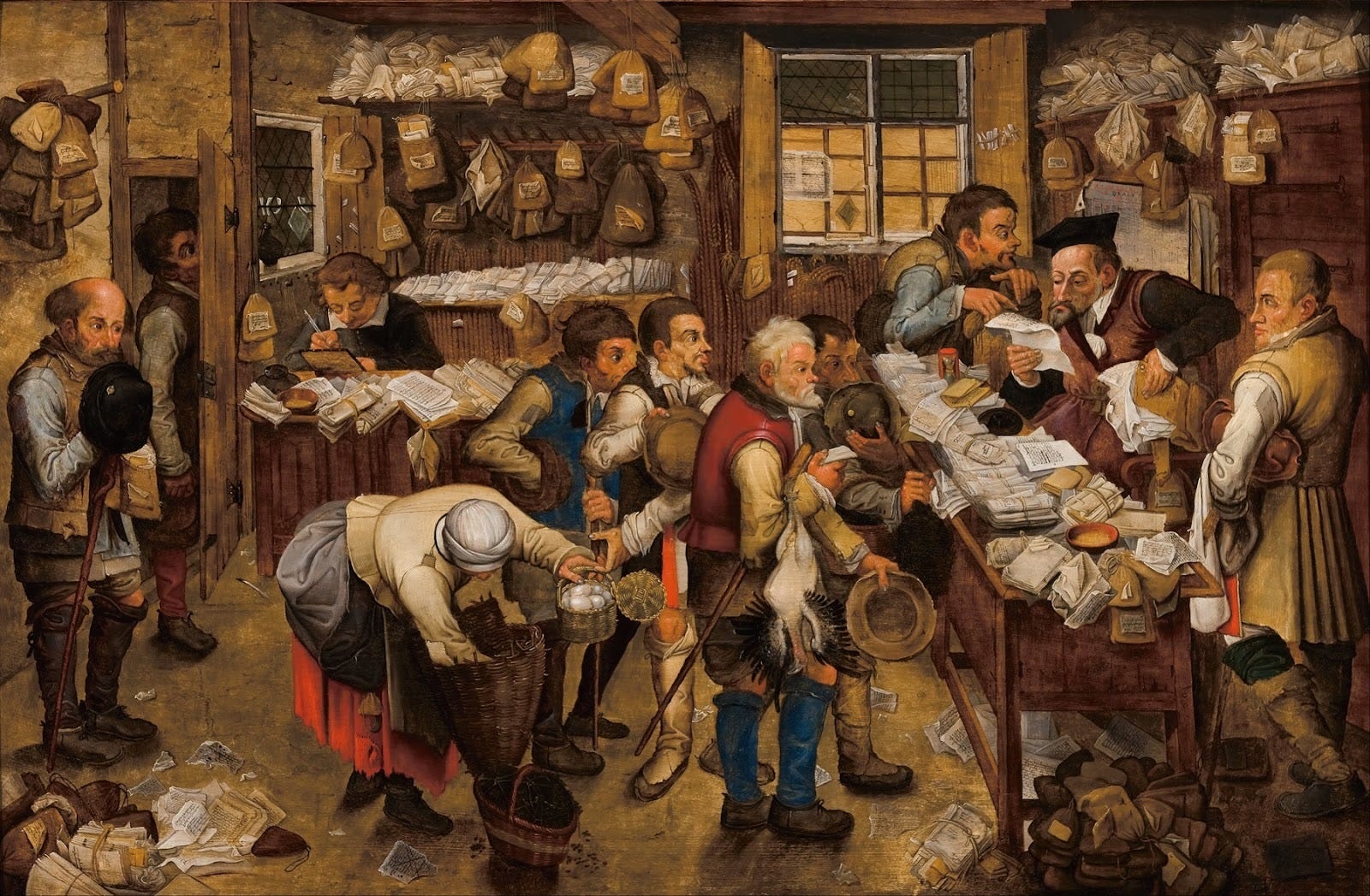
Debt is a weird word, although not quite weird enough to warrant its own entry in the weird words series. This is because the weirdness of debt is mainly found in its spelling. It’s the silent b that makes debt weird, not any mystery concerning its origins.
In fact, the origins of debt are very clear: the word itself came into English in the 13th century from the Old French dette. The weird silent b even gives us a clue of the word’s etymology: it comes ultimately from the Latin word dēbitum ‘something owed,’ which is nothing but the past participle of the verb dēbēre ‘to owe.’
But that b sound had long since been obliterated by the time it was written down in French. It sounded in Old French like it sounds in Modern English (albeit with a short ‘uh’ vowel on the end). A silent b was inserted into the spelling of the word by educated types in France and England in the Middle Ages and Renaissance. These were educated writers who wanted to show the relationship between the French word and its Latin forebear.
The silent b didn’t stick in French dette, but it did in English debt.15
I bring up debt not merely because it’s thematically related to the shifts we’ve been talking about, but because the verb it comes from, Latin dēbēre ‘to owe,’ underwent the exact same development. Like Old English āgan and sċulan, Latin dēbēre evolved in the Romance languages into a word meaning ‘should, ought to.’
In fact, this process was already underway in Latin. We see classical Latin prose writers using dēbēre as a modal verb expressing moral duty, like a Modern English ‘should.’ Poets sometimes used it for necessity, like a Modern English ‘must.’16
This Latin verb dēbere became the Romance verbs meaning ‘should’: Spanish deber, Portuguese dever, French devoir, and the Italian form dovere.17
The same development happened in Breton, with the verb dle ‘owe’ developing into a marker of obligation.18
This development, where expressions of obligation or necessity arise from words referring to debt — the owe-to-ought pipeline — seems to recur again and again. But, oddly enough, all the examples we have of this phenomenon are found in European languages.19
Is there any deeper meaning to this? If I had to guess, I would venture that it was the influence of Christianity and the Biblical metaphor of sin as debt which opened up the owe-to-ought pipeline in European languages in particular. If sin is a kind of debt, it’s easy to imagine moral action as repayment of that debt. Therefore obligation becomes a kind of owing.
Owing isn’t the only source of these kinds of modals, though. Another common pathway is for phrases expressing possession to become expressions of obligation.
This development is found in a more widespread set of languages, including many in Africa. If this pathway seems hard to conceive of, think of the English phrase have to, which contains the verb of possession have. Another, similar pathway involves verbs meaning ‘to get’ (like English I’ve got to…).
All of these developments are examples of the phenomenon of grammaticalization, the phenomenon by which concrete words are worn down through everyday use until they become abstract bits of grammar. A famous example of grammaticalization from the recent history of English is how the phrase going to was worn down to gonna, which no longer refers to motion to a place. Instead, in casual spoken English, gonna acts as a kind of future tense marker.
Cases of grammaticalization, such as the owe-to-ought pipeline, show us how language enlists comparatively concrete words (like owe) to express more abstract concepts (like ought). As these words are used more and more often in this abstract way, the memory of what they used to mean fades, and they become part of the grammatical system of the language.
In the case of owe-to-ought (and related developments), it’s not hard to see why the experience of owing something might serve as a useful metaphor for obligation in general. Not only do you have to pay back the debt, but you likely have to do a raft of other things you’d rather not do just to come up with the money for the payments.
The experience of being in debt is the situation of obligation par excellence. It’s no wonder it left its mark on the language we speak.
At least, that is, in societies of a certain kind, i.e. the ones we all live in.
Oxford English Dictionary. “owe.”
A gloss is a word-for-word translation of a text, where the translations are written alongside the original. Read more on glosses here.
Oxford English Dictionary. “owe.”
Own comes from the verb āgenian ‘possess; claim, make one’s own,’ rather than āgan, although āgenian is itself derived from āgan through its past participle āgen. This verb vanished over the course of the later Middle Ages, only to be used again in the 16th century, perhaps as a back-formation from the commonly used noun owner.
This ‘should’ usage wasn’t originally limited to the past tense. Present tense forms of āgan were also used with this meaning in Old English. But this usage ended in the 16th century, leaving only the past tense ought in this usage.
Technically, I should be writing *sċulan with an asterisk. An infinitive form, meaning ‘to X’ (which is how we normally cite Old English verbs), is not actually attested for sċulan in Old English. Nor can you really say to shall in Modern English, now that you think about it… But for ease of exposition, I write sċulan without the asterisk here.
Quotations from OED. “shall.”
van Kroonen, Guus (2013). Etymological Dictionary of Proto-Germanic.
The modal can is another good example: it comes from a verb meaning ‘to know, to be familiar with.’ Traces of this older use can be found in related words ken ‘awareness,’ as in the phrase beyond my ken ‘outside of my awareness,’ or in the word canny ‘wise, knowing, crafty.’
As in, e.g., the parable of the unforgiving servant in Matthew 18:21–35.
The context is in a discussion of giving to the poor, which the author, Pope Gregory I, saw as repayment of a debt owed to the poor rather than an act of generosity towards them. Crucially, there’s no notion of sin or guilt here.
The usage of shall in Modern English is frankly confusing, not to mention contested: it’s one of the things prescriptive grammarians once got themselves worked up about. This is worth an article of its own.
The OED does, however, have an entry (shildy) for the related Old English word sċyldiġ ‘guilty,’ which died out along with sċyld around the year 1200.
A similar thing happened in the words doubt and receipt, from dūbitāre ‘to doubt’ and recepta ‘something received.’ More on this phenomenon of etymological spelling here.
See notes in the Lewis & Short entry on dēbeō for more details on the modal usage in classical texts.
Romanian is an exception to this pattern, with no descendant of dēbēre.
Heine and Kuteva (2002). World Lexicon of Grammaticalization. p. 227.
ibid.
Your great learning is put to great use here. We're indebted to you.
The obligation aspect of the move from "owe" to "ought" reminded me of the way that obligation, or indebtedness, relates to thankfulness as well, from "much obliged" to "obrigado."
Very detailed and fascinating history. I immediately recognized that Spanish and French still use the same verb to express *owing* and *obligation*. This didn’t make a lot of sense to me when I was first learned these languages.
Question about “should”: I can see from reading old books that people in the 19th Century said “should” when we would say “would.” They might write something like “I should like to try it” or “If I had the choice, I should do it.”
I’m not sure when we made the transition from using “should” to “would” to mark the conditional, but is there an explanation that is consistent with your hypothesis?