


There’s a dream people report having all over the world. Maybe you’ve had it too. It goes something like this: you’re in your own house, everything is as you’re used to, with one exception. There’s a door you’ve never noticed before. Behind it, there’s an whole room full of treasure.
For someone who reads English, that dream is a reality.
It so happens that a room full of treasures is waiting for you in real life, just within arm’s reach: an entire library of medieval books.
They’re medieval, but don’t let their age fool you. Many of the genres are still popular today: battle-of-the-sexes comedies, romances with otherworldly beings, and fan-fiction sequels to hugely popular franchises.
In other words, they’re the perfect beach reads. And you can read them today — yes, today! — in the original Middle English (or Middle Scots!).
Middle English, you see, is not really a foreign language. It’s not like Old English, which you can’t read at all without special training. Instead, Middle English often looks like weirdly-spelled Modern English:
Himself he lerned forto harp,
And leyd theron his wittes scharp;
He lerned so ther nothing was
A better harpour in no plas. (Sir Orfeo 29–32)
There’s no word in there that isn’t also in Modern English, although some meanings have shifted a bit: for example, we no longer learn ourselves, we teach ourselves.1 And nothing means more like in no way.
There’s often an additional challenge: alongside the strange spellings and uses of familiar words, there comes a sprinkling of words that are utterly incomprehensible:
The vousour was avowed al
Of ich maner divers aumal. (Sir Orfeo 363–364)
But beyond hard words like vousour ‘vault’, avowed ‘adorned’, and aumal ‘enamel’, the rest is pretty easy: divers ‘various’ and ich ‘each’ are bit tougher, but the, was, al, of, and maner are all familiar friends.
Wouldn’t it be nice if you had help just for the words which are totally foreign, or have changed in their meaning significantly? You could read the Middle English as it is, without recourse to a translation.
Well, I have some good news for you.
You’re reading The Dead Language Society, where 76,000+ readers explore the hidden history of the English language. I’m Colin Gorrie: PhD linguist and your guide through 1,500 years of linguistic history.
I publish every Wednesday. Paid subscribers get every issue, the full archive, and my most in-depth work, including longer essays that trace the mysteries of English to their source, practical guides to reading historical texts yourself, and live book clubs where we read texts like Beowulf and Sir Gawain and the Green Knight.
Where to begin
Allow me to introduce you to the library full of treasure you didn’t know you had: The Middle English Texts Series, aka METS.2
This is a collection of Middle English and Middle Scots literature in exactly the format a reader wants: the original text, along with glosses — short Modern English translations — of all the difficult words.
There are also the right kind of notes: the kind that explain cultural and historical context, rather than litigating old academic feuds.
Without these notes, you may understand all of the words and nod vaguely along with the plot, but you haven’t had anything like the experience you’ve come looking for. And, best of all, the METS texts are all available online, absolutely for free.
This is exactly the format of text that you, as a reader of Modern English, need when approaching Middle English. The glosses give you the help you need at exactly the point you need it and nothing more, leaving your experience of the original text relatively unmediated.
And better still, it’s all in a format you can actually take to the beach with you, which means no need to worry about spilling your mojito on a dictionary you’ve balanced precariously on your leg as you try to slog your way through untranslated 14th century romances.
So, where to begin?
Sir Orfeo
Sir Orfeo is the best place to start. It’s 600 lines of Middle English verse, and we’ll read the first four together in a moment, so you’ll have a head start!
Sir Orfeo is a retelling of the story of Orpheus and Eurydice, except in this version Orpheus is an English king and his queen is stolen, not by death, but by the king of Faerie.
Orfeo gives up his throne, wanders the wilderness for years, and unlike the Greco-Roman original, actually ends up bringing her back home.
It dates from the late 13th or early 14th century, so it’s a bit earlier than either Chaucer’s works or Gawain.
When you go to the METS website and open the text, this is what you see:
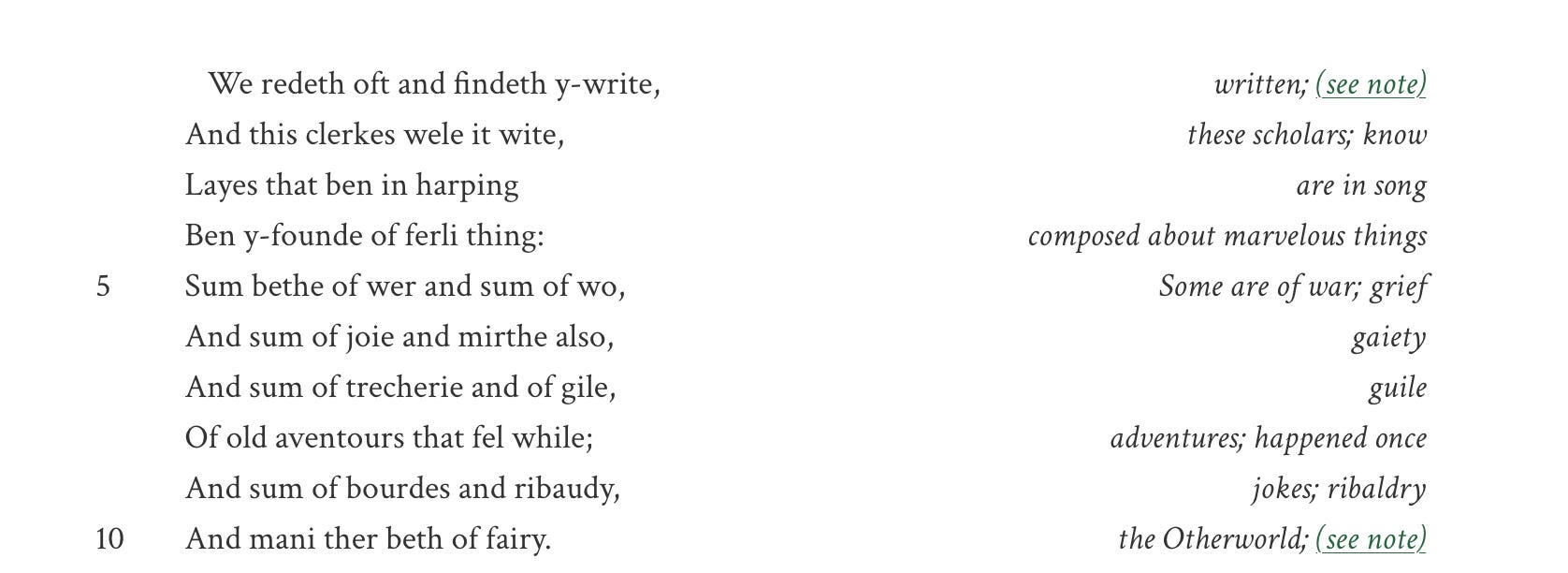
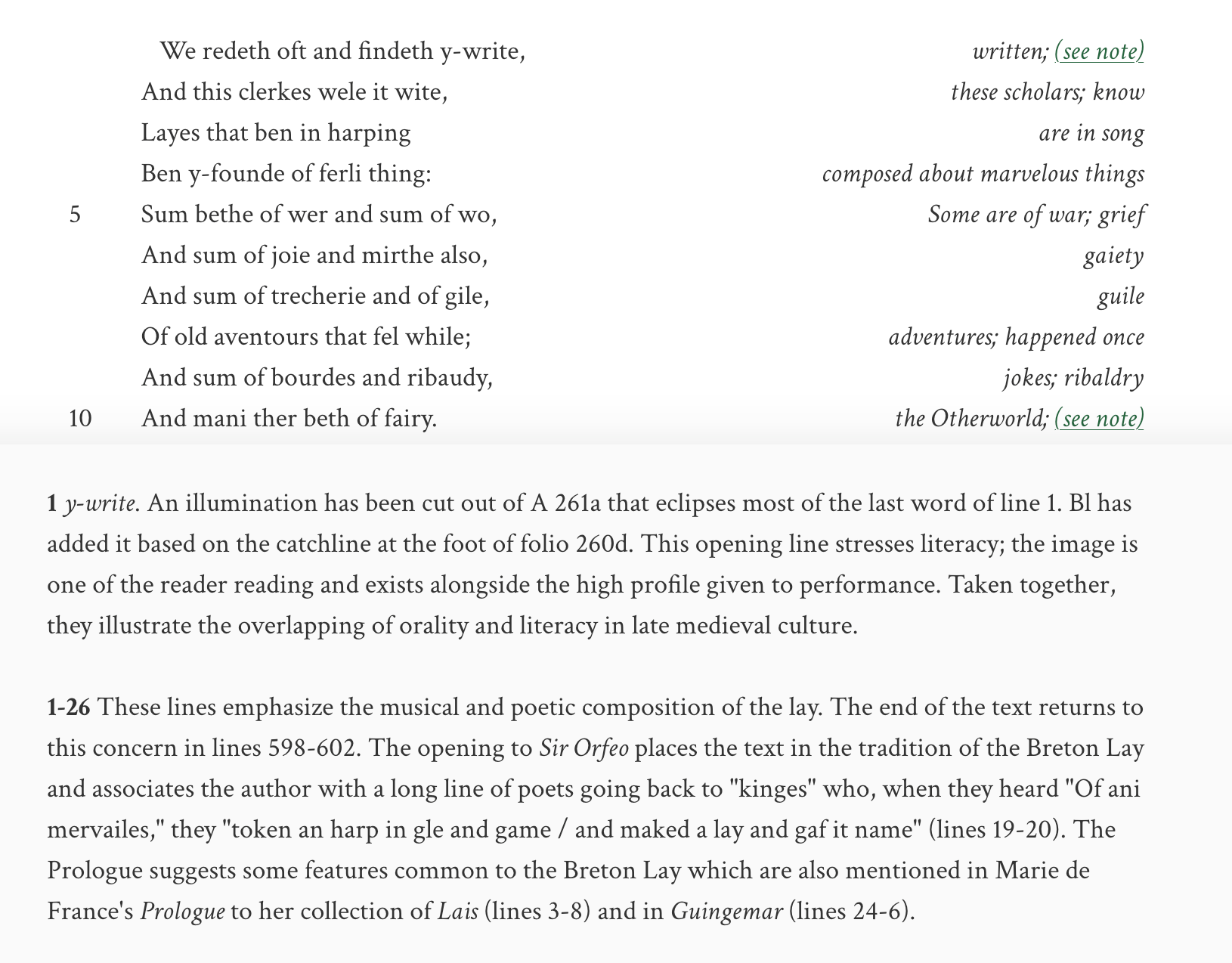
The text is on the left. On the right, in italic type, are the glosses for any hard words on the line. When there are multiple hard words, as is often the case, the glosses are separated by semicolons. Whenever a line has a note, you’ll see a link. If you click this, a note panel opens up at the bottom of the screen.
How to read a glossed text
If I’ve sold you — I hope I have! — on the idea of reading Middle English and Early/Middle Scots texts in the original using glossed editions let me offer some guidance, as it isn’t always obvious how best to use this tool.
My method uses a three-step process. First, read a chunk of the text. I usually like to go up to a full sentence at a time, although that can sometimes be difficult depending on the type of text.
Using Sir Orfeo as an example, I’d begin with the first four lines. They end in a colon, close enough to a full sentence.
We redeth oft and findeth y-write,
And this clerkes wele it wite,
Layes that ben in harping
Ben y-founde of ferli thing: (Sir Orfeo, 1–4)
I like to read out loud, especially for poetry. If your goal is to acquire some ability in the language rather than just to get through the text, it’s best to remember that spoken language is much older and more fundamental than written language.
We have amazing abilities to acquire language from hearing. Hearing the text spoken also allows you to take advantage of things like meter, rhyme, alliteration, and other “sound effects”. If you’re curious how to read Middle English, I have written a guide for you.
Now let’s return to those first four lines. Unless you have extensive background in Old or Middle English, you probably don’t know some of these words. This is where the glosses come in handy. The editors have tried to guess the words that you will have trouble with and given you modern English translations of them off to the side. Now you need to match the glosses to the hard words, but that usually isn’t very difficult.
In the second step of the reading process, I like to take those glosses and mentally substitute them for the hard words. In the case of the lines from Sir Orfeo, it would look like this, with the glosses in italics:
We redeth oft and findeth written,
And these scholars wele it know,
Layes that are in song
Ben composed about marvellous things: (Sir Orfeo 1–4)
The few differences that remain after you’ve applied the glosses in this way are differences of spelling or grammar. The editors expect you to handle these differences on your own.
In this case, the plural ending -eth may give you pause at first, but you’ll have ample opportunity to get used to it throughout the poem because it will be a constant companion. During this second phase, I do not read out loud. I simply try to understand the meaning.
In the third and final step, I’ll read the original text again, letting what I now understand infuse into the original words. This creates a small, weak link between the Middle English words that I see on the page and the meanings as I understand them in Modern English.
These links are weak at first, but as I read and see the same kinds of words occur over and over again, the links start to get stronger, and I start to need the glosses less and less.
At this point, when I feel I understand the meaning of the original text, only then do I look at any notes, to catch any meaning outside the literal words.
And that’s more or less the process. I continue through the text like this, breaking into chunks and doing this three-step reading process as I go.
This, by the way, is more or less the same technique that I use with students when they are intermediate-level readers of a language I’m teaching them. It’s also the technique I use for myself, as I am an intermediate-level reader in a few languages that I’m studying. I find a text that has a good reader-friendly edition and then proceed.
If there is no such edition for a text I really want or need to study, I make one myself. I did this when I was first beginning to read Beowulf seriously: I looked up all the difficult words, made my own glosses, and compiled notes from commentaries into a makeshift reader’s edition. It ended up being about a year-long project. I don’t recommend this path unless you’re seriously obsessed with a text.
Have I mentioned Scots?
But for many Middle English texts, you don’t need to worry about clearing your calendar for a year. You have METS!
METS doesn’t have every Middle English text, but it has so many that you’re not going to run out this summer or the next or the next.
Excitingly, METS offers not only Middle English, but also Early and Middle Scots.3
Early Scots corresponds in time to the last phase of Middle English (1375–1450), while Middle Scots is contemporaneous with Early Modern English (1450–1700). If you haven’t encountered Early, Middle, or any Scots at all, I highly recommend starting to read it in the METS format.
This Scots is still accessible to a reader of Modern English: the METS team have often glossed Scots more extensively than Middle English, where Scots is more distant from Modern English.
And it’s uniquely delightful. Here’s an excerpt from Robert Henryson’s Fables:
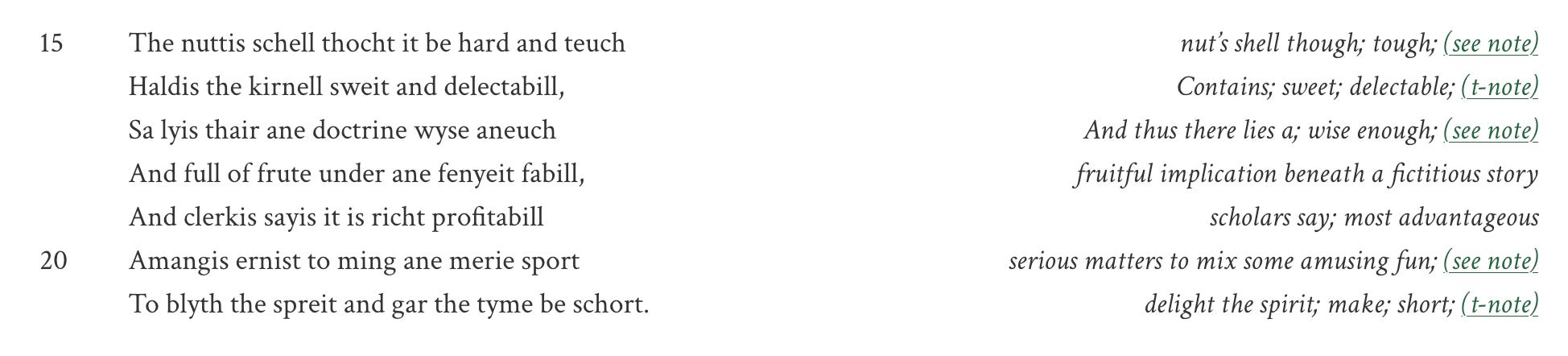
Henryson’s Fables may look hard and teuch — that is, tough — on the outside, but they hold a kirnell which is sueit and delectabill: they are adaptations of fables from Aesop and from the medieval tradition of stories of the trickster Reynard the fox, here called Lowrence. And they are merie sport — great fun — indeed.
You can see that each line of Henryson’s Fables is much more thoroughly glossed than Sir Orfeo was.
Often whole phrases need to be glossed into modern English. Nevertheless, the text is accessible in the original and you can actually start to learn these historical forms of Scots as a reader of Modern English with nothing more than a quick visit to a website.4
And if you’ve already read some Middle English, you’ll recognize some words — clerkis ‘scholars’ is a Scots spelling of the word clerkes you read in Sir Orfeo. The more you read, the easier it gets.
The starter pack
Here are three more poems to fill out the starter pack, and one bonus. Each of these comes in a great glossed edition, but is still an enjoyable text to read in its own right.
If you’re dreaming of Chaucer or Gawain, they’re not in METS. But get some experience with Middle English using the METS texts first, and you’ll find the rest so much the easier when the time comes to read them.
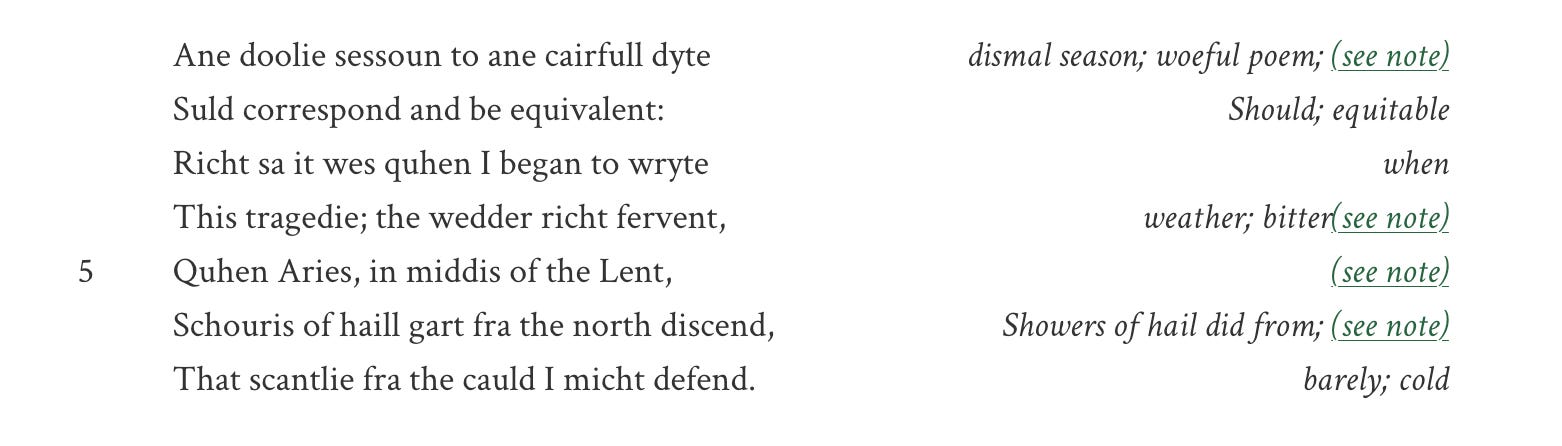
The Testament of Cresseid
This is a poem written in Middle Scots by Robert Henryson. He was one of a group of 15th-century poets called the Scots makars, literally, ‘makers’, a word which came to mean ‘poets’ just as the Greek word ποιητής poiētḗs ‘maker’ did.5
These Scots makars absolutely loved Chaucer. The Testament of Cresseid is a kind of fanfiction sequel to Chaucer’s Troilus and Criseyde, the tragic story of two lovers during the Trojan War.
Henryson manages to make the ending even more depressing than Chaucer’s original. Read it here.
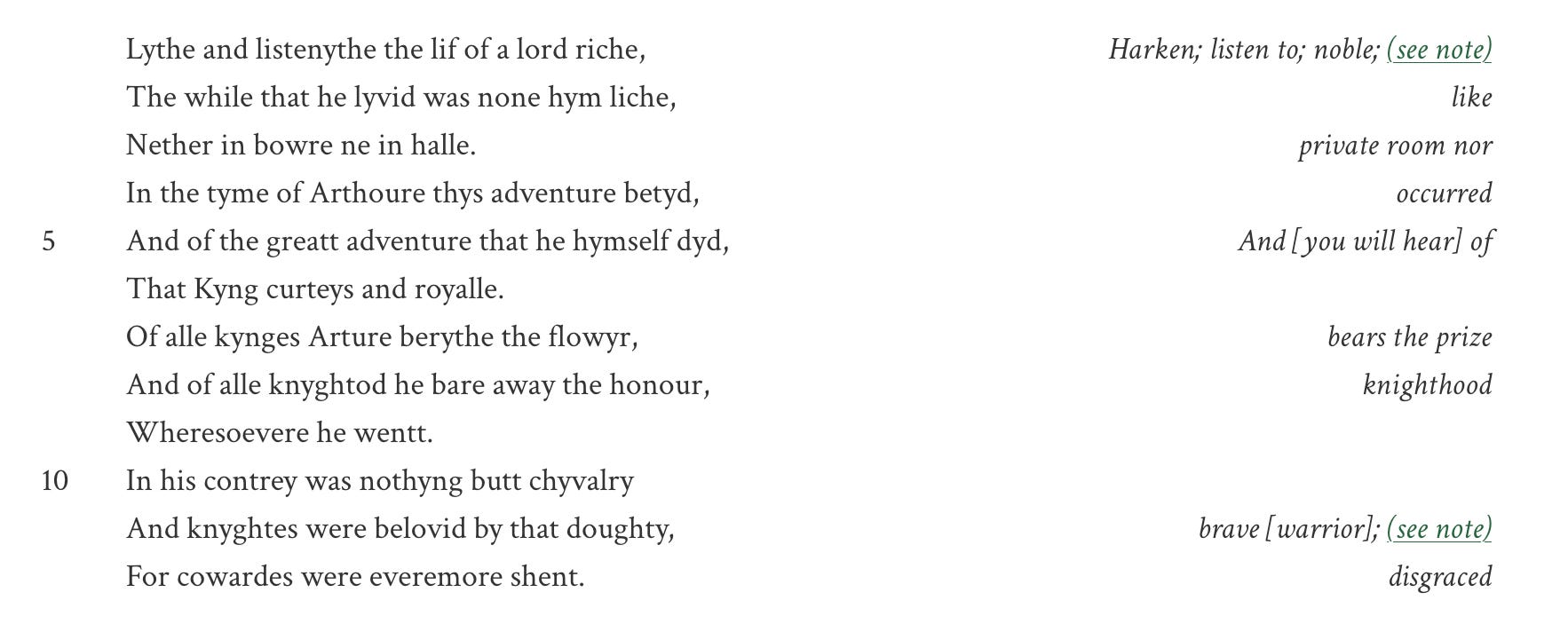
The Wedding of Sir Gawain and Dame Ragnelle
In this poem Sir Gawain gets to appear in a comedy. Like Sir Gawain and the Green Knight, it includes another challenge.
King Arthur is given a year to come up with an answer to a difficult question: whate wemen love best? (91) A hideous woman, Dame Ragnelle, agrees to help, on the condition that she be allowed to marry the flawless Gawain. Slightly bawdy hilarity ensues. Read it here.
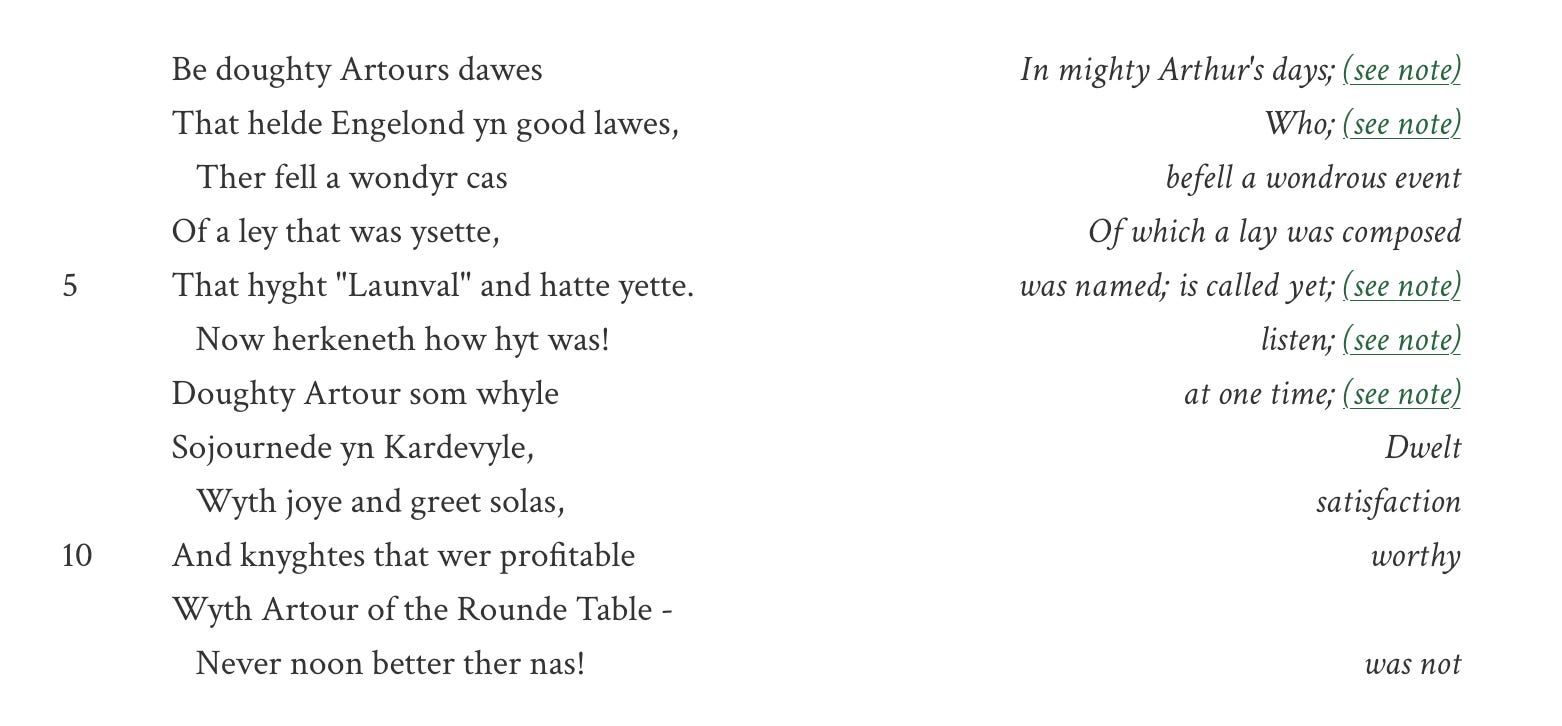
Sir Launfal
Here we have another Arthurian tale, but this one is more fantastical.
Sir Launfal, one of Arthur’s knights, falls out of favour at court and into poverty. He’s rescued by a fairy princess who showers him with wealth on one condition: that he keep her a secret. Of course he can’t — you know how these kinds of stories go. Read it here.
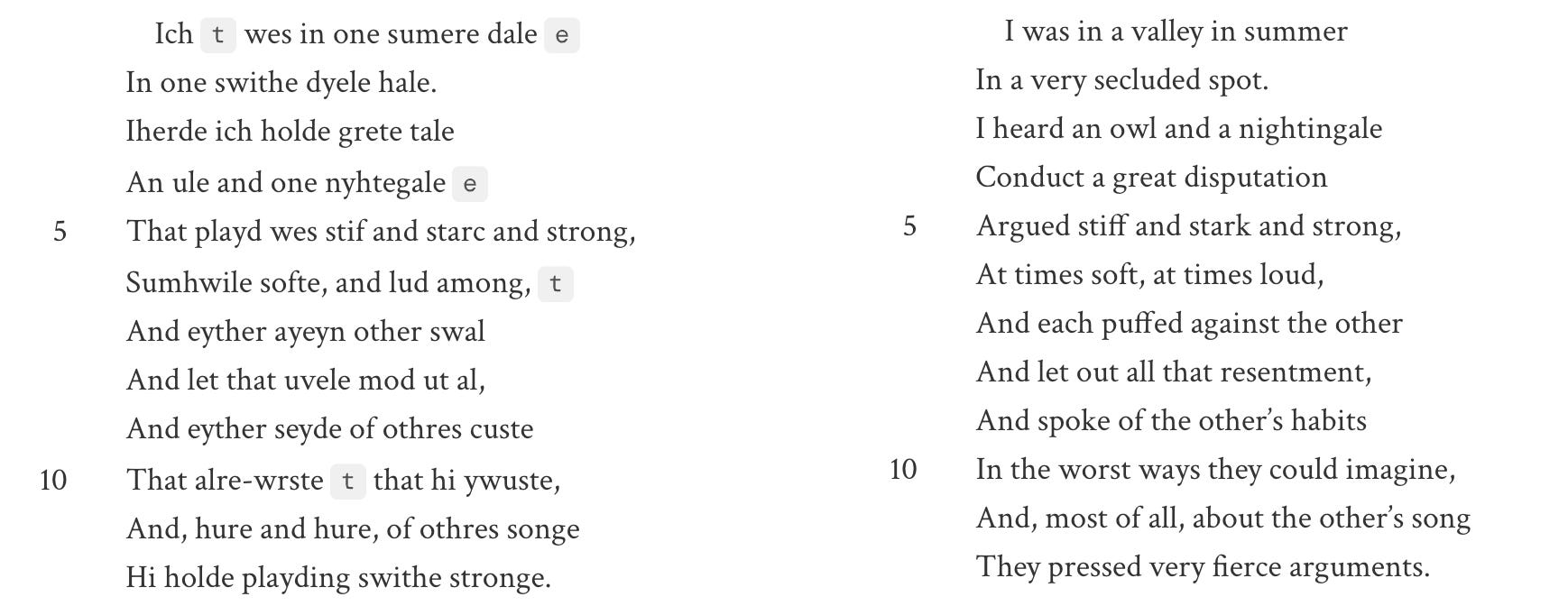
The Owl and the Nightingale
This text is a bonus. It is very early Middle English indeed, from around 1200.
Because this text is older, it comes with a translation rather than glosses. But it’s well worth the read, because it is hilarious.
It’s a comic debate poem in which two birds go after each other with increasingly petty insults. They fight over their singing, their usefulness, their morals, and who, in the end, is the bigger disgrace to birdkind. Read it here.
These are just a few of the treasures awaiting you in the library you didn’t know you had. And, since it’s summertime (in the northern hemisphere at least), any of these poems would be just the thing to take with you on a trip to the beach.
The website looks great on a tablet, though the more heavily glossed texts will require landscape mode. Or, if you prefer the hard-copy experience, there’s a button on each of the pages that allows you to download a beautifully typeset PDF. Print it out and take it to the beach, to enjoy alongside a drink with one of those little umbrellas in it.
References
Fein, Susanna, ed. (2022). The Owl and the Nightingale and the English Poems of Oxford, Jesus College, MS 29 (II).
Hahn, Thomas, ed. (1995). Sir Gawain: Eleven Romances and Tales.
Kindrick, Robert L., ed. (1997). The Poems of Robert Henryson.
Laskaya, Anne, and Eve Salisbury, eds. (1995). The Middle English Breton Lays.
Middle English Texts Series (METS). https://metseditions.org
You may have heard — or uttered — a phrase like That’ll learn him, meaning that’ll teach him. This is a survival of this older usage of learn which we see in Middle English.
Published by the Teaching Association for Medieval Studies, aka TEAMS. These people have good acronym game.
And a variety of other languages besides.
One day I will do a more thorough introduction to Early and Middle Scots, including a pronunciation guide.
It’s unclear whether the Scots word makar was applied to poets based on how the equivalent Greek term ποιητής poiētḗs ‘maker’ became our word poet, or whether the two were simply parallel developments. I think they were likely parallel developments, because maker was used to mean ‘poet’ in 14th-century Middle English, before much Greek knowledge had ever reached England.
How did I not know about the METS resource?! I took a Chaucer/Middle English class in university and haven't gone back since; which is a shame. Might pick it up again, and dust off the Old English! Great article.
This is fascinating…and so tempting to dive into. Thank you.