

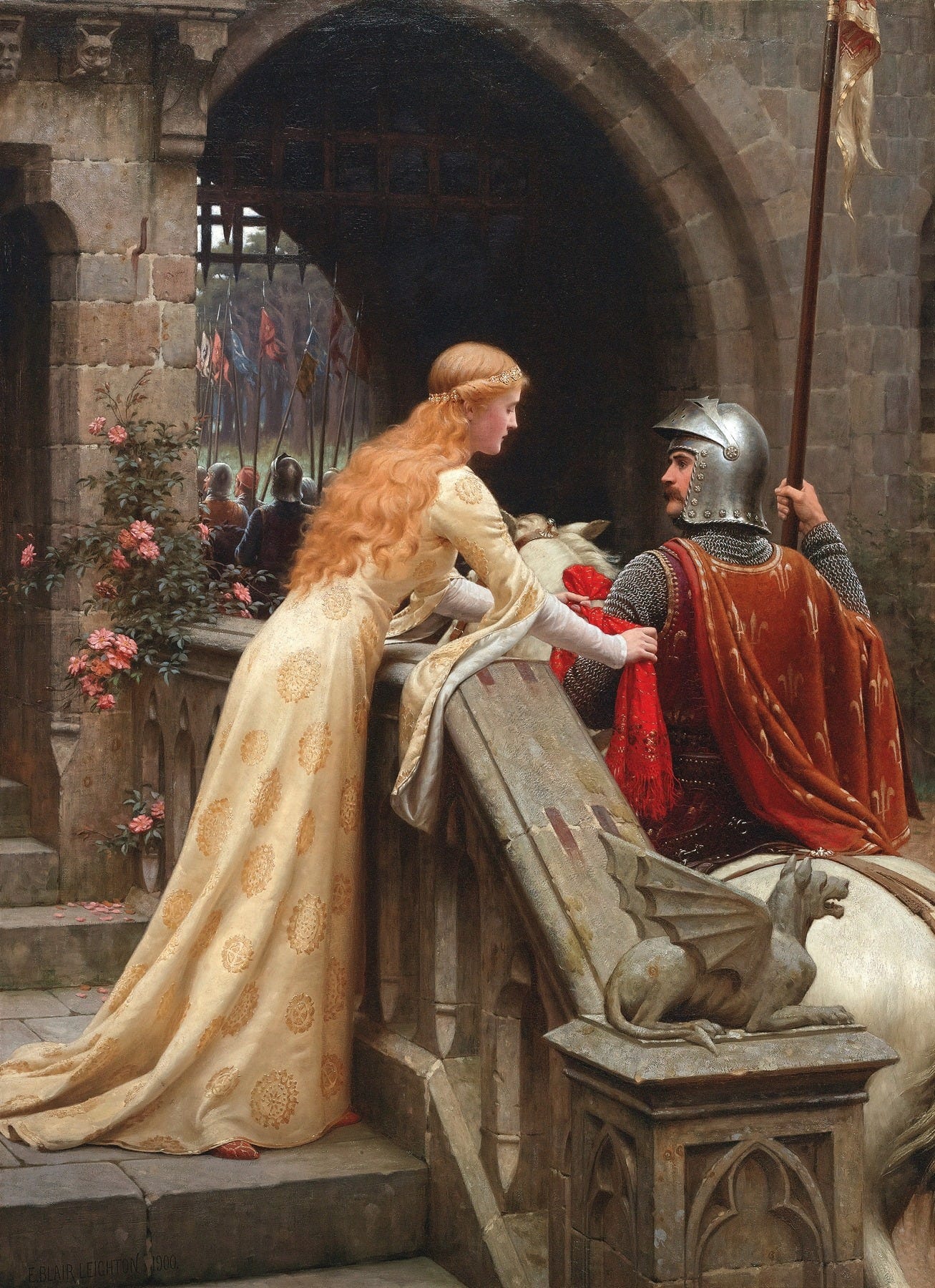
It was a good feast. Tournaments in the mornings, food and drink through the afternoons, and dancing at night for anyone who still had energy left to stand.
The great hall at Camelot was warm and bright and full of beautiful people who fully expected to live forever.
Arthur wouldn’t eat, of course. He had a rule. He wouldn’t touch his food until someone brought him “a marvel.” A wonder. Something worthy of a king’s attention. This is the kind of indulgence you could get away with when your knights were winning every war and none of them yet had the poor taste to die on you.
Then the door swung open. Smashed is actually the better word. It was hanging from one hinge.
A man rode into the hall on a horse.
The man was green.
Not green like someone who’d been sick. Not even like someone who’d taken a roll in the grass. Green like nothing you’d see in nature. Green skin, green hair, green beard, green clothes. Even his horse was green.
He filled the doorway the way a spring flood fills a river valley. In one fist he had a bough of holly. In the other he had the kind of axe that had no business being carried by just one man.
“Let’s play a game,” he said. “Any one of you may swing this axe. All I ask is that you come find me in a year’s time and let me return the favour.”
The hall went quiet, each of the revellers desperately working out exactly how far the exits were.
All but Arthur, who reached for the axe, of course. The sort of thing you’d expect from a man who pulls swords from stones. But Gawain — the youngest at the table, not to mention the most courteous — stood up first and walked over. Arthur sat down.
You can say this for Gawain: the blow was a clean one. The green man’s head came off in one swing. It hit the floor with a wet crack. Then the courtiers, being the flower of British chivalry, started kicking it around the hall like children with a pig’s bladder.
They were so busy with their game that they didn’t notice that the body hadn’t dropped when its head came off. Instead, it walked over to where its head had been kicked to, bent down, and picked it up, holding it by the hair. That stopped the game.
The eyes moved. The mouth opened.
“Remember your promise, Gawain,” the green head said. “One year.”
Then he tucked his head under his arm, climbed back on his green horse, and rode back out through the smashed up doorway.
The feast went on. Now, at last, Arthur could eat.
This is a retelling of the opening scene of Sir Gawain and the Green Knight, possibly the strangest story from the vast collection of Arthurian legends. This spring, we’re going to read the original together.
You’re reading The Dead Language Society, where 50,000+ readers explore the hidden history of the English language. I’m Colin Gorrie: PhD linguist and your guide through 1,500 years of linguistic history.
I publish every Wednesday. Paid subscribers get every issue, the full archive, and the content I’m most proud of: practical guides to reading historical texts yourself, honest takes on how language really works, and live book clubs where we read texts like Beowulf and (up next!) Sir Gawain and the Green Knight.
The rest of the story
A year passes. Gawain rides north to keep his promise to the Green Knight. The journey is one of the poem’s great set-pieces: wolves, wild country, and freezing rain.
He sleeps in his armour. He fights serpents, wild men, and giants who come down from the high fells to torment him. He nearly dies on more than one occasion.
On Christmas Eve, half-frozen, he prays to the Virgin Mary, and a castle appears through the trees.
The lord of the castle is a big, jovial, red-bearded man who offers Gawain hospitality and warmth. He tells Gawain that the Green Chapel (you’ll never guess who lives there) is nearby, but Gawain is early. He can stay at the castle until his appointment.
His host, however, proposes a second game: each day, the lord will go out hunting, and whatever he catches, he’ll give to Gawain. In return, Gawain must give the lord whatever he “wins” while staying at the castle.
What Gawain “wins” is the lord’s wife, who comes to his bedroom each morning and tries to seduce him.
Three days, three hunts for the king, three temptations for Gawain. Each evening they exchange their winnings. Gawain stays courteous — and nothing more — to the lady throughout. He gives the lord the kisses the lady gave him, without saying where they came from.
The poet tells the stories of each “hunt” in parallel, and each day the tension rises. Gawain resists, mostly. When he finally reaches the Green Chapel, there’s a big twist which I won’t spoil for you here. All I’ll say is that Gawain kept one small secret, and the Green Knight knows.
A tale from another England
Here’s what that journey through the frozen wilderness actually looks like on the page:
Mony klyf he ouerclambe in contrayez straunge.
Fer floten fro his frendez, fremedly he rydez.
At vche warþe oþer water þer þe wyʒe passed
He fonde a foo hym byfore, bot ferly hit were,
And þat so foule and so felle þat feʒt hym byhode.
So mony meruayl bi mount þer þe mon fyndez
Hit were to tore for to telle of þe tenþe dole.
Sumwhyle wyth wormez he werrez and with wolves als,
Sumwhile wyth wodwos þat woned in þe knarrez,
Boþe wyth bullez and berez, and borez oþerquyle,
At etaynez þat hym anelede of þe heʒe felle.
Nade he ben duʒty and dryʒe and Dryʒtyn had serued,
Douteles he hade ben ded and dreped ful ofte.
(713–725)
Since this is the English of the late 14th century, it needs a bit of translation.
Here’s Marie Borroff’s (1967) version:
Many a cliff must he climb in country wild;
Far off from all his friends, forlorn must he ride;
At each strand or stream where the stalwart passed
‘Twere a marvel if he met not some monstrous foe,
And that so fierce and forbidding that fight he must.
So many were the wonders he wandered among
That to tell but the tenth part would tax my wits.
Now with serpents he wars, now with savage wolves,
Now with wild men of the woods, that watched from the rocks,
Both with bulls and with bears, and with boars besides,
And giants that came gibbering from the jagged steeps.
Had he not borne himself bravely, and been on God’s side,
He had met with many mishaps and mortal harms.
Even if you’re used to reading Chaucer — who was a rough contemporary of the Gawain poet — this language can be hard going. Both are written in what scholars call Middle English, the period of the English language corresponding to the latter half of the Middle Ages.
But Chaucer was a Londoner, so his writing is relatively accessible to readers of Modern English, which descends from the speech of late medieval Londoners.
Gawain, on the other hand, is written in a Northwest Midlands dialect. The dialectologist Angus McIntosh was even able to localize the language of the manuscript itself to a small area of south-east Cheshire or north-east Staffordshire.1 It’s a kind of English so different from the one spoken in London that Chaucer and his circle would likely have found Gawain difficult to read.2
In the 14th century, there was no single “English.” Local dialects differed from each other, just as they had done throughout the earlier history of the English language.
But the Middle English period is where that diversity of dialect is most apparent on the page. In Old English, most writing sought to imitate West Saxon speech. In Modern English, standardization based on the London dialect quickly took hold.
But, in between the two, people wrote much more as they spoke, wherever they were from. This makes Middle English challenging to learn to read — it’s not just a single language — but it’s also part of the fun.
French indoors, Norse outdoors
That dialectal variety shows up most clearly in vocabulary. The Gawain poet’s word-hoard is roughly 60–70% Old English in origin, 22–30% Old French, and 8–10% Old Norse. That Norse number may seem small, but it’s much higher than the rate of Norse words in Chaucer (2.1%) or Middle English more generally (3.74%).3
A recent etymological survey identified no fewer than 496 different words in the poem whose form, meaning, or usage shows some degree of influence from Old Norse.4
Although many of these examples are ambiguous (Old English and Old Norse were so similar that a clean separation is often impossible), even a conservative count runs to over a hundred clearly Norse-derived words.
For a poem whose vocabulary runs to around 2,650 distinct words, that is a lot of Norse.5
There’s a lot of French too: about 28% of the words in the poem have French origin, although some, such as co(u)rt ‘court’ or laumpe ‘lamp’, had likely been in the English language long enough that they had ceased to feel foreign. But many others were more recent additions to the language.
Conspicuously French words tend to cluster in certain scenes within the poem. When Gawain is at the castle, being tested by the lady, their speech is dense with French. They talk of plesaunce ‘pleasure,’ prys ‘excellence,’ drury ‘love,’ and walour ‘valour.’
For example, in the following line, spoken by the lady, every content word is of French origin. English has supplied only the grammatical glue:
to þe plesaunce of your prys, hit were a pure ioye (1245–1247)
‘[I would gladly aspire] to the pleasure of your excellence; it would be a pure joy’.
When the Green Knight speaks, however, French is almost nowhere to be heard. And when, as we saw above, Gawain rides through the frozen landscape, the poet largely turns to native English vocabulary, albeit a Norse-inflected version: felle ‘mountain’ (from Old Norse fjall), dryʒe ‘strong; patient’ (from Old Norse drjúgr), dreped ‘killed’ (from Old Norse drepa ‘to kill’).
The poem sets court and culture against nature, and its representative, the Green Knight. The indoor world is adorned with French vocabulary; the outdoors is distinctly Germanic.
A poetic throwback
The verse form is part of the story too. Unlike most Middle English poetry — including The Canterbury Tales — Gawain doesn’t rhyme. Or, at least, most of it doesn’t rhyme.
Most lines of the poem alliterate in the old Germanic way: the stressed syllables in each line begin with the same sound, much as they did in Old English poetry centuries earlier. (If you want a fuller explanation of how alliterative verse works, I wrote about alliterative verse in a previous article.)
But the Gawain poet adds a twist. The poem is divided into stanzas, and each stanza ends with a short rhymed section called the bob-and-wheel. Here’s how the wilderness ride stanza ends:
Þus in peryl and payne and plytes ful harde
Bi contray caryez þis knyʒt tyl Krystmasse Euen,
Alone.
Pe knyʒt wel pat tyde
To Mary made his mone
Pat ho hym red to ryde
And wysse hym to sum wone. (733–739)
‘Thus in peril and pain and predicaments dire
He rides across country till Christmas Eve,
our knight.
And at that holy tide
He prays with all his might
That Mary may be his guide
Till a dwelling comes in sight.’ (Borroff trans.)
Notice how the first two lines are alliterative: peril, payne, plytes; contray, caryez, knyʒt, Krystmasse.
These lines represent the last part of the stanza’s main body. Then we get a very short line, with just one stress: Alone. That’s the bob. Following the bob we get the wheel: four short lines of rhyming verse.
The combination of the alliterative stanzas with the bob-and-wheel technique at the end brings to the poem a kind of balance between the earlier alliterative style of English verse and the later rhyming style. It’s not clear where the bob-and-wheel technique comes from, but the Gawain poet uses it to great effect.
The alliterative verse of Gawain isn’t exactly the same as what you find in Old English poems like Beowulf, but the two are clearly part of the same tradition.
Why Gawain is special
Alliterative verse is not the only thing Beowulf and Gawain have in common.
The manuscript very nearly didn’t survive at all. Like Beowulf, it was in the Cotton Library, which caught fire in 1731. The Gawain manuscript was unharmed, but, if that day had gone a little differently, we would have lost one of the finest pieces of English poetry ever written.
Just as we don’t know who the Beowulf poet was, the identity of the Gawain poet remains lost to history. And, like Beowulf, Sir Gawain and the Green Knight survives in a single manuscript, British Library MS Cotton Nero A.x, alongside three other poems: Pearl, Cleanness, and Patience. All are believed to have been written by the same author, who is sometimes also called the Pearl poet.
(We don’t know with certainty whether the Gawain poet was a man or a woman, but most scholars suspect that he was a man, so I’ll use “he” to describe him.)
Something new
The Gawain poet may not have lived in London, but he was as cosmopolitan and sophisticated as his counterparts in the capital. He knew Latin and French. Two of his other poems, Cleanness and Patience, are biblical paraphrases that show a familiarity with theology.
And the material of Gawain itself is steeped in French-language Arthurian romance. The beheading game traces back ultimately to an eighth-century Irish tale, but comes through French intermediaries.6 Similarly, the poet’s characterization of Gawain as the perfect courtier follows the French tradition, rather than the somewhat cruder English idea of Gawain.7
This is part of what makes reading Gawain so rewarding. You’re encountering the work of an author who had absorbed the high culture of his time — French romance, Latin theology — and reflected it out in a regional English and a native form of alliterative verse that London had long abandoned.
The kind of English poetry the Gawain poet wrote would soon be eclipsed by the style, and language, of Chaucer and his many imitators. Reading Gawain offers contemporary readers a glimpse of an English that might have been.
The invitation
Sir Gawain and the Green Knight was effectively lost to the literary world for centuries. It was only rediscovered in the 19th century, but it has been gathering fans ever since.
J. R. R. Tolkien himself co-edited the scholarly edition in 1925 and later translated it into Modern English. It’s even been made into a (weird and artistically daring) film starring Dev Patel.
To paraphrase the scholar Larry Benson, Gawain has more fans today than it ever had during the Middle Ages.8 And this spring, we’re going to join their number.
We’re reading Sir Gawain and the Green Knight together in four sessions on Substack Live. The poem naturally divides into four parts called fitts, so we’ll read one fitt per session.
Since we’re doing this on Substack Live, if you can’t make it at the time of the event, you’ll be able to watch the replay after.
When are we doing this?
Session 1: Tuesday, May 5, 11:00am–12:00pm Eastern Time. Fitt 1.
Session 2: Tuesday, May 19, 11:00am–12:00pm Eastern Time. Fitt 2.
Session 3: Tuesday, June 2, 11:00am–12:00pm Eastern Time. Fitt 3.
Session 4: Tuesday, June 16, 11:00am–12:00pm Eastern Time. Fitt 4.
Which edition to get?
We’ll read primarily in translation, using Simon Armitage’s translation (Norton, 2007). Like Heaney’s Beowulf, this is a poet translating a poet. It’s the most accessible translation to get started with. The alliterative feel of the original comes through without lapsing into obscurity.
But we will be dipping into the Middle English original often: this is the Dead Language Society, after all. At least some of the Armitage editions have the Middle English on the facing page. Get one of those if you can.
We’ll focus on the language, of course, but also on the storytelling, the structure, and the way the poem yields more every time you read it.
The book club is a benefit for paid subscribers. If you’d like to take part, you can upgrade your subscription here. You’ll also get access to the full archive of members’ only posts:
We began today by reading about a king who refused to eat until someone brought him a marvel.
What the Gawain poet left us is exactly that: a poem written in an English that London would soon eclipse, preserved in a single manuscript that nearly burned, and still, after six hundred years, well worth the wait. Bon appétit.
Works Cited
Benson, Larry (1965). Art and Tradition in Sir Gawain and the Green Knight.
Borroff, Marie (1967). Sir Gawain and the Green Knight: A New Verse Translation.
Brewer, Derek, ed. (1992). Sir Gawain and the Green Knight: Sources and Analogues. 2e.
Brewer, Derek and Jonathan Gibson (1997). A Companion to the Gawain-Poet.
Dance, Richard (2018). Words derived from Old Norse in Sir Gawain and the Green Knight: An etymological survey. Transactions of the Philological Society 116.
Görlach, Manfred (2020). The Linguistic History of English.
Tolkien, J. R. R. and E. V. Gordon, eds. (1925, rev. Norman Davis 1967). Sir Gawain and the Green Knight.
Volkonskaya, M. A. (2013). Loanwords and stylistics: on the Gallicisms in Sir Gawain and the Green Knight. ESUKA – JEFUL 2013(4–2): 145–156
Tolkien and Gordon (1925, rev. Davis 1967). McIntosh’s dialect localisation is cited in the introduction: the language “can only fit with reasonable propriety in” a very small area of the Northwest Midlands.
Brewer and Gibson (1997). “Chaucer and Langland would have found the Gawain-poet’s dialect difficult” (6). Görlach (2020) concurs: the Gawain poet’s dialect “was difficult for” southern readers (13).
Brewer and Gibson (1997).
Dance (2018).
Total word count from Volkonskaya (2013: 147).
The earliest known source of the beheading episode is in the Old Irish Fled Bricrenn (Bricriu’s Feast). For the sources and analogues of Gawain, see Brewer (1992).
Gawain was a popular character in English romances, but the typical English version of Gawain was far from the paragon of courtly virtue we find in Sir Gawain and the Green Knight or its French forebears. Instead, the English Gawain is as known for the rhyming vices of treachery and lechery as for his courtesy.
Benson (1965: vii): “Indeed, if such comparisons are possible, Sir Gawain is more widely appreciated today than it was in the Middle Ages.”
I live in the North-West of England — not very far from the Cheshire / Staffordshire border, in fact — and for those not familiar with this part of the world, you may be interested to know that Northern English accents and dialects are still to this day noticeably different from those in London and the South. (Although not as different now as they were once.) There are definitely Northern dialect words that you don't hear anywhere else — and one of them is "fell" for "hill / mountain", which is of course that Old Norse word "fjall" in modern form! It's not used in Cheshire (we don't have many big hills), nor in the Peak District to the east, but hills are definitely fells further north in Lancashire, Yorkshire, and most of all in Cumbria / the English Lake District. I spend a lot of time in the latter and I can say for sure, up there you always go walking up in the fells, never the "hills"!
Not sure I will be able to join in the reading group, but this is definitely a piece of Middle English literature I should get to know better, especially now I know the author came from near where I now live!
YESSSS I love Gawain so much. Getting my teeth into pearl next and it’s a very different beast!