

Weird is one of the most commonly used words in the English language. Chances are, the word will pass through your lips (or be tapped out by your fingers) today.
You’ll use it when you need to describe something out of the ordinary: a weird coincidence, a weird smell in the fridge, or — heavens forfend! — that weird guy at the office.
We say weird all the time for the little everyday oddities we encounter.
But weird wasn’t always such a casual word. A thousand years ago, it was one of the heaviest words in the English language: the ancestor of weird was the Old English word wyrd, which meant ‘fate’ or ‘destiny’
Wyrd haunts Old English poetry. It shows up in the bleakest and most fateful moments of poems like The Wanderer and Beowulf.
The Beowulf poet puts it on the lips of the hero of his poem, who mentions wyrd after detailing his requests for what should happen if he perishes in battle: don’t worry about burying him, send his armour back to his uncle. Then comes wyrd, in what sounds like a proverb:
Gǣð ā wyrd swa hīo sċel.
‘Wyrd always goes as it must’ (Beowulf 455b)
Or, as the narrator of The Wanderer puts it, in the middle of an account of how he’s forced to sail the sea, utterly alone:
Wyrd bið ful ārǣd.
‘Wyrd is totally inexorable.’ (Wanderer 5b)1
Wyrd comes from the same root as the verb weorþan, pronounced roughly WEAR-than, which meant ‘to happen’ or ‘become’.
So wyrd is ‘that which happens’.
Poets praised above all the man who could face whatever happens — to face wyrd — “without flinching”.2
So how did a word for the inexorable logic of the universe end up describing things as mundane as that rather peculiar smell in your fridge?
The answer is, oddly, a literary one, and one in which destiny itself seems to have taken a hand: but for the choices of two or three people, we might not have had the word weird in English at all.
You’re reading The Dead Language Society, where 65,000+ readers explore the hidden history of the English language. I’m Colin Gorrie: PhD linguist and your guide through 1,500 years of linguistic history.
I publish every Wednesday. Paid subscribers get every issue, the full archive, and my most in-depth work, including longer essays that trace the mysteries of English to their source, practical guides to reading historical texts yourself, and live book clubs where we read texts like Beowulf and Sir Gawain and the Green Knight.
Wyrd happens
The story of wyrd’s transformation into weird begins in the later Middle Ages, in the period we call Middle English (AD 1100–1450).
The dividing line between Old English and Middle English is the Norman Conquest of 1066. The Normans, who spoke a form of French, gained political power in England, and for a while, French displaced English as the language of prestige among the higher classes of society.
Eventually, however, even the nobility came to adopt English, but they brought many of their French words with them when they did. As a result, French words started pouring into the English language around AD 1250.
These included words that meant the same thing as wyrd, namely, fortune and destiny. They were later joined by the Latin word fate. Once these new, fancy-sounding French and Latin words had entered the language in the 13th and 14th centuries, the native English wyrd became superfluous.
As a result, wyrd is missing from the Middle English record, at least, in the south of the English-speaking world. It was in the north, particularly Scotland (the really far north!) that wyrd survived. There, in the Scots language, it came to be spelled weird rather than wyrd.
These Scots origins are the reason weird is spelled so, well, weirdly. After all, it is one of the classic exceptions to the rule “i before e, except after c”.
Given its pronunciation, we would expect it to be spelled with ee, ie, or ea, to match how the ee-sound is written in weed, field, or beard. But it’s not.
Weird is spelled weirdly because it follows the rules of Scots, not English.
Featuring the latest advances in necromanticall science
Like Old English wyrd, the Scots weird meant ‘fate’ or ‘destiny’, as in this quotation from the 14th-century Scots poem The Brus:
Bot Werd that to the end ay driffis // The varldis thingis
‘But Fate that to the end always drives the world’s affairs’ (The Brus, 4.148–149)
Just as fate was often personified in classical mythology, so too could weird refer to the personified agents of destiny.
The classical idea was of three supernatural sisters — in Greek, they were called the Moirai: Atropos, Clotho, and Lachesis — who measured out the thread of each person’s destiny, and cut it where fate decreed. The Romans had an equivalent trio called the Parcae.
Norse mythology also records the Nornir, or Norns, who had a similar function to that of the Moirai and Parcae. Their names were Urðr, Verðandi, and Skuld. The name Urðr is simply the Old Norse equivalent of wyrd.3
Scots authors used the phrase weird sisters to refer to the Fates of classical mythology:
The thre sisteris fatall callit Cloto, Latis & Antropus thre werd sisteris
‘The three fateful sisters called Cloto, Latis, and Antropus, three weird sisters’ (1515; The Asloan Manuscript)4
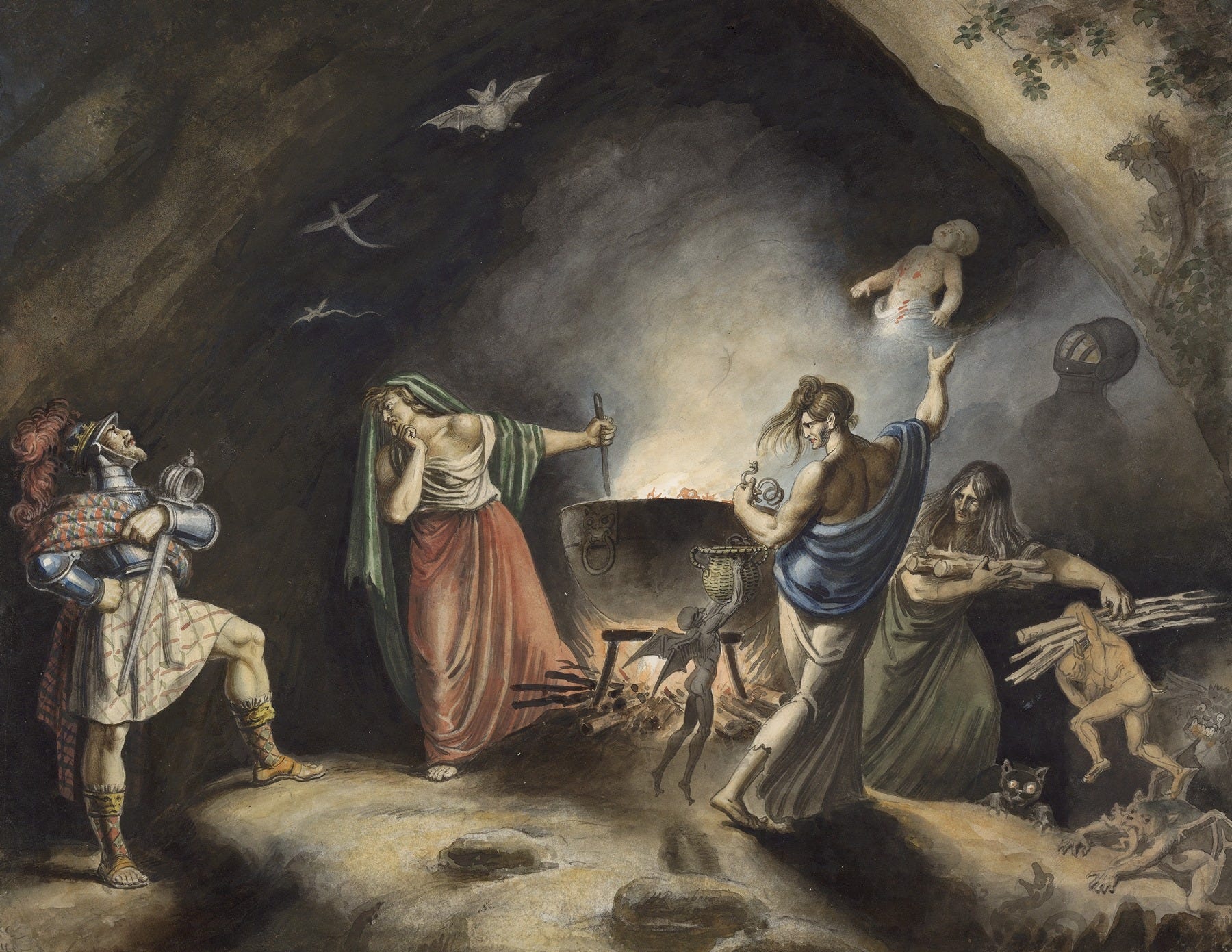
Later, the term weird sisters was applied to the three women in the story of Macbeth who prophesied his rise to the throne. When Shakespeare tells the story, these are three witches. But Shakespeare isn’t the only one who told this story, nor was he the first to do so.
Shakespeare’s source was a work called Holinshed’s Chronicles of England, Scotland, and Ireland, published in two editions in the late 16th century.
In Holinshed’s account, Macbeth encounters “three women in strange and wild apparell, resembling creatures of elder world”. After they make their prophecies, Holinshed reports:
afterwards the common opinion was, that these women were either the weird sisters, that is (as ye would say) the goddesses of destinie, or else some nymphs or feiries, indued with knowledge of prophesie by their necromanticall science, bicause euerie thing came to passe as they had spoken.5
Holinshed helpfully glossed the term weird sisters for his English-speaking audience as goddesses of destinie. When Shakespeare took this scene into Macbeth, he kept the phrase weird sisters but left out the explanation.
In the First Folio text of Macbeth, printed 17 years after the play was first performed, the word is spelled weyward or weyard rather than weird, for example:
The weyward Sisters, hand in hand (Macbeth 1.3.30)
The use of weyward for weird is usually thought of as a mistake by one of the compositors — the typesetters who assembled the printed pages — of the First Folio.
Weird was not a common English word at the time, which is why Holinshed defined it for his readers. Weyward, on the other hand, standing for wayward ‘having gone astray’, was a much more common word, one often used by Shakespeare.6
The mistaken word wayward is distantly related to weird, or at least the -ward portion is. Both -ward and weird come from the same ancient root, one that meant ‘to turn’.7
Just as fate — weird — is the way things ‘turn out’, someone going homeward is ‘turning home’.
The obscurity of weird was what made it so prone to miscopying. Some later folio editions of Shakespeare even changed it to wizard!
In modern editions of Macbeth, however, the spelling of the phrase has been normalized to weird sisters, often spelled weïrd to indicate that the word must be pronounced with two syllables rather than one.
This change was made by Lewis Theobald (1688–1744), the first rigorous textual critic of Shakespeare’s works. He did so based on how weird was used in Holinshed, Shakespeare’s likely source for Macbeth.8
Once weird was established in subsequent editions of Macbeth, it stuck. In fact, weird has done more than stick. It has downright flourished in the English language since then.
But the same obscurity that had troubled the compositors of the First Folio meant the meaning of weird was a blank slate upon which those hearing it could project whatever they wanted. But many more changes were in store for weird.
The turns of fate
For many years, the only place most English speakers ever saw the word weird was in the phrase weird sisters or weird women in the play Macbeth.
The word weird shows up six times in Macbeth, and in no case is it clear from the context alone what it means.9 Weird simply named the three women who foretold that Macbeth would become king.
This gave listeners and readers latitude to ascribe to the word weird whatever meaning seemed appropriate given the context.
It wasn’t even clear that weird was originally a noun: the weird of weird sisters could just as easily have been an adjective. If it were an adjective, what could it mean?
The weird sisters were three strange, uncanny, supernatural women telling the future. Perhaps weird simply meant ‘strange’, ‘uncanny’, or ‘supernatural’.
This appears to be what enough people thought to change the meaning of the word. Uses of weird simply meaning ‘eerie’ or ‘supernatural’ — with no connection with the weird sisters of Macbeth — began in the early 19th century with the Romantic writers.10 Shelley, for example, was fond of using weird in this way.
Some said I was a fiend from my weird cave,
Who had stolen human shape (Laon and Cythna 9.8; 1817)
In lone and silent hours,
When night makes a weird sound of its own stillness. (Alastor 29–30; 1816)
Almost as soon as weird began circulating outside of Macbeth, its meaning broadened too, from ‘eerie’ and ‘uncanny’ to ‘odd’ or ‘unusual’. Dickens, for example, used weird simply to mean ‘odd’:
He was a man with a weird belief in him that no one could count the stones of Stonehenge twice, and make the same number of them. (Holly-tree Inn: Guest in Household Words; 1855)
This broader usage is the one that has exploded in popularity, especially in the second half of the twentieth century.
The Oxford English Dictionary reports the frequency of the adjective weird rising from 2.3/million words in 1960 to 6.1/million words in 2010.
These frequencies are computed from Google Books; when the internet is used instead, we see that weird is even more frequent still: the OED’s online corpus, covering 2017–2025, shows the frequency of weird hovering between 15–17/million words.
That makes weird one of the most common words in the English language. Quite the journey from a Scots word so obscure that people misunderstood its meaning on hearing it!
Weird is now a fixture of the contemporary English language, but its destiny hinged on the decisions of individuals: if Holinshed had not written weird sisters into the story of Macbeth, if Shakespeare had not found that story interesting enough to turn into a play, if Theobald had not emended weyward to weird, if the Romantic poets hadn’t found the word just perfect for expressing an uncanny mood, we wouldn’t have weird today.
And I’d have had to give this “Weird Word” series an entirely different name.
Works Cited
Scots quotations have been drawn from A Dictionary of the Older Scottish Tongue, English quotations from the Oxford English Dictionary.
Barbour, John (1997). The Bruce. Ed. A. A. M. Duncan.
Bek-Pedersen, Karen (2022). ‘Macbeth and the “Weird Sisters” – on Fates and Witches.’ Scottish Studies 39: 58–80.
Braunmuller, A. R. (ed.) (2008). Macbeth (The New Cambridge Shakespeare).
Craigie, W. A. (ed.) (1925). The Asloan Manuscript.
Dickens, Charles (1855). “The Holly-Tree: The Guest.” Household Words.
Fulk, R. D., Robert E. Bjork & John D. Niles (2008). Klaeber’s Beowulf. 4e.
Holinshed, Raphael (1587). Holinshed’s Chronicles of England, Scotland, and Ireland.
Shelley, Percy Bysshe (1816). Alastor, or The Spirit of Solitude.
Shelley, Percy Bysshe (1817). Laon and Cythna.
Oxford English Dictionary: weird n., weird adj., -ward suffix.
The meaning of ārǣd is up for debate; popular translations include ‘inexorable’, ‘relentless’, ‘resolute’, or even ‘wise’.
Fulk et al. (2008): lxxiii.
Verðandi ‘becoming’ is also from the same root as wyrd. As for Skuld ‘debt; obligation’, that’s another article.
The Asloan Manuscript. Craigie, ed. (1925): 324–325.
Holinshed (1587), Holinshed’s Chronicles of England, Scotland, and Ireland, Vol. II: The historie of Scotland, 170–1.
For much more on the weyward question, see Braunmuller (2008: 255–256). The other spelling in the First Folio, weyard, is a reasonable enough spelling for a pronunciation of weird drawn out into two syllables, which is what the metre requires.
This root is Proto-Indo-European *wert-, the same root that gave birth to the Latin verb vertere ‘to turn’, which English has in words like convert, invert, revert, etc.
Theobald is pronounced as if it were spelled Tibbald. Not every scholar agrees with Theobald’s change. Bek-Pedersen (2022), for instance, suspects the weyward spelling may have been deliberate.
In the New Cambridge Macbeth, weird appears at 1.3.30, 1.5.7, 2.1.20, 3.1.2, 3.4.133, 4.1.134.
Weird was far from the only Scots word that gained currency in English through the Romantic movement.
I break this word down even further and attempt to exegesis its relation to the middle Hekat scene.
Wyrd is also cognate with old norse "Urd/Urdr", meaning "past, fate" and is one of the names of the Norns, the divine fate carvers akin to the Moirai and Parcae, hence why the word fate is related to these fortune telling witches. The original folio also has different spellings in the beginning acts versus the latter ones, with the phrase "wayward son" as the hinge of the play. Modern scholars say it is just different editors with different spelling preferences but I think that dodges some of the interesting aspects of not only the word but the play too.
'Wayward' was used in exactly this sense in Nahum Tate's libretto for Henry Purcell's 'Dido and Aeneas' first performed in 1689.
Enter the Sorceress:
Wayward sisters, you that fright
The lonely traveller by night,
Who like dismal ravens crying
Beat the windows of the dying,
Appear at my call, and share in the fame
Of a mischief shall make all Carthage flame.
Appear, appear!
Can we assume this use of wayward was directly influenced by the 1623 First Folio?