

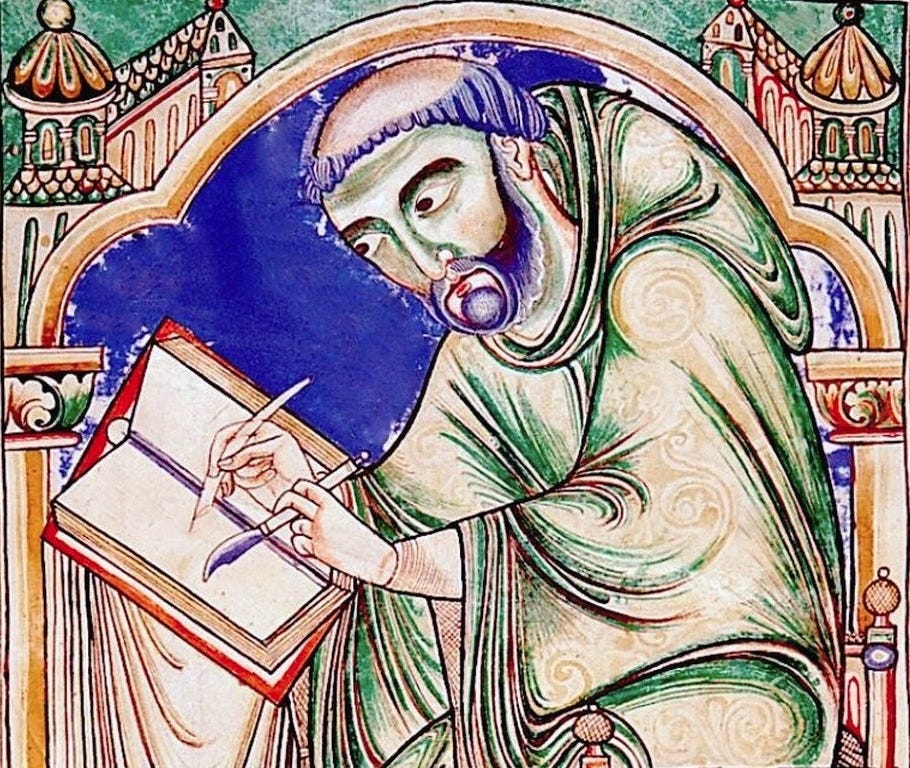
AD 1155, Peterborough, Cambridgeshire.
The light of a late winter afternoon reaches feebly through a cloister window. The light is thin, but it is enough to illuminate the work of the elderly monk as he writes.
He sits alone. Everything here is new: a new abbot at Peterborough, a new king in England, even the room he sits in smells of fresh lime mortar. His hands stiffen and ache with the chill of the winter wind blowing in from the garth.
The work must be done today. He is old, and Abbot William has little patience for old things. He will certainly not allow an old monk to spend ink or parchment, much less the time of a skilled scribe, on what, for the abbot, is one man’s vain fancy: writing in English.
But is it vain to record the nineteen years of war they have recently endured? Is it merely one man’s fancy to want to continue the chronicle handed down by those who came before through war, fire, and conquest?
I ne can ne I ne mai tellen alle þe wunder ne alle þe pines ðat hi diden wrecce men on þis land
‘I do not know how, nor am I able, to tell all the outrages or all the suffering that they inflicted on the wretched people in this land.’1
He will finish it today and have done with it, even if — even though — he is a poor writer in English. He has tried his best to write properly, the way the chronicle began. Nevertheless, his task is too great to be cowed. He thinks of the words of St Paul: But though I be rude in speech…
He writes on over the hours, the lines above browning and deepening as he writes the lines below. His back hurts, his hand aches, and his eyes squint in the light, which has now almost gone completely.
At last, his task is almost complete. In the final lines, he records the death of King Stephen and the end of the bad times:
Þa þe king was ded, þa was þe eorl beionde sæ; ⁊ ne durste nan man don oþer bute god for þe micel eie of him.
‘When the king was dead, the earl [Henry II] was overseas; but no one dared do anything but good for the great fear they had of him.’2
Like the passing of a sudden sickness, the wickedness departed from the land with the death of Stephen. There was now a new king. Perhaps this Henry will even be a good king. But that will be for some younger man to write about.
No younger man ever continued the Peterborough Chronicle, as this text is known to us today.
The entry for 1154, which described the end of Stephen’s reign and the beginning of the reign of Henry II, is the last entry in a chronicle whose first entries were compiled in the reign of King Alfred (871–899).
Copies of the Anglo-Saxon Chronicle, as we call the chronicle more generally, were kept, and kept up to date, in several locations in England. We know of nine today. The practice of keeping the chronicles up to date was gradually abandoned in various places around the time of the Norman Conquest, or shortly thereafter. The Peterborough copy kept the tradition alive the longest, but it too died out after the entry for the year 1154.
To linguists, the Peterborough Chronicle is the most interesting version of the Anglo-Saxon Chronicle because it spans what they consider two separate periods in the language’s history: the bulk of it is written in Old English, but the later continuations, such as the one I dramatized above, are written in early forms of Middle English.
To the scribes who wrote down the continuations, however, they probably didn’t seem like two different forms of the language. For these 12th-century monks, English was English. It’s just that people used to write a bit differently in the old days. Properly. What we see today as a break between two distinct periods, they likely saw as slow change, or, more likely still, degeneration.
Linguistically, at least, great changes are often imperceptible to those going through them. It makes you wonder: are we also at the end of an era without realizing it?
You’re reading The Dead Language Society, where 58,000+ readers explore the hidden history of the English language. I’m Colin Gorrie: PhD linguist and your guide through 1,500 years of linguistic history.
I publish every Wednesday. Paid subscribers get every issue, the full archive, and my most in-depth work, including longer essays that trace the mysteries of English to their source, practical guides to reading historical texts yourself, and live book clubs where we read texts like Beowulf and (currently) Sir Gawain and the Green Knight.
As modern as pleated collars
Like Caesar’s Gaul, the history of the English language is conventionally divided into three parts: Old, Middle, and Modern English.
Old English is said to have lasted from the Anglo-Saxon settlement (around AD 450) until the Norman Conquest (AD 1066), or soon thereafter: AD 1100 is a popular round number. After that, we had Middle English, which lasted until about AD 1450 or so, and, finally, Modern English continues the story into the present day.
As you may well imagine, there’s nothing magical about these dates. From the point of view of the language, things stayed basically the same between December 31, 1449 and January 1, 1450.
Language change doesn’t announce itself as a revolution. Instead, it shows up as complaints that kids say things differently (and wrong), or that old people speak strangely and embarrassingly. Or it appears as a slight cringe at the terminology employed in an old book you’re reading.
Within the three broad periods in the history of the English language, there were big differences between the language as it was at the beginning of a period and at its end. Ask anyone who’s read Shakespeare — written, ostensibly, in Modern English — just how much it can change.
Nevertheless, divisions have to be made somewhere, and the convention is to divide the history of English into these three periods — Old, Middle, and Modern, with boundaries at roughly these three points (AD 1100 and 1450).
But, at the risk of sounding like a two-year-old, why?
Why do we do this? Why three divisions and not five? Why divide them at AD 1100 and 1500, rather than 800 and 1700?
And why does Modern English last so long?
I could have sworn “Goldilocks” was one of his…
Not everyone accepts that the last five centuries of the English language belong under a single label.
For this reason, it’s very common to subdivide modern English into Early Modern English and Present-Day English (or Late Modern English), with a dividing line between them somewhere in the 18th century. I like 1700 as a round number. This gets us around the awkwardness of putting William Shakespeare in the same linguistic category as William Faulkner.3
But even so, Early and Late Modern English are usually treated as subdivisions of Modern English. Modern English, including both periods, is usually understood as the proper overarching category to set in opposition to Old and Middle English.
This schematic rule of three is not given by nature but has a particular birth date and a particular parent. The originator of this organizational scheme is none other than Jacob Grimm, a pioneer not only of the study of folklore but also of comparative linguistics.
In his 1848 work Geschichte der deutschen Sprache ‘History of the German Language’, Grimm split the history of the German language into three periods: Alt-, Mittel-, and Neuhochdeutsch, or Old, Middle, and New High German.
Grimm’s choice to split the German language in this way came not from the facts of the language’s history, but from a general belief he had in a Gesetz der Trilogie, a Law of Threes, which he saw as pervading nature and language.4
This compulsion to find threes everywhere you look seems to be a part of human nature. The philosopher Charles Sanders Peirce called it triadomany, a craze for threes. Grimm seems to have been particularly afflicted.5
Whatever the reason for its origin, the schema was soon applied to English by the philologist Henry Sweet, who also coined the term Old English, to replace the name Anglo-Saxon, which he considered barbarous.6
So before we can really ask when a period begins and ends, we have to notice that the familiar threefold frame for thinking about linguistic history is imposed upon that history rather than arising from it. We are still stuck in Jacob Grimm’s triadomany.
The three-part division works well enough for English, except when it doesn’t. The existence of Early Modern English as a category is a good example of this. Even Sweet, godfather of the triadomaniacal division of English into Old, Middle, and Modern, admitted subdivisions: three each in Old and Middle English, and two in Modern English.
But nevertheless, even if we are to accept the overall validity of the threefold division — as we more or less have to be, since everyone else does — we are still left with the problem of determining where the boundaries between the three periods are. Given that language change is continuous rather than discrete, is there ever truly a way to divide the periods of a language without lapsing into arbitrariness?
This is written in Extremely Late Old English
There are two categories of criteria for dividing periods in a language’s history: Internal criteria, that is, those arising from within developments in the language itself, and external criteria, those arising from factors in history writ large: wars, migrations, technological change, etc.
Linguists, being linguists, have occasionally tried to come up with exclusively internal criteria for the periodization of a language. Henry Sweet, perhaps in a fit of triadomaniacal inspiration, came up with one influential criterion, which has to do with word endings.
For Sweet, Old English is the period of full endings, Middle English is the period of levelled endings, and Modern English is the period of lost endings.
To show what he means by this, let’s take a look at the four words Sweet himself uses as examples: moon, sun, son, stones (in the plural).
When we trace these word forms back through Sweet’s three periods, they show us what he meant by full, levelled, and lost:
Old English: mōna, sunne, sunu, stānas
Middle English: mōne, sunne, sune, stǭnes
Modern English: moon, sun, son, stones (pronounced with no vowel in the ending)7
In Old English, the vowels in the endings of the four words are kept separate: a is distinguished from e, which is distinguished from u. I
n Middle English, all of these vowels are spelled e, and pronounced as schwa (the indistinct vowel in the first syllable of above). This is the levelling that Sweet considered so distinctive of Middle English: the vowels of different endings are pronounced the same.
In Modern English, all of the vowels in these endings have disappeared, leaving only the final -s to mark the plural stones. This is what Sweet means by lost endings.
Sweet also gave examples of authors whose work he considered to fall within each period. For Old English, which he divided into three subperiods: Alfred the Great (c. 849–899), Ælfric of Eynsham (c. 955–c. 1010), and Laȝamon (the late 12th- or early 13th-century author of the poem Brut).8
Unfortunately, Sweet’s internal criterion doesn’t quite work. As the linguist Roger Lass has pointed out, there is levelling of endings even in the work Sweet calls most typical of Early Old English, the works of Alfred the Great.
For example, in Alfred’s preface to the Old English translation of the Cura Pastoralis, fully 5% of the vowels in endings and other weak positions are spelled in a way that suggests the author had confused them with other vowels.9
The problem is that the process Sweet chose to demarcate the phases of English doesn’t line up cleanly with any of his stages. The levelling of endings began in Proto-Germanic and isn’t even complete today: many dialects of English still distinguish Rosa’s and roses, or proven and provin’. Does that mean we still speak Old English? No, it does not.
Even though Sweet’s internal criterion didn’t end up working, we still use his overall schema of Old, Middle, and Modern English. We don’t use Sweet’s exact dates anymore, but there is remarkable consistency in the dates we do use.
Almost everyone divides Old English from Middle English between 1050 and 1100, meaning that the later continuations to the Peterborough Chronicle are written in a different phase of the language than the chronicle’s main body. Likewise, the boundary between Middle and Modern English almost always falls between 1450 and 1500.
So where does this unanimity come from?
What have the Normans ever done for us?
The language itself doesn’t seem particularly keen on giving us clear guidance on when one phase begins and another one ends. So what most linguists and historians do today is use external criteria for determining the boundaries between stages in the history of a language.
These external criteria are political and technological events rather than sound laws. To divide Old from Middle English we have the most famous date in English history: 1066, the Norman conquest, an event whose consequences on the history of the English language cannot be understated — although they can be misdated. Or, if you’re the kind of person who likes a round number, you can use 1100 instead.10
The next great date is 1476, which often serves as the boundary between Middle and Modern English. This is the date of Caxton’s printing press, another event which would have dramatic effects on the course of linguistic history. A good date to use, then, unless you want to round up or down to an even half-century.
If, after all that splitting, you’re still in the mood to subdivide Modern English, 1776 is a good date to do it: this is the year of American independence, which first broke the political unity of English speakers in a dramatic way, and opened the door to multiple standard forms of the language.
For that reason, the Cambridge History of the English Language chose this date to divide its early modern and late modern volumes. Others have chosen 1650 or 1700. Whichever date gets us on the opposite side of Shakespeare seems to do the job well enough.
Of course, the problem of the falsely crisp cutoff remains, whatever date you choose. But at least the problem of arbitrariness is solved to a degree. Choosing an external criterion gives linguists and historians an escape hatch out of the difficulties that we have seen in Sweet’s attempt to find an internal criterion for dividing language periods.
So if we are comfortable with external criteria for dividing language stages, we’re confronted with a new question. Has anything as consequential as the Norman Conquest or the invention of the printing press happened lately?
Or, put another way, has Modern English (1450–) actually ended already without us knowing?
Some changes have wanished
We can only call an end to a period when we realize something has changed. It can only be done in retrospect.
Let’s accept, for the sake of argument, that 1776 marked the beginning of Late Modern English. When does it end? Have we experienced any great event since then with reverberating linguistic consequences?
Almost certainly.
The English-speaking world has been rather busy over the past 250 years. We’ve had, among other things, two world wars, the inventions of the telephone, the computer, and the internet, and the proliferation, through a sequence of colonialism and decolonization, of many independent countries where English is spoken.
All of these things have changed English. But have they changed it enough to make it useful to talk about a new phase in the history of the language?
We may try to look to histories of the English language for guidance, but they are of no help to us: they typically peter out around 1800. It’s not for a lack of evidence. After 1800, we have more than ever before. We even have audio!
And it’s not for a lack of things happening. Language is in a constant state of change; even as you read this there are multiple vowel shifts, each on the scale of the Great Vowel Shift, at work reshaping dialects of English. Maybe even your own!
But it’s hard to know which of these changes will end up spreading as you’re watching them happen. Some changes which seem of great importance today may end up as footnotes to linguistic history.
Did you know, for example, that there were varieties of speech in 19th-century England that interchanged v and w?11 If you’ve read Dickens, you know. This is Sam Weller’s accent from The Pickwick Papers, in which Dickens depicts Weller as saying things like avay instead of away, and circumwented for circumvented. This sound change never caught on, and, 150 years later, it’s been almost totally forgotten.
On the other hand, one slightly shifted vowel — say, an a that sounded too much like an e — could end up setting off the next Great Vowel Shift.
The reason no one tends to talk about anything after 1800 in the typical History of the English Language textbook is that we’re simply too close to the question to know with certainty what will matter.
And, when we zoom in even more to the present day, historical linguists tend to leave the question of language change in contemporary English to sociolinguists. The two have a relationship like the one historians have to journalists: just as journalists are said to write the first draft of history, sociolinguists capture variation in progress that future generations of historical linguists will write up in about two hundred years.
But, acknowledging the difficulties posed by our lack of perspective, we can still try to draw a line in the sand. The question is: where?
Of course, they would spell it Americanisation
If we’re going to split today’s English from Late Modern English, I think the best place to do it is somewhere between 1900 and 1950.
One of the big stories in the first half of the 20th century is, of course, the two world wars, which created a decisive break in so many ways with the world of the 19th century.
From a linguistic perspective, this new phase of English has been marked by three forces, two of them in competition.12
One is centrifugal: this is pluricentricity, or the shift away from a single standard for the English language.
A pluricentric language is one where multiple standards exist. Think of the different standards as used in Britain and the United States, not to mention Australia, New Zealand, and English-speaking Canada and South Africa. Each of these countries has developed a standard English of its own, which, while not differing extensively from other standard Englishes, may differentiate further over time.13
The second force has been homogenization: the influence of communication technology, such as the telephone and television, and the increased ease and affordability of travel, have tended to make people speak and write more like each other, wherever they happen to be within the English-speaking world.
Couple this with the fact that the centre of cultural gravity in the English-speaking world shifted from Britain to the United States during the same period between 1900 and 1950, and you get a recipe for Americanization (sorry, Americanisation) of non-American varieties of English, something much complained about in the British press.
Alongside these two forces there has also been a third: colloquialization. Simply read a novel from this year alongside a novel from the 19th century and you’ll see exactly what I mean. The gap between speech and writing has narrowed.
While in previous centuries the written word had a standard of its own, which was rather distant from the spoken language, the 20th century brought in a norm of writing more like we speak. Of course, we don’t write exactly like we speak, even now. But that’s a topic for another day.
These differences may lead you to the conclusion that the 20th century beginning sometime between 1900 and 1950 marks a new phase in the history of the English language.
I’m not entirely convinced. I think we’ll only know the true importance of the changes of the 20th century after we’ve had another century to digest them.
There’s a quotation attributed to Chinese statesman Zhou Enlai, who, when asked by Henry Kissinger about the impact of the French Revolution — which had occurred almost two centuries prior to this conversation — is reported to have said, “It is too soon to tell.”14
I feel that way about the changes the English language has undergone in the twentieth century. For now, I’m going to say the same thing the monk in Peterborough would have said. We’re speaking the same language today that we spoke 200 years ago. It’s all English, or, Modern English, in our case. We just speak it a little differently now.
But ask me again after another 200 years.
Works Cited
Clark, Cecily (1958). The Peterborough Chronicle 1070–1154.
Lass, Roger (2000). “Language periodization and the concept ‘middle’.” In Taavitsainen et al. (eds.), Placing Middle English in Context, 7–42.
Mair, Christian (2006). Twentieth-Century English: History, Variation and Standardization.
Sweet, Henry (1891). A New English Grammar, Logical and Historical.
Peterborough Chronicle, 1137 (Clark 1958: 56)
Peterborough Chronicle, 1154 (Clark 1958: 60)
Faulkner would no doubt have appreciated being in such esteemed company.
Lass (2000) describes the numerological origin of the “Old, Middle, Modern” system of language periodization and links it to Peirce’s triadomany.
Sweet is not alone in that opinion. Although the debate over which is the appropriate term for the first phase in the history of the English language continues to this day, Old English has long had the upper hand over Anglo-Saxon, in part for political reasons and in part to emphasize the continuity between Old English and the varieties that followed.
Sweet (1891: §594)
In Modern English, the name Ælfric is typically pronounced [ˈælfɹɪtʃ], i.e. ALF (like the alien) + rich. Laȝamon has various pronunciations today; one common way to say it is [ˈleimən], i.e. layman.
Lass (2000: 22).
I like the round number myself. One reason is to avoid giving the impression of false precision. Another is to allow a few decades of breathing room, so the generation of writers and scribes trained before such a great historical event have time to complete their literary careers.
Or perhaps they were merged into an in-between sound, such as IPA [ʋ], the voiced labiodental approximant. This sound occurs for v in some varieties of Indian English, and for r in some varieties of English spoken in Southeastern England. To make it, try to make a v, but don’t allow your upper teeth to make contact with your lower lips.
These forces are discussed in Mair (2006).
There is an indication that other English-speaking jurisdictions, for example, in the Caribbean, are beginning to develop standards of their own as well, although this process belongs to the second half of the 20th century and to the 21st.
The details of what actually happened in this exchange are interesting, and make Zhou’s response slightly less quotable.
"Think of the different standards as used in Britain and the United States, not to mention Australia, New Zealand, and English-speaking Canada and South Africa"
Also India: when I'm wandering around visiting family, many people speak a standardized English to speak across the countries internal linguistic divides that they insist to me is "British English" when it clearly has both clear vocabulary and grammatical differences.
It's clearly English, but not any English anyone speaks anywhere else.
I think the biggest split will be the creations of different 'Englishes' in England, America, Australia, India, the Caribbean, etc. I studied abroad in England (far too many years ago to give a number) and was talking in a group that consisted of college girls from England, America, and Australia. It was a lovely conversation and suddenly none of us could understand each other. Ostensibly we were speaking the same language but comprehension was not there. Even with the internet, I don't doubt that the differences will increase over time.