

Didao, State of Qin, 250 BC.
Frost still lay on the ground when Heng began his work, but it had melted by mid-morning. By that point, Heng had already cleared the goods of a dozen merchants.
He worked at a plank table in a room attached to the rammed-earth wall that surrounded Didao, a town set at the very edge of the world. Any farther west and you’d leave civilization behind. The road out there was no place to test your luck.
Why would you leave, anyway, when the barbarians brought everything they made or gathered — or stole, for all Heng knew — into the central states. He didn’t care how the barbarians got their goods. His only job was to tax them once they crossed into Qin.
Grain came in, and went straight into the bronze measure. Hemp was counted by the bolt, hides by the bundle. Horses brought down by the Rong barbarians were graded by the teeth. Everything was counted, assessed, and written down.
It paid to be quick, but it paid much better to be correct. Everything Heng wrote down was a little wager. If a measure of grain was later found to be wrong, or a horse improperly graded, he would pay for it.
Mistakes were paid in armour. A small error would mean Heng owed the state a shield. A larger error would mean a full suit. And a man who could not pay his debt in armour would pay it in hard labour. The granaries were full of men like that.
But Heng had never been one of them. He vowed he never would be.
Heng was still turning such thoughts over in his mind when the next trader came in around midday, on foot. He led a short string of pack horses and wore sheepskin on his back. Heng counted his wares while the man waited nervously for the assessment.
It was mostly the usual fare: wool and raw hides. But this time there was something else: jars. Four of them.
“What is in these jars?” he asked slowly, gesturing with his hands.
The barbarian answered in surprisingly good Chinese, “This is mit.”
“What is mit?” asked Heng.
The man began to explain, but Heng cut him off.
“Open it,” Heng ordered.
The man complied. Once he had loosened the clay stopper with his thumb, the smell hit him first. It was sweet, almost the scent of flowers. Heng picked up the jar and tilted it. The brown liquid inside lurched to the side rather than flowing.
Heng took a bronze spoon from his table and scooped out a portion of the liquid. It wasn’t as dark as it seemed in the jar: more golden than brown.
“It is sweet,” said the barbarian trader.
Heng had never seen this mit before. Perhaps it was some kind of malt syrup, made from a grain they had in the west.
“How is it made?” asked Heng.
“There is a… fly,” said the trader. This conversation seemed to be testing the limits of the man’s Chinese. “Not a fly. But like a fly. Its tail is sharp. What is the word for this?”
Heng realized what he was looking at. “The word is bee,” he told the man.
Mit, the substance in the jars, was honey.
But Heng had a problem. No statute told him how to tax honey. He’d never even seen the stuff before today — almost no one had but kings.
He could just write in “malt syrup” and assess it at the rate for malt syrup. That, at least, was in the statutes. But if anyone ever found out he’d knowingly misassessed something, he’d pay for it, and the price would be more than a suit of armour.
The barbarian looked at him, clearly growing nervous himself.
Then Heng realized the answer. Mit wasn’t in the statutes. So mit didn’t have to be taxed at all!
If the King of Qin had wanted mit taxed, he would have set a tax rate for it. So Heng gave the opened jar back to the trader. No tax was owed on mit.
The trader put the stopper back in the jar, gathered up his things, and was led into another chamber where he’d turn over the portion of the goods the statues demanded.
Heng turned to the next trader. More skins, more hides, and more small wagers against the statutes. As for today’s wager, only time would tell if it would end up costing him.1
Have you drunk any mead lately?
In case you never touch the stuff, mead is an alcoholic beverage made from honey.
It has a long history. The word mead is the oldest word for any alcoholic beverage in the English language. It’s the only one we can reconstruct back to the earliest ancestor of English: Proto-Indo-European.2
The root that gave us mead has been reconstructed as *médʰu in Proto-Indo-European,3 and it’s one of the stickiest words in the entire Indo-European lexicon.
The relatives of mead sit across the entire map of that extremely widespread family. From Old Irish mid ‘mead’ in the northwest to Sanskrit mádhu ‘honey; wine’ in the southeast, words that sound like mead can be found everywhere in Europe and Western Asia.
The shape of *médʰu was relatively stable in the descendant languages, but its meaning often drifted. In some languages it drifted towards ‘honey’, which we see in the meaning of Sanskrit मधु॑ mádhu.4 In other languages, it drifted towards ‘wine (from grapes)’, such as in the Ancient Greek word μέθυ méthy ‘wine’, something the Ancient Greeks enjoyed more often than honey mead.
English has a derivative of méthy, too, which we can see in the word for amethyst, from the Greek ἀμέθυστος améthystos ‘not drunk; not intoxicating’.
This may sound like an odd ancestor for a gemstone, but it was reported — by no less than Pliny the Elder — that if you put an amethyst in your wine as you quaffed the night away, it would act as a remedy against drunkenness.5 Or perhaps, as the Oxford English Dictionary suggests, it was because the stone’s light purple colour is the colour of wine diluted past the point of intoxication.6 Either way, a strange etymology.
Stranger still, another one of these mead relatives, the word mit, which so troubled our fictional customs officer Heng, survives in Chinese to this day.
You’re reading The Dead Language Society, where 62,000+ readers explore the hidden history of the English language. I’m Colin Gorrie: PhD linguist and your guide through 1,500 years of linguistic history.
I publish every Wednesday. Paid subscribers get every issue, the full archive, and my most in-depth work, including longer essays that trace the mysteries of English to their source, practical guides to reading historical texts yourself, and live book clubs where we read texts like Beowulf and Sir Gawain and the Green Knight.
Can it be coincidence?
What I just said — that English mead is related to a word in Chinese — should surprise you a bit. It surprised me when I learned it, not just because of the geographical distance between Chinese and English.
I was surprised because Chinese is in no way an Indo-European language. Chinese is part of the entirely unrelated Sino-Tibetan language family.7
The word for ‘honey’ in Chinese is 蜂蜜 fēngmì.8 The first part, 蜂 fēng, means ‘bee’. But that second part looks familiar, doesn’t it? Our friend Heng would certainly recognize it, give or take a consonant: today it’s 蜜 mì.
Just the mi is enough to make us want to uncover the story behind it.
We should, however, be a little suspicious. All this could, after all, be an accident: Chinese mì and English mead could be look-alikes for no deep reason.
Perhaps this is just a coincidence, the way Japanese has namae ‘name’ where English has name. When you have enough words and enough languages, there are bound to be similarities arising from chance alone.
One way to rule out coincidence is to show that the correspondences between two languages are numerous and systematic. When we see this, we start to suspect common ancestry.
This is how we have reconstructed families like Indo-European. But common ancestry is simply not on the table here: Chinese and the Indo-European family share no systematic correspondences in vocabulary.
With isolated similarities, there’s another possibility: borrowing through contact. But, if we’re to say that one language has borrowed a word from another, there should be some plausible historical mechanism for how this happened.
Speakers of those languages had to be in the same place at the same time. Was this ever the case for an Indo-European language and an ancestor of Chinese?
Honey comes from (Tocharian) B’s
Despite their name, Indo-European languages have been spoken in places other than Europe and India. One of the more obscure branches of the family was spoken inside what is today China.
This branch is called Tocharian. The Tocharian languages were spoken in the Tarim Basin, a desert region in the southern part of today’s Xinjiang, in northwestern China.
There were two attested Tocharian languages, creatively called Tocharian A and Tocharian B. Tocharian A shows no evidence of the *médʰu word, but Tocharian B has the word mit ‘honey’.9
Our earliest texts in Tocharian B date to around the beginning of the fifth century AD.10 The texts in Tocharian A date from the seventh to the tenth centuries AD.11
The two languages both descend from a common ancestor, which we call Proto-Tocharian. The two Tocharians differed enough that they must have been separated by several centuries of development. As a result, most scholars believe their last common ancestor was likely spoken around 500 BC.
The people who spoke Tocharian B lived in cities situated around oases in the Tarim basin, on the northern route of the Silk Road: the most famous are the cities of Kucha and Agni.
These cities, and their inhabitants, were known to the ancient Chinese. China was, after all, just to the southeast, the last stop on the trade route that first stopped in Kucha and Agni.
So when did the 蜜 mì element come into Chinese? The earliest examples of 蜜 mì, or rather, of its ancestor, are found in the Han dynasty (202 BC–AD 220). According to Sinologist Victor Mair, the first securely dated example is in a first-century AD encyclopedia.12
Archaeology adds a second line of evidence: hard evidence for beekeeping in China dates back only to the later Zhou dynasty (1046–256 BC).13 Beekeeping implies honey, and a word for honey almost certainly existed in speech long before anyone wrote it down.14 This is a common pattern: the first attestation of a word tends to lag behind its use in speech.
Whenever exactly the word entered Chinese, it was well before the first Tocharian texts, which are dated to the fifth century AD, but close enough that some form of Tocharian was already spoken in the cities of the Tarim basin.
So we have a plausible route of borrowing, and a strong suggestion of contact between speakers of Old Chinese and some early version of Tocharian.
But so far the evidence is just circumstantial. Contact alone isn’t enough; the linguistic details also have to work out. All of it — every vowel, every consonant, the shape of the word — has to fit the precise time and place.
No match? Your borrowing theory has some explaining to do.
The telltale t
To see if the borrowing hypothesis stands up to scrutiny, we need to match up the forms of the word in each of the two languages at the time of borrowing.
Let’s begin with Tocharian. We know the word’s shape well enough, and one consonant matters above all: the -t in the Tocharian word mit.
The first question we need to ask is: what form of Chinese would the word have been borrowed into?
If mit had been borrowed in the 3rd century BC, the language that received the word would have been Classical Old Chinese (500–1 BC). This is the form of the language attested in the most famous Classical Chinese texts such as the 論語 Lúnyǔ or Analects of Confucius and the 道德經 Dàodéjīng (or Tao Te Ching).
This stage of the language has been reconstructed, but I should warn you reconstruction of Chinese is much more difficult than reconstruction of most of the languages we tend to talk about.
The Chinese writing system records sound only very indirectly, which makes reconstruction far harder. So there’s a lot more uncertainty about how things were pronounced during the period of Old Chinese.
Even so, the comparative method, loanwords, and other sources of evidence make reasonable reconstructions possible. And the ancestor of our ‘honey’ word 蜜 mì has been reconstructed as *mit, with that telltale t.15
This is exactly what we would expect from a Tocharian loanword. That final t consonant has been lost in Mandarin, but it remains in many other Chinese varieties, such as Cantonese mat6 (the 6 marks the tone), or Sixian Hakka me̍t.16
The Old Chinese reconstruction *mit is virtually identical to the Tocharian word mit. Working out the precise chronology is still an active area of research,17 but no one doubts the Indo-European origins of this Chinese word 蜜 mì.18
People who live near beehives shouldn’t say “honey”
Why should this one word prove so persistent across the Indo-European family and beyond? Part of the answer is that *médʰu was not just a name for a drink. It was the name for the drink: it’s what was in the cup you raised to a god or a king.
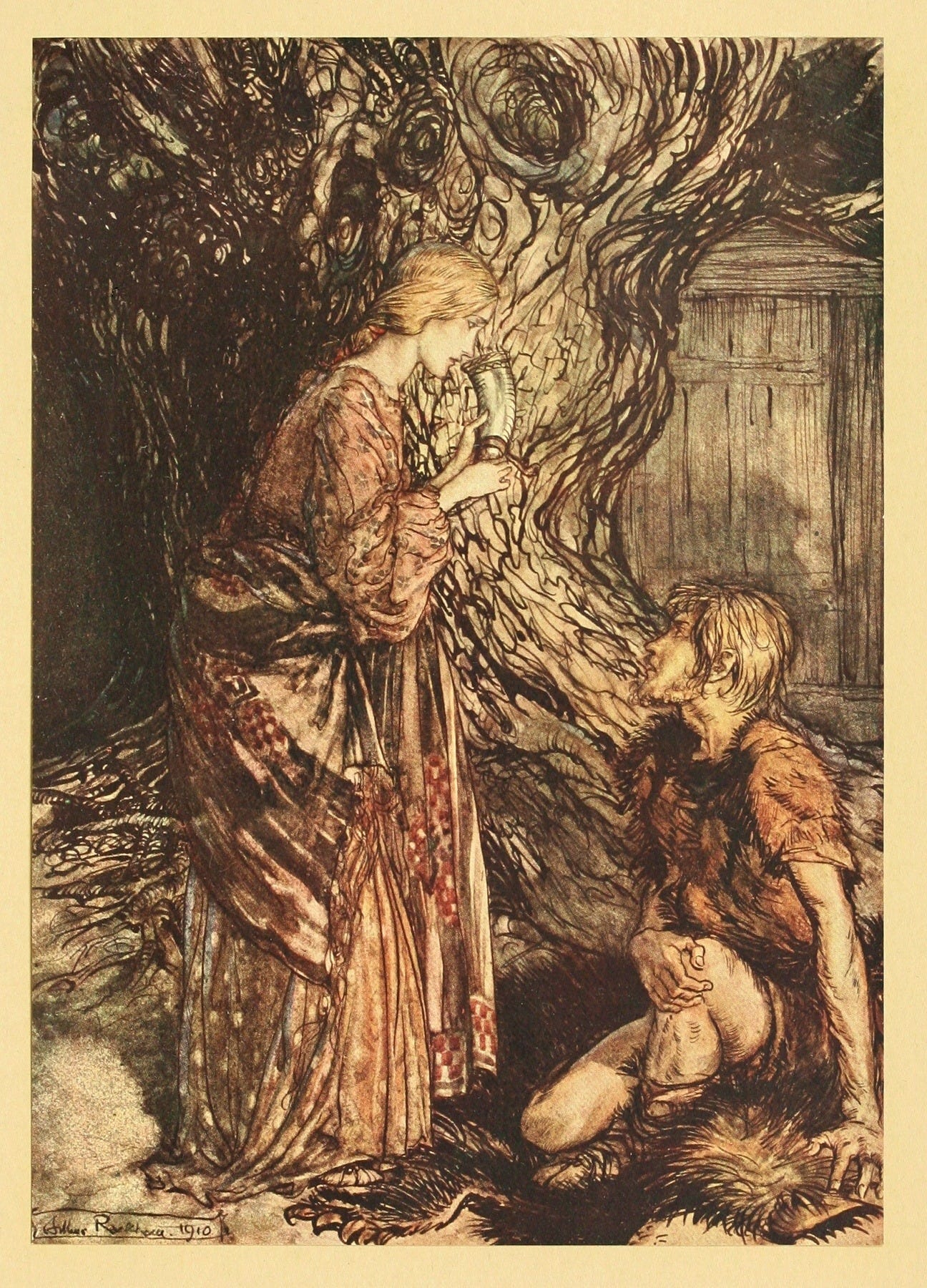
In Norse myth, it’s quite literally the source of poetry: the gods brewed mead from honey and the blood of a wise being named Kvasir, himself originally made of their spittle. It was a complicated recipe. Anyone who drank that gained poetic inspiration.19 As a result, a poet could call his own verses Odin’s mead.
A word with that cultural importance doesn’t get replaced lightly, kind of like how we still talk about living by the sword and the pen is mightier than the sword today, even though swords haven’t been the weapon du jour for centuries. The cultural weight of the word has kept it around.
But there’s an irony here. The form of the word *médʰu has stuck around, crossing thousands of years, and thousands of kilometres, without altering its shape enough to become unrecognizable. But its meaning could not sit still.
The root took three directions which you can divide roughly geographically. In Northern Europe, the forms descended from *médʰu mean ‘mead’, the alcoholic beverage made from honey, as in the English mead.
Farther south, it turned into a word for ‘wine’, the alcoholic beverage made from grapes. This is what happened in Ancient Greek μέθυ méthy.
In the east, it often ended up losing its alcoholic connotations, coming to mean primarily ‘honey’, as happened with the Tocharian B word mit.
There is a certain logic to these developments. In Southern Europe, you can grow grapes and make wine from them. So, there, the word *médʰu started referring to the beverage people drank most often: wine made from grapes. In these languages, the word for ‘honey’ was often supplied by another root *mélit, the word that gave Latin mel and Ancient Greek μέλι méli.
That *mélit root does survive in English, by the way, but not in our word for ‘honey’. It hangs on very marginally in a single word mildew.20
Mildew first meant the sweet substance secreted by aphids feeding on plants, which today we call honeydew. Only later did it come to apply to other diseases of plants, such as the fungal disease we refer to as mildew today.
Our word honey, however, comes from a different source. The main theory about its origin is that it was once a colour word meaning roughly ‘golden’ or ‘yellow’.21
Why all this replacement of words to do with honey? There may be no special reason. Words get replaced all the time. But one suggestion is that the word was replaced because of a lexical taboo.22 People may have been unwilling to say the true name of honey while they were engaged in collecting it.
Remember that collecting honey involves a close encounter with stinging insects. It’s a relatively high-stakes situation, exactly the kind of place where you might expect a little bit of linguistic caution to creep in.
So instead of risking the bees’ wrath by calling the honey by its true name, speakers of some early Germanic language called it by a euphemism ‘the golden stuff’, just as actors will often refer to Macbeth as the Scottish Play for fear of invoking bad luck. Eventually, the name honey — once just ‘the golden stuff’ — stuck.
It’s a strange fate these words have had. The word for the drink proved almost impossible to kill: *médʰu wandered across continents, slipped into a language that wasn’t even Indo-European, and still came out the end still looking more or less like itself.
So the next time you ladle out some honey, consider that the contents of that spoon — the golden stuff — have been known under that name for thousands of years.
And if you’re inclined to pour yourself a glass of mead, know that the name of the contents of that glass would be recognizable to a customs officer in Ancient China as well.
Works cited
Baxter, William H., and Laurent Sagart (2014). Old Chinese: A New Reconstruction.
Behr, Wolfgang (2001). “Review of J. Ulenbrook, Zum Alteurasischen: Eine Sprachvergleichung.” Oriens.
Bjørn, Rasmus G. (2022). “Indo-European Loanwords and Exchange in Bronze Age Central and East Asia.” Evolutionary Human Sciences.
Jacques, Guillaume (2014). “The Word for ‘Honey’ in Chinese and Its Relevance for the Study of Indo-European and Sino-Tibetan Language Contact.” Wékwos.
Mallory, J. P., and D. Q. Adams (2006). The Oxford Introduction to Proto-Indo-European and the Proto-Indo-European World.
Meier, Kristin, and Michaël Peyrot (2017). “The Word for ‘Honey’ in Chinese, Tocharian and Sino-Vietnamese.” Zeitschrift der Deutschen Morgenländischen Gesellschaft.
Oxford English Dictionary, s.v. “mildew.”
Watkins, Calvert (1985). The American Heritage Dictionary of Indo-European Roots.
West, M. L. (2007). Indo-European Poetry and Myth.
This vignette, which is totally fictional, shows the kind of interaction that might have brought this word into Chinese.
Mallory and Adams (2006: 261).
The asterisk is there to tell you it’s a reconstruction, not an attested word. The dʰ is a bit harder to explain, but it’s more or less like saying d followed quickly by a breathy h, like in aha. It’s a sound that survives in many languages of India. In IPA, it’s [dʱ].
The Sanskrit word मधु॑ madhu has other meanings too: ‘mead; wine; any sweet or intoxicating drink; milk; things produced from milk.’ (Monier-Williams Sanskrit-English Dictionary, मधु).
I’m sure there are others, since Sanskrit words are famous for their many meanings. There’s even a joke about this: “Every word in Sanskrit means itself, its opposite, a word for an elephant, and a position in sexual intercourse.” (as told by Wendy Doniger; source)
It doesn’t work, by the way. Pliny didn’t believe it did either, but he attributed the belief to the Magi, magicians who are Pliny’s frequent punching bag.
OED, amethyst.
A bit of terminology: I’m using Chinese to refer to the standard variety of the language as spoken and written in China, Taiwan, and other places. There’s another way to use the term Chinese, referring more broadly to the many varieties of related languages, such as Mandarin, Cantonese, Hokkien, Hakka, and many others. Chinese in this broader sense is better thought of as a whole language family — linguists often call this family Sinitic — of its own within the Sino-Tibetan family. For cultural reasons, however, it’s more common to speak of Mandarin, Cantonese, etc. as Chinese dialects than as Sinitic languages. In this article, Chinese means Standard Chinese.
Those marks on ā and ì, by the way, indicate tones, contours in pitch with which you must pronounce the syllable for it to mean what you want it to mean. These tones are tremendously important for Chinese, but not so important for us right now. Say the Chinese word for ‘honey’ with different tones, and you may end up saying the word 風靡/风靡 fēngmǐ ‘popular’ by mistake.
Meier and Peyrot (2017: 7).
Meier and Peyrot (2017: 8).
Mallory and Adams (2006: xxi)
This is Mair’s analysis, via Meier and Peyrot (2017: 7). The encyclopedia was 王充 Wáng Chōng’s 論衡/论衡 Lùnhéng, which meant something like ‘Balanced Discourses’.
Behr (2001: 359).
A different word, now lost to us, may have been used before *mit.
Baxter/Sagart (2014) reconstruction.
There’s a wrinkle in the chronology. The Tocharian form that matches Old Chinese so closely, mit, belongs to Tocharian B, which isn’t attested until the fifth century AD, centuries after the word had reached Chinese. Its reconstructed Proto-Tocharian ancestor, written rather imposingly as *ḿətə (roughly myuh-ta, [mjətə]), is a poorer match. Partly on this basis, Jacques (2014) dissents from the *médʰu theory — citing the *ḿətə vs mit temporal mismatch, among other issues — and argues that the Chinese word comes from another Indo-European root, *melit- ‘honey’, which we’ll have occasion to discuss below. Meier and Peyrot (2017) disagree, and present arguments for the traditional analysis.
Bjørn (2022: 13).
West (2007: 90).
At least, that’s the usual etymology (OED, mildew).
Mallory and Adams (2006: 263).
Watkins (1985).
Not just mildew but mellifluous, yes? Or does that not count because it came through Latin?
It's enough to make you want some metheglin.
Huh, well that makes sense. So the idea is that the reason the Chinese use the Tocharian word for it is that beekeeping was introduced by an Indo-European people, so the Chinese borrowed the word for honey along with the practice?
Incidentally, the Japanese word for honey is 蜂蜜, hachi-mitsu (hachi = bee, mitzu = nectar/honey/honeydew), so there's that mi-root again. I'm assuming in their case though that they got it from the Chinese in a game of telephone rather than directly from IE speakers.