

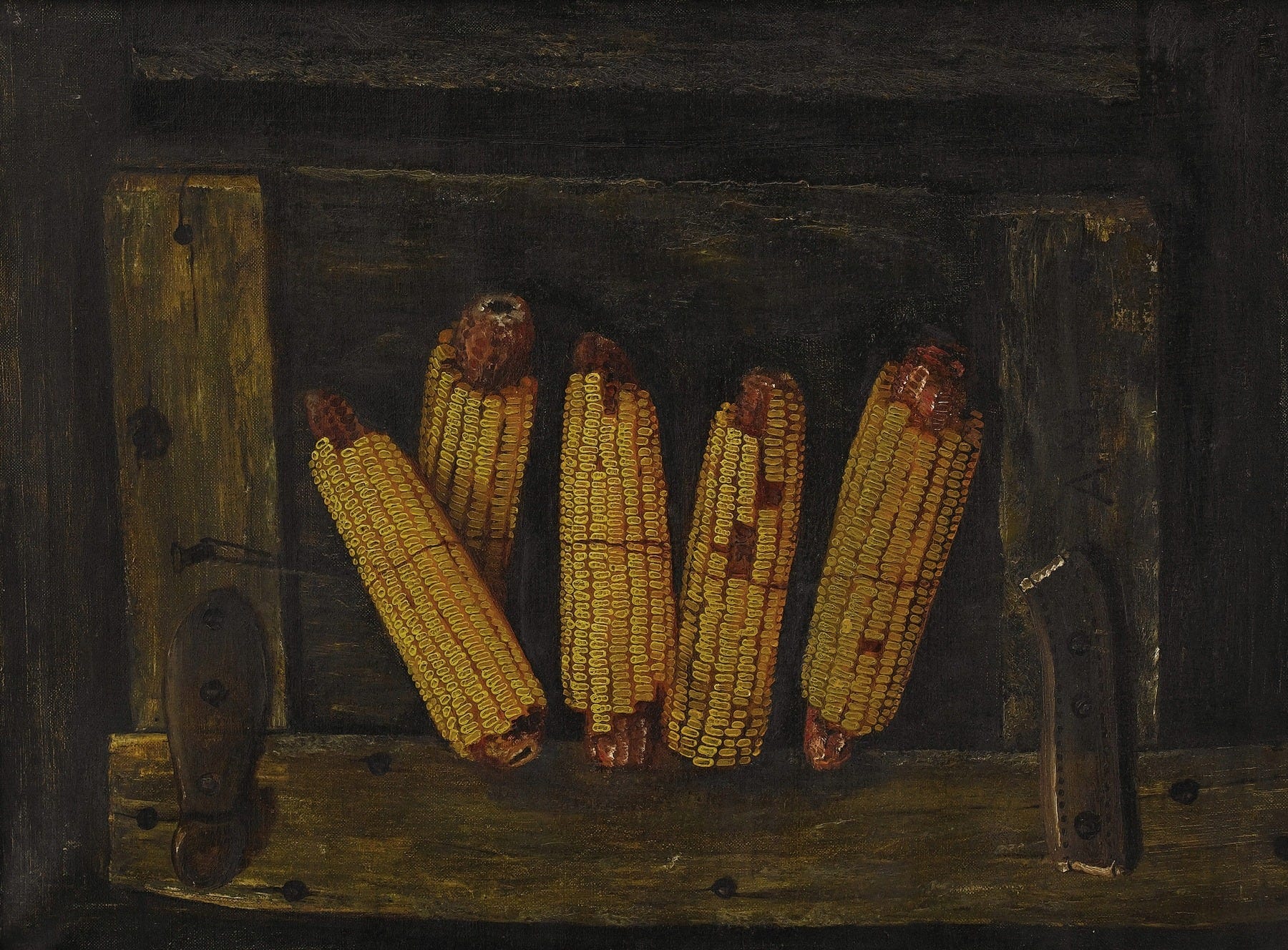
It is the last day of September, when a young man’s fancy quickly turns to corn.
But what plant, precisely, is he imagining?
If he is in North America, Australia, or New Zealand, it’s probably Zea mays — also known as sweetcorn or maize. This is the plant whose yellow kernels come on cobs, eaten boiled or grilled, or dried and popped, or ground finely into flour, or in a thousand different other ways. This corn is a versatile plant.
If the young man is British, however, he may — having been raised on American films — think of corn in the same way. But if he’s not so young, or perhaps if he lives in the countryside, he may have a different plant in mind.
In England, corn traditionally referred mostly to plants in the genus Triticum, that is, wheat. In Scotland, however, corn once referred primarily to Avena sativa, or oats.1
Recent generations of English speakers around the world have largely converged on the idea that corn means maize, but the fact that corn could once refer to three completely different plants raises some questions.
Whose corn was the original? And why did the meaning of corn ever split into three?
You’re reading The Dead Language Society, where 88,000+ readers explore the hidden history of the English language. I’m Colin Gorrie: PhD linguist and your guide through 1,500 years of linguistic history.
I publish every Wednesday. Paid subscribers get every issue, the full archive, and my most in-depth work, including longer essays that trace the mysteries of English to their source, practical guides to reading historical texts yourself, and live book clubs where we read texts like Beowulf and Sir Gawain and the Green Knight.
To see a World in a Corn of Sand
I hate to disappoint anyone hoping that maize, the most common meaning of corn today, is the original, but it’s actually the most recent.
This makes logical sense — English speakers only encountered the plant Zea mays when they began to colonize North America, because Zea mays is indigenous to the Americas, not to Europe.
Since the word corn was present in English already in Old English (450–1100) times, it could hardly have originally referred to maize.
But partisans of “team wheat” and “team oats” will be disappointed as well. When the word corn was used to refer to plants at all in Old English, it referred to cereal crops in general, without an attempt to differentiate exactly what plant it referred to. The best translation for Old English corn in this sense is the Modern English word grain, a cover term for a variety of crops.2
But Old English corn also meant ‘grain’ in another sense. We still speak of grains of salt or grains of sand. These were also called corn in Old English:
swā fela welena swā þāra sondcorna bēoþ be þisum sǣclifum.
‘as much wealth as there are grains of sand by these sea-cliffs’3
This is grain in the sense of ‘a small, hard particle’ — and this is the core meaning of corn in Old English. It could apply to grains of sand, salt, ice — the Old English Rune Poem tells us hæġl byþ hwītust corna ‘hail is the whitest grain’ — or the seeds of crops like oats, wheat, and barley.4
Evidence for this older meaning of corn can be found preserved in some otherwise mysterious phrases. My favourite of these is corned beef, which has nothing to do with maize, wheat, or oats. Instead, it refers to the fact that the beef was preserved with large grains — corns — of salt.5
But other examples are easy to find: a barleycorn is a grain of barley, and a peppercorn is a grain of pepper.
Even the word kernel, so linked to corn in the maize sense, is a derivative of the same corn root — just a diminutive version. A kernel is a corn-le, a little grain of something.6
So corn meant — and, in some cases, still means — grain, not any particular plant.
This warms my heart, in a way that only a particularly tasty etymology can. You see, it’s entirely appropriate that we should treat grain as a synonym of corn. They are, on closer inspection, actually the same word.
How big is that trench coat?
An anonymous internet joke describes English as “three languages in a trench coat”. In the realm of vocabulary at least, this is a good description.
Huge quantities of English words were not inherited directly by English from its ancestors but came in through borrowing. The two languages English has borrowed the most from — presumably two of the languages in the trench coat — are Norman French and Latin.
Norman French and Latin could also be thought of as two stages of the same language, since French, Norman or otherwise, developed out of the spoken Latin dialects of Gaul.
Both of these languages are distantly related to English, through an ancient common ancestor, a language scholars have given the ungainly moniker Proto-Indo-European.
The details of these relationships aren’t as important as the fact that a single word in the ancestral language — say, *bʰréh₂tēr, the Proto-Indo-European word for ‘brother’ — often appears in English in three forms, corresponding to three routes of entry: inheritance, borrowing from French, and borrowing from Latin.7
Inheritance is when a word is passed down through the generations in an unbroken chain. This is how the word *bʰréh₂tēr passed down into English as brother.
To understand the other two routes — borrowing from French and from Latin — you need to know that Proto-Indo-European had many more descendants than just English.
Latin was one of these, and the word *bʰréh₂tēr was passed down into Latin as it was passed down into English, changing as it was handed down across the generations. It surfaced eventually in Latin as frāter — and, after further changes, the same word became French frère.
Because English borrowed extensively from both Latin and French, we have other descendants of *bʰréh₂tēr represented in English vocabulary: fraternal, fraternize, fraternity, etc., from Latin; and friar — a monastic brother — from French.8
Corn and grain have the same relationship as brother and friar. Both descend from a Proto-Indo-European word *ǵr̥h₂nóm ‘grain’, although the French word had a stopover in Latin grānum.9
The sound changes that turned *ǵr̥h₂nóm into corn and grain are complex, but systematic. They produce regular correspondences between inherited English words and their Latin/French cousins.
The c-to-g relationship is particularly robust. Alongside corn vs. grānum we have cold vs. gelidus ‘icy’ and kin vs. genus ‘kind; family’. This last example shows us that sound, rather than spelling, is the key thing.
Now we know where corn came from — what happened later to turn it into a word used for not one, but three, plants?
Food fit for pigs
It’s easy to understand how corn changed from its original concrete meaning ‘a small, hard particle’ to its later meanings ‘the type of plant that produces corn’ or ‘harvested grain in general’. Its French cousin grain made the same shift, both in French and when borrowed into English.
The divergence into the three separate plants is more interesting.
The word corn never stopped meaning ‘grain’ in general, but it began to specialize, and did so differently in different regions, because different grains were grown in different places. Corn came to mean whatever the most important grain was.
In Southern England, wheat was the predominant cereal crop, so corn came to be used primarily for wheat. In Northern England, Scotland, and Ireland, oats were more common, so corn specialized to mean ‘oats’ there.10
In the Americas, when English-speakers encountered the new (to them) crop maize, they categorized it as a type of corn:
It pleased God..to moue the Indians to bring vs Corne, ere it was halfe ripe. (1608; John Smith, Works)11
When being more specific, the colonists called maize by the name of Indian corn.12 Eventually, however, just as corn on its own came to refer to wheat in the south of Britain, and oats in the north, corn came to stand in for what had earlier been called Indian corn.
All of these shifting meanings cause no end of confusion when reading books from other times and places.
For example, if you read about 19th-century Britain, you’ll read about the Corn Laws — tariffs and trade restrictions used to prevent the importing of grain. But maize was not the main issue here. The Corn Laws were trying to protect British farmers, who farmed mostly wheat, rye, barley, and oats — though the law applied to maize too.13
If I had written this article 70 years ago, I could have pointed to a living dialect distinction between the meaning of corn on either side of the Atlantic. But, in the 20th century, the North American meaning of corn spread across the English-speaking world, propelled by Hollywood, breakfast cereals, and Saturday morning cartoons.
Funnily enough, the majority of dictionaries are out of date on this question — most repeat the older state of affairs — that corn refers most often to wheat in England, oats in Scotland, and maize in North America. These need to be updated — in my experience, there are many, many people in the UK (and Ireland!) who use corn to refer to maize.
This seems to be borne out by the unscientific poll I conducted last week on Notes:
Now, even in southern England, the homeland of corn-as-wheat, many young — and not-so-young — people only know the originally American meaning of corn. This is natural enough, of course, but I can’t help but feel a sense of nostalgia for this little piece of dialect diversity that English is losing.
Unlike other “weird words” in this series, the ultimate origins of corn are no great mystery. What’s weird about corn is the path this ancient word took to meaning what it means today.
So, to end, I feel compelled to ask: What does corn mean to you?
Works Cited
Buck, Carl Darling (1949). A Dictionary of Selected Synonyms in the Principal Indo-European Languages.
Cassidy, Frederic G. & Joan Houston Hall (2001). “Americanisms.” In The Cambridge History of the English Language, vol. 6: English in North America.
de Vaan, Michiel (2008). Etymological Dictionary of Latin and the Other Italic Languages.
Fox, Samuel, ed. (1864). King Alfred’s Anglo-Saxon Version of Boethius De Consolatione Philosophiae.
Kroonen, Guus (2013). Etymological Dictionary of Proto-Germanic.
Oxford English Dictionary, s.v. corn, n.¹.
Smith, John (1884). Works, 1608–1631. Ed. Edward Arber.
OED, s.v. corn n.¹, sense II.3.a.
In agricultural circles in Britain, corn retains this meaning of ‘cereal crops growing in the field’.
Old English Boethius, ch. 7 § 4 (Fox 1864: 22); diacritics added by me.
Rune Poem, stanza 9, as quoted in the OED, s.v. corn n.¹, sense I.1.a.; diacritics added by me.
OED, s.v. corn n.¹, sense I.1.c.
OED, s.v. corn n.¹. This -le ending comes from an old Germanic diminutive suffix. It’s also found in English nozzle (a little nose) and dimple (a little dump — this dump means ‘pit’), as well as the German names Hänsel and Gretel (‘little Hans’ and ‘little Margarete’), and even Yiddish — בייגל beygl ‘little ring’ is the source of English bagel.
Today I’ll ask you to accept that Proto-Indo-European notation looks like an algebraic formula. The asterisk at the beginning at least I can explain briefly: it marks a reconstructed form, as opposed to one which we have recorded in writing. It’s a good practice to signal that such forms are reconstructed, because a reconstruction is nothing but a hypothesis — and hypotheses can, and should change, as more data comes in. In the case of Proto-Indo-European forms like *bʰréh₂tēr, however, the hypotheses have been refined for so long that they’re fairly uncontroversial. As for how these forms would have been pronounced, there’s a good deal of uncertainty.
Specifically, friar descends from Old French frere, no accent.
Kroonen (2013: 312); de Vaan (2008: 271).
Buck (1949: 514).
Smith (1884: 9), via the OED, s.v. corn n.¹, sense II.5.a. Yes, that John Smith. The first-attested use of corn meaning maize, and it’s by the blond guy from Pocahontas…
Cassidy & Hall (2001: 189).
I was curious about this last part. It turns out that maize was covered by the Corn Laws — proof comes from the fact that Parliament discussed reducing restrictions on maize in particular — because it was only “food fit for pigs” — during the debates that led to the repeal of the Corn Laws in 1846.
(I am a 74 year old English women-for context). Corn for me evokes the image of fields of golden cereals of unspecified type, swaying gently in waves in the wind, before being harvested. It could be barley, wheat, rye, oats or other rarer types of cereal, but definitely not maize (which I called sweetcorn as a child) as it doesn’t look the same at all.
I am an American in my 50s and I was today years old when I learned that British people born the same time as me are talking about wheat or oats when they say "corn".