

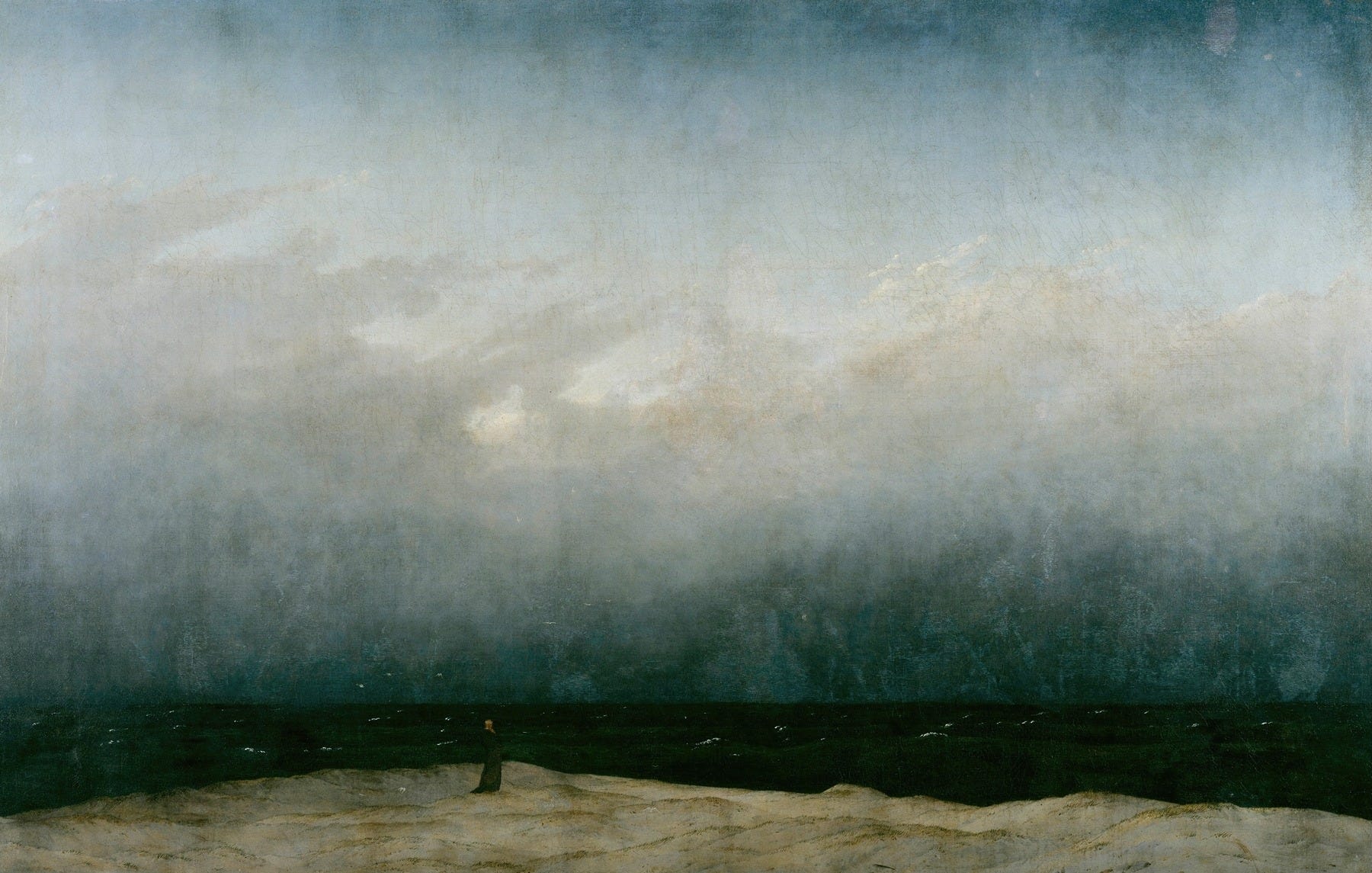
He’s lived too long. He’s sure of that now.
Sea spray flecks his cheek. He’s close to where he found the barrow. Just one mile more, although a mile for an old man bearing a heavy load is no small distance.
He utters no word of complaint — who would he say it to, anyway? — and keeps going.
It wasn’t always like this. Once it was good. He was young and the world seemed to be young with him. The hoofbeat of horses, the screech of hawks flying overhead, the sound of the harp, he can hear them all still when he closes his eyes.
And then there is nothing. Not even the servants who used to polish his armour. They’re all gone now. Taken by death, or bloody battle.
And yet some things still remain. The golden cups, the sword that once won him glory. Things. Just things. There’s no one left to swing the sword, no one to carry the cup.
He has lived too long. A warrior is not meant to walk bent with age. He should have died before, a good death on the field of battle. And yet he lived, when better men did not.
He carries his bag to the barrow. The mound is empty now, but he will fill it. He’ll fill it with a lifetime of treasure, an immense inheritance he would sooner bequeath to his son or his sister-son. But they are gone, so it goes to the earth, the mother of us all.
He stands before the mound, and places the sack down. He takes out a single cup and holds it up before the barrow, as if he were drinking her health. Then he speaks his word of bequest.
“Hold these treasures, Earth, now that men no longer can.” He looks at the cup, and down at the treasures. “These things once came from you. So have them again. The bright helm will tarnish. The sword will grow dull. The coat of mail that even iron could not bite will be, at last, devoured by rust.”
He places each item carefully in the barrow, giving each its place of honour. And, as he sets them carefully down under the earth, he says the names of the friends who once carried them, of those who lived not nearly long enough.
The wind carries his words into the far distance. Whether anyone heard them, not even a wise man can say.
You’re reading The Dead Language Society, where 55,000+ readers explore the hidden history of the English language. I’m Colin Gorrie: PhD linguist and your guide through 1,500 years of linguistic history.
I publish every Wednesday. Paid subscribers get every issue, the full archive, and my most in-depth work, including longer essays that trace the mysteries of English to their source, practical guides to reading historical texts yourself, and live book clubs where we read texts like Beowulf and (currently) Sir Gawain and the Green Knight.
Why people bounce off Beowulf
What you just read is a prose adaptation of an episode in Beowulf, the foundational poem of English literature. It’s a work of Old English verse composed by an unknown poet sometime between the eighth and eleventh centuries, recounting — among many other things — the heroic adventures of a man named Beowulf.
It is also a miracle of survival. The world it describes vanished centuries before the poem was set down. The poem itself almost vanished too: it comes to us in a single manuscript whose pages still bear the scorch marks of the fire which, in 1731, nearly took it from us.
The episode I adapted above is called the Lament of the Sole Survivor. This passage occupies just 40 of the poem’s 3182 lines,1 features a character who is never named — he’s never even referred to in any other part of the poem. And yet, despite its brevity, I think the Lament is the key to unlock what the Beowulf poet is trying to tell us.
I’ve spoken to many readers over the years who “bounced off” of Beowulf: they came in expecting monster fights aplenty, and ended up reading a poem whose narrator seems distractible, even flighty: unable to hold his attention on what is most interesting about his story. Which is the monsters, right?
Beowulf, you see, has an image problem.
By reputation, Beowulf is a poem about fighting monsters. And it’s not entirely undeserved: Beowulf does indeed fight three monsters in the poem.
As a young man, he fights first the ogre-like creature Grendel, then Grendel’s mother, and finally, as an old man, he confronts a fire-breathing dragon.
These fights are beautifully written and wonderfully cinematic, some of the most thrilling combat scenes ever written in English. Their influence runs directly into the foundations of modern fantasy: J. R. R. Tolkien lifted Smaug from the dragon in Beowulf almost wholesale, and most of the dragons we’ve met since are his spiritual descendants.
But the fight scenes are relatively short: when you combine them, they amount to about 13% of the total poem.2 The remaining 87% of the poem consists of, well, everything else, including a generous helping of digressions, in which we’re treated to legends, lore, and plenty of stories-within-stories.
What makes this frustrating for readers is not just that they came wanting to read about monster fights and ended up having to keep track of the jockeying for position of rival claimants to the Swedish throne. That stuff can be fun too, as any Game of Thrones fan will tell you.
But many of these digressions seem irrelevant to the main story. For example, the poet spends hundreds of lines in the third part of the poem recounting the wars between the Geats3 and the Swedes, which have dubious relevance to the main action of the section: Beowulf’s fight with the dragon.
As a result of all these digressions throughout the poem, many readers never even make it to the Lament of the Sole Survivor, which takes place around three quarters of the way through the poem. It too is a digression, but, if we understand it correctly, it provides the crucial clue to unlocking the rest of Beowulf.
Beowulf is not a story about killing monsters which happens to be told by a distractible poet. Instead, think of Beowulf as a three thousand-line version of the Lament of the Sole Survivor: an extended farewell to a vanishing world. It just happens to be punctuated by three monster fights.
To understand why the poem works — and why it isn’t the mess of digressions it appears to be — we need to understand the world of Beowulf. Fortunately, the poet tells us a lot of what we need to know. We just need to learn how to listen.
The world that was
What we hear, when we listen carefully, is a single theme: strength inevitably declines into nothingness. This pessimistic theme repeats throughout the poem, at various scales, both intimately, in the lives of individuals, and more grandly, in the fate of whole peoples.
The most obvious example is the life of Beowulf himself, who sees his strength flower in his youth and decline in old age. But it is also present in the Lament of the Sole Survivor, and in the dire predictions of the fate of Beowulf’s people, the Geats, which occupy a large portion of the end of the poem.
Even the beginning of the poem closes on a funeral, recounting the earlier great deeds of the Danes. The present state of the Danes, however, is much reduced. They are beset by troubles, principal among them the monster Grendel, but also the unsubtle hints the poet gives of coming strife, both with other peoples, and within the Danish court, between the king’s nephew and his own children.
The constant repetition of this pattern of decline, told at various scales and in various ways throughout the poem, is what leads to the elegiac mood — a mood of lament for what has been lost — that pervades the poem.
What makes this mood so appropriate for Beowulf is that the poet didn’t have to invent a lost world to mourn. The poem’s events take place over a span of fifty years in late fifth-century and early sixth-century Scandinavia. Many of the events are fantastical, of course, but the core setting was a real time and place. And it really did vanish.
The poem itself was composed later — it’s unclear exactly how much later — under circumstances we can’t reconstruct with any certainty.4 But much of the poem bears the characteristic traces of something that evolved out of oral tradition. Through this oral tradition, memories of that era persist in the poem.
Beowulf is set in the era that archaeologists call the Early Germanic Iron Age, from around AD 400–550. It is bookended by two historical events: at the beginning, the collapse of Roman authority in Western Europe (an event in which Germanic peoples played no small role), and at the end, a climate disaster set off by volcanic eruptions in AD 536–540, which caused a large-scale decline of living standards in Scandinavia.
During this period, while Western Europe was undergoing severe decline, Scandinavia entered its Golden Age. You should take the phrase “Golden Age” literally: immense hordes of gold were deposited in Scandinavia during this period. The gold was ultimately of Roman origin, but the wealth flowed north with the decline of Roman power in Western Europe and the rise in the power of the Germanic peoples, who began to organize themselves into kingdoms.
This Scandinavian Golden Age came to an end, in part due to the climate disaster of the mid-6th century, and in part because the wealth of southern Europe had been exhausted. The gold stopped flowing.
This is the background against which I recommend you read Beowulf, a poem which traces the career of a hero living in the final, declining, years of this period. It’s entirely appropriate that a poem written about that time should be a poem of mourning.
But I digress
Even if Beowulf is an elegy, why does the poet seem incapable of telling it without digressions? Why, immediately after Beowulf has defeated Grendel, are we treated to a retelling of two unrelated stories about characters we never meet: a dragon-slaying hero named Sigemund and a wicked king named Heremod? What do they have to do with Beowulf?
Tolkien — yes, that Tolkien — once asked the same question. Before he became famous as the author of The Lord of the Rings, he was a professional Anglo-Saxonist, and a scholar of Beowulf. The consensus in the field when he began his career was that these digressions were defects in the poem, whose only use was as a scrap-heap to be rifled through for historical information.
At least that was the consensus until 1936, when Tolkien gave a lecture that changed the way people saw Beowulf forever. In that lecture, which he called Beowulf: The Monsters and the Critics,5 he argued that the digressions weren’t a defect at all. They were essential to the structure of the poem, which, by the way, was actually a great work of literature.
For Tolkien, the digressions served to furnish the world in which Beowulf operated. Not only do they maintain the elegiac mood that saturates Beowulf’s world, but they populate that world with other heroes — and villains — who serve as examples of what a man can become.
The digressions show us what was praiseworthy in this world and what was contemptible. For example, let’s look more closely at the two digressions that follow immediately after Beowulf has slain Grendel: the story of Sigemund the dragon-slayer and the story of Heremod the wicked king.
Why these stories at this moment? They serve to place the actions of Beowulf, the character, within the context of what is morally possible in the world.
A hero could rise as high as Sigemund, fighting dragons singlehandedly and freeing its hoarded treasure. Or he could sink as low as Heremod, who refused to distribute treasure to his people. Instead, he kept the wealth to himself, like a human version of a dragon, and like Sigemund’s dragon, he too met his end for it.
The poet does not make the conclusions explicit for you. He simply places the images of Sigemund and Heremod in proximity and lets you work out what it means. As a result, other answers than the one I’ve given here are possible, probably even necessary, which leads me to my final point: Beowulf is one of those few, special texts that, to adapt Walt Whitman, contains multitudes. No matter how much you look into Beowulf, it never seems to exhaust its ability to surprise you.
Because Beowulf is so inexhaustible, I have a word of advice for anyone set on reading it.
You must re-read Beowulf
You’re not going to get everything out of Beowulf in your first reading. You may not even be able to exhaust what Beowulf has to offer in a lifetime, although I’ve not yet attempted this.
My experience has been that Beowulf yields up something different every time you approach it. Depending on the stage of life you find yourself in, you may be more attracted to the boastful energy of the young Beowulf, or perhaps you’ll identify more with the older Beowulf looking back on his long and storied life.
Your interests may change: on one occasion you may read Beowulf with an eye for the monsters and the fighting. Another time, your interests may lie in uncovering the politicking of the Danish court, or untangling the sequence of events that made up the Swedish-Geatish wars discussed in the final part of the poem. You may become fascinated by the balance struck between Christian and pre-Christian elements in the poem, or the folkloric material that several of the episodes in Beowulf seem to have been drawn from. Suddenly, one day, you may be seized by a desire to learn more about what archaeology can tell us about the period.
There are many ways to enjoy Beowulf, and you don’t have to choose just one. If you’re anything like me, different interests and themes will take hold of you on different occasions as you re-read the poem.
But re-read you must. Because Old English — the language Beowulf was written in — is essentially a foreign language, most people will read Beowulf in translation (and here’s some advice for choosing your first translation). The need to read in translation, however, can be a blessing in disguise, because you can simply change your translation and the poem becomes half-new once again.
Of course, if you’ve truly been bitten by the Beowulf bug, you’ll want to read it in the original Old English. If this sounds like it describes you, I’ve written up some (rather comprehensive) advice on how to get started.
If you do want to read the original, I won’t sugar-coat it: Beowulf is a challenging text, even for students of Old English. But you don’t need to be able to read the poem fluently to derive some benefit from knowing a bit of Old English, even when you’re reading a Modern English translation.
Translators always have to make interpretive decisions, and these decisions are often hidden to you, the reader. If you know Old English well enough to pick out which word in the original corresponds to which word in the translation, you’d be wise to have the original open alongside the translation as you read. You’ll be surprised at how a word that you thought was of great significance in the translation turns out to correspond to nothing at all in the original: it’s simply been added to make the Modern English flow better.
You can get the same effect by reading multiple translations, as different translators tend to make different decisions. By seeing where translators differ, you get a sense of what parts of the original give them the most trouble. That’s also where all the fun is, once you learn Old English.
There is, however, one joy that the Old English reader has which is entirely withheld from the reader of a translation: the joy of the sonic texture of the original.
Beowulf was written in alliterative verse, which — if you’ve never heard it recited — has a propulsive energy which is hard to replicate. Many translators have attempted to capture this energy in their Modern English renderings, but none, in my opinion, have truly succeeded. How could they? Keeping the meaning intact while also working within the constraints of alliterative verse in Modern English is virtually impossible.
Whether you end up reading Beowulf in translation or in the original, knowing what to expect is half the battle. If you go in expecting a heroic succession of monster fights, you’ll be puzzled, perhaps even disappointed, by the other 87% of the poem. But if you understand what that other 87% is doing, you’re going into your encounter with Beowulf armed with everything you need to enjoy it.
So go pick up Beowulf. At 3182 lines, it’s something you can read in a few hours. This is a poem that will keep you company for the rest of your life.
In a way, Beowulf is like the Sole Survivor. It too has come through great dangers to stand before us as the last witness to a world that no longer exists. But unlike the Sole Survivor, whose name was lost forever, the glory of Beowulf will never truly die, as long as we keep reading it.
P.S. Want to hear some Old English?
If you’d like to listen to Beowulf — and other Old English texts — in the original, I’ve been working on a way: an app called Ekho, which is an audio library providing definitive recordings of historical texts in the original language, beginning with Old English and Ancient Greek.
My recording of Beowulf is currently available on the app and covers up to the end of the fight with Grendel, with new content added every month.
Full disclosure: I have a stake in the project, so I’m not a neutral party here. But if you’re the kind of person who wants to read Old English literature in the original language, I think you’ll really enjoy it.
What’s especially fun about Ekho is that the voice actors (myself included) use carefully reconstructed historical pronunciation schemes, so you can hear Beowulf and other texts as close to how they would have originally sounded as possible.
They have a rotating free sample text for each language: currently, for Old English, it’s The Wanderer — another fine example of Old English elegy, by the way.
Works Cited
Fulk, Robert D., Robert E. Bjork, and John D. Niles, eds. (2008). Klaeber’s Beowulf and the Fight at Finnsburg. 4th edition.
Tolkien, J. R. R. (1936). Beowulf: The Monsters and the Critics.
Beowulf 2231b–2271a; all citations are to the Klaeber 4e text of Beowulf (Fulk et a. 2008).
If you want to check my math, I’m counting Grendel (710–834a), Grendel’s mother (1492–1590), and the dragon (2538–2724). That’s 418 out of 3182 lines, or 13.1%
Pronounced roughly like “Yats.”
The dating of Beowulf is one of the principal controversies in the scholarship about the poem. The possibilities range from the early eighth century to the eleventh century, when the manuscript containing the only copy of the poem was produced. Regardless of when you think the poem was composed, it has a gap of at least 200 years between the poem in its more-or-less final form and the setting it describes.
Tolkien (1936).
Thank you for the excellent article. I once attended a poetry reading where everyone participated with their favorites. I chose to read the section of Beowulf where the stag - driven through the forest - refuses to seek safety in the dark water. I read the Old English phonetically - and dramatically - while my wife, standing behind me, read the modern English translation simultaneously, almost like audible subtitles. The effect was eerie, even to the two of us. Our listeners were captivated. There is something almost hypnotic about the sound of Old English spoken aloud.
I’m now regretting not joining the Beowulf sessions that you did (I’m currently enjoying Gawain). Might you be running those again? Presumably those sessions are no longer available …