

Now that the ink has dried on the contract, I can at last share some news that I’ve been sitting on for a while: I’m writing a new book!
Unlike last time, this book will be non-fiction, and written in Modern English (for a change!) It will be published by Thesis, an imprint of Penguin Random House.
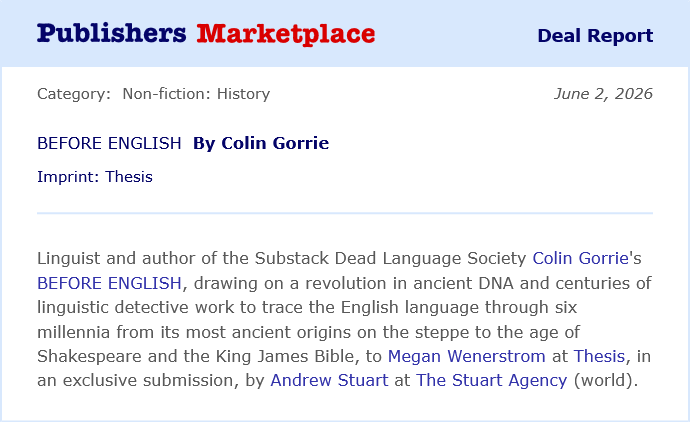
As you can see from the Publishers Marketplace screenshot — that, by the way, is where book deals get announced — the working title of the book is Before English. That’s likely to change by the time the book is published. Nevertheless, it gives you a pretty good idea of what the book will be about.
When we tell the history of the English language, we usually focus on a few big events, dwelling on things like the Old English literature of the Anglo-Saxons, the Norman invasion and subsequent French influence on the language, the effects of the printing press on how words are spelled today, or the influx of learned Latin vocabulary that flowed into English during the Renaissance.
All these developments are extremely important, but they occurred after English was first written down in the 7th century AD. They represent only the most recent act in the long story of the English language: a mere fourteen centuries. But by this time, three quarters of its story had already been told.
In the millennia before a single word of English was written down, it already had its key features: the core grammar, almost all of its sounds, and most of its everyday vocabulary.
To uncover the rest of the story, the deep inner logic of the language, we need to travel back in time to before English was even English.
But there are no clean boundaries in the history of a language: what we call English today was transmitted from one generation to another in an unbroken chain that goes back thousands of years, long before English had differentiated itself from its relatives
If you follow the chain of transmission back 2000 years or so, English will slide imperceptibly into its ancestor: Proto-Germanic, a language once spoken on the shores of the Baltic and North Seas. This language gave birth to all the Germanic languages, so it can just as easily be called “really old German” or “really old Danish” as “really Old English”.
Go back even farther, and you’ll find a language spoken on the steppes of modern Ukraine and Russia, one that would give birth to most of the languages of Europe, and many of Asia: a language which is simultaneously “really really Old English” and “really really Old Spanish” and “really really Old Russian”. This is the common ancestor of them all: Proto-Indo-European.
From the 18th century to the present, the nature of these early, unwritten ancestors of English has gradually become clearer, due to the work of generations of historical linguists.
In more recent years, their findings have been joined by those of archaeology and, even more recently, archaeogenetics, the study of ancient DNA.
We now have an unprecedented view of the earliest reconstructable ancestor of English, as well as the people who spoke it: we know much more than ever before about where and how they lived, the kinds of stories they told, and how they saw the world.
Specialists have frequently disagreed, not only across disciplines but also within them; however, a picture has emerged that allows us to see the whole history of the English language in a new context.
Much of this research is so new, especially in the field of ancient DNA, that it hasn’t yet percolated out of the academy.1 The linguistic side of the story has been much more stable, but has traditionally been presented in impenetrably technical ways.
This book is meant to fill that gap, and will tell the story of the English language in an accessible way — the whole story, beginning six millennia ago with Proto-Indo-European. I’ll trace the evolution of this language alongside the lives of the people who spoke it, as it gradually became something we’d recognize as English.
Since this newsletter is about the history of the English language, there will be some overlap in topics, but the two projects are separate. The book will tell a single, integrated story across the entire span of the history of the English language and its ancestors.
It’s the kind of project you need a book’s length to do justice to: you can show long-term trends and themes much better over 80,000+ words than over the length of one of these articles. This newsletter, on the other hand, will continue to highlight individual events and topics from a more self-contained perspective.
There’s no firm publication date yet for the book, but these projects tend to have long timelines, so I’m not expecting to hold the book in my hands until 2028 at the earliest. Of course, I will keep you posted if I have any updates on the timeline.
This has been a very busy and exciting time, one which has taught me a great deal. Even in these early stages of the project, I’ve learned so much about the process by which non-fiction books are made that I can no longer see them in the same way: What does the length of this book’s chapters say about its target audience? How does this author acknowledge scholarly debate without bogging down the book in endless argument? How does this one transition between historical narrative and conceptual explanations?
All that to say: I’ve been enjoying the process tremendously!
Finally, I want to take a moment to thank all of you reading for being part of the Dead Language Society. It’s a privilege to be able to share these stories with you every week.
It’s thanks to you that we’ve carved out this corner of the internet, dedicated entirely to the history of the words, sounds, and even the grammatical rules that the English language is made of. And it’s thanks to you that I have the opportunity to bring some of these stories into the real world as well.
Special thanks go to three readers in particular: Natasha, Andrew, and Megan, who believed in this project and have helped so much in bringing it into being. None of this would be happening without you!
But, in the meantime, I will see you, dear reader, back here next week for another story drawn from the near-endless library that the history of the English language provides.
An exception is Laura Spinney’s excellent book Proto, which focuses, naturally enough, on the Proto-Indo-European chapter of the story.
Wow, I actually squeled out loud when I read this 🤣 I really enjoyed reading Proto and I have very high expectations of your books because you manage to churn out these meticuously written pieces every week. A refuge from the world of AI slop! Looking forwards to it 👏
I am excited that you are writing a book. Keep us updated on when it will be published, when and where we can pre-order, etc. I learn so much from your posts I can barely comprehend how much I will learn from your book.