


I first started writing on the internet in 2022, with the ambition to, as I put it then, “bring linguistics out of the ivory tower”. At the time, I had no idea whether this kind of work would find an audience.
On the positive side, many people are interested in how their language works and where it came from. Etymologies are perennially popular on social media for a reason.
But linguistics has some disadvantages too: its terminology is some of the most obscure of any discipline — any field that uses “pied-piping” as a technical term has much to answer for — and, like any other academic subject, much of the interesting work is locked away in books and articles written not for the public but for other members of the guild.
Now, four years later, this project has reached a milestone: I am privileged to be able to share my work with 100,000 people. I’m extremely grateful for this opportunity, and want to thank you for reading and making this possible!
To celebrate this milestone, I have two things to share with you.
First, behold the new look of the Dead Language Society! I commissioned a redesign of the Substack a while back, and this seems like as good a time as any to release it.
From now on, the Dead Language Society will have a new logo (goodbye, skull; hello, owl!), a new masthead, even new section dividers. All of this is thanks to the amazing designer, and my dear friend, Lucy Dove.
By the way, the owl doesn’t have a name yet — we’ll talk about that at the very end. I have a request for you, in fact.
Second is this article itself. The milestone put me in a reflective mood, so I sat down with my editor Natasha and charted the course of this project over the past four years. The result is an “oral history” of how the Dead Language Society and its predecessor projects came to be, and the lessons we’ve learned along the way.
The mission has not changed, but, as you’ll see, my thinking about how best to accomplish that mission has evolved over the past four years. I hope this gives some insight into the process of creating this Substack, and that it might spark some ideas in people who are considering similar projects of their own.

You’re reading The Dead Language Society, where 106,000+ readers explore the hidden history of the English language. I’m Colin Gorrie: PhD linguist and your guide through 1,500 years of linguistic history.
I publish every Wednesday. Paid subscribers get every issue, the full archive, and my most in-depth work, including longer essays that trace the mysteries of English to their source, practical guides to reading historical texts yourself, and live book clubs where we read texts like Beowulf and Sir Gawain and the Green Knight.

Natasha: This is a big milestone! And it’s one I don’t think either of us thought would happen so soon, if at all. How are you feeling?
Colin: It feels weird! When I started on Substack in January 2025, I thought that 100,000 people would be the absolute maximum I could ever hope to reach with this kind of work.
There are, I thought, only so many people who are interested in historical linguistics — there can’t surely be more than 100,000 of them. But there are, and I’m very grateful for that.
Natasha: From the very beginning you had a goal to “bring linguistics out of the ivory tower”. Why are you so passionate about historical linguistics, and what did you believe made it inaccessible to a general audience?
Colin: Historical linguistics is interesting because your language is a possession that’s very close to you. It feels like part of you. So my job is, in a way, like the experts on Antiques Roadshow, who get to tell people that the set of cutlery they inherited from their Aunt Edna actually once belonged to Charles Dickens. That’s what we’re able to do with historical linguistics.
The challenge has been figuring out how to get people to that moment of recognition without having to take them through three semesters of grammatical terms!
Beyond that, university — which is where you’d learn this stuff — costs university prices. You can learn the terminology on Wikipedia or YouTube, but that’s usually not enough to start reading scholarly articles. You need a long acquaintance with how linguists think about problems.
I think the weekly newsletter model does a good job of replicating that one part of a formal linguistics education, giving people constant contact with linguistic thinking.
The trick is to help people find easy ways into the material, so they can get the first payoff without having to invest so much. Once they’ve had their first payoff, they’re willing to invest more. It’s like leading people into a virtuous form of addiction.
Natasha: But Dead Language Society didn’t start as Dead Language Society, did it?
Colin: No, no. It started as The Winged Schwa.
Natasha: How did you start to write publicly about historical linguistics?
Colin: I only started writing online in any great quantity in 2022. My first attempts at doing so — I think this is true for everyone who comes from academia — were trapped by the norms and the structures of academic writing. Even if you’re consciously trying to break free from it, you can only take so many steps away before its gravity pulls you back.
The first attempts I made resulted in a newsletter by the name of The Winged Schwa. That name is illustrative of the problems with the approach I had been taking, because what’s a schwa? You have to know what a schwa is before you understand why that is a good name for a newsletter.
Natasha: What is a schwa?
Colin: A schwa is just the “uh” vowel that we see in the first syllable of above. It’s really typical of English. Unstressed syllables in English tend to be reduced over time to schwa, which is written like this: ə. Because it’s kind of a cute symbol, linguists have taken it as a sort of graphic mark.
I thought, “If I’m bringing linguistics out of the ivory tower,” I’m taking the schwa and giving it wings to land in your inboxes. That was the thought process behind the name The Winged Schwa, and it had a really cool logo, made by the amazing Daniela Tokashiki:

But that name is the problem in a nutshell: you need to have made the initial investment in linguistics terminology even before you understand what the newsletter is about!
That was characteristic of the kind of writing I was doing then. I would try really hard to explain all of these technical terms to people, but I still viewed teaching those technical terms as an essential thing that I was doing.
Instead of helping readers bypass the difficult parts, I was helping them through the difficult parts, but still forcing them through, as if it built character.
Natasha: Your written blog pieces from that era were a lot denser and a lot more technically challenging than the content you’re doing today.
Colin: Yes. The problem is: what you assume someone knows at the start of your piece sets the upper limit of that piece’s audience. So if I write a piece saying, “Let’s talk about reduplication,” I’ve now excluded everyone who doesn’t know what reduplication is.
Reduplication, by the way, is the phenomenon in language where you say the same thing twice, usually for some grammatical purpose. We don’t do it so much in English, but we have a few words where we use partial reduplication, like “bow-wow” or “helter-skelter.” It’s not a big feature of English grammar, though.
Natasha: You can’t assume that people are going to care about reduplication without any kind of wider context for it.
Colin: Worse, a large percentage of the people who know about reduplication don’t need me to explain it to them. So that limits the audience even further.
Natasha: When did you start to change your approach?
Colin: The big hinge was Ōsweald Bera, my Old English textbook. That was my first experience of having a product to try to market. The publisher, Vergil Press, set me up with a press tour, but there’s also a lot of work that an author can do to improve how a book finds its audience, so I turned to social media to get the word out about Ōsweald.
I started using Twitter to get people excited about predominantly Old English at that point, because that’s what Ōsweald is about. And I had some success on Twitter. I was helped in that by Evan Amato, who showed me how to succeed on the platform as it existed in late 2024.
This was during the era of the “Threadboys” — people who wrote (would-be) viral threads on Twitter. I was briefly one of these Threadboys, although for what I think was a good cause: telling people about etymologies. Some of those threads did surprisingly well — surprising to me, at least — which is how I learned that there might just be an audience for popular historical linguistics.
The second part of the promotional strategy was Substack. At the time, I had transferred my earlier newsletter from my blog over to Substack, all 200 or so followers’ worth.
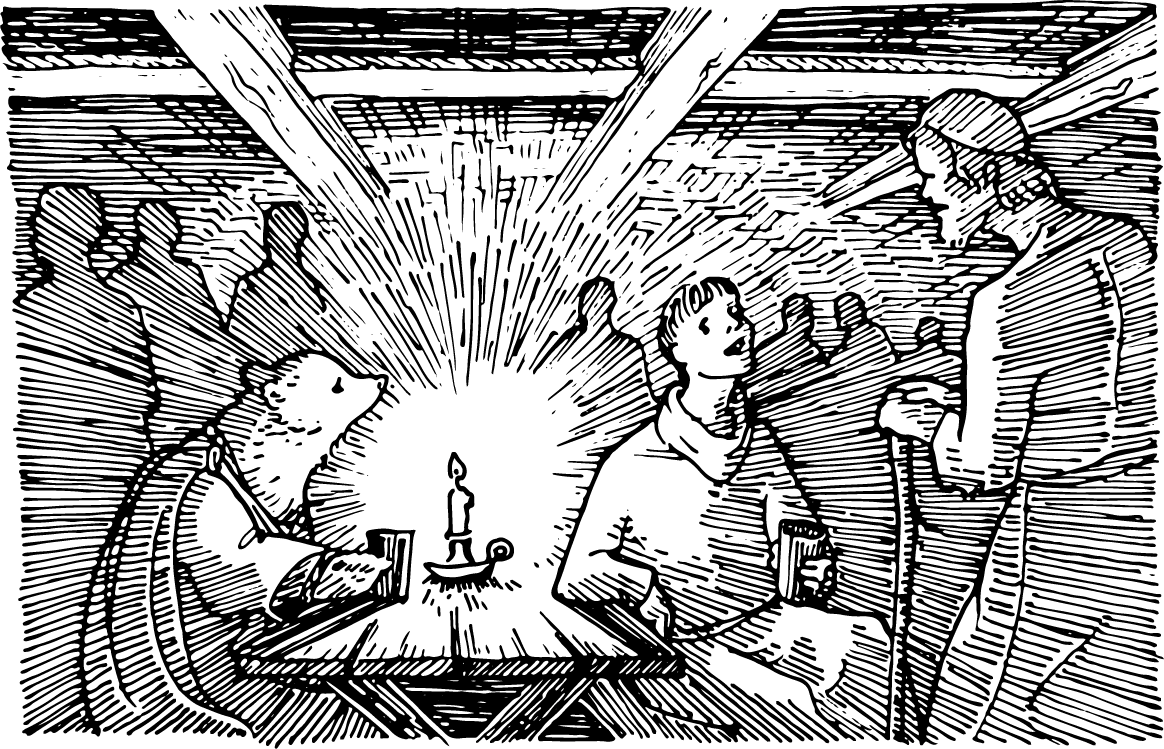
You and I had been working on a pre-launch campaign for Ōsweald Bera in mid-to-late 2024, giving people a behind the scenes look at how Ōsweald was written and how best to use it. Luckily, we had access to the book’s lovely illustrations by Alex Swanson to use as the art for it.
At the time, I wasn’t sure I was going to do anything with Substack beyond that. I said, “I’ll do this up until the end of the year, and then we’ll see what happens after that.”
So those two things were running in parallel, the Twitter and the Substack. But in early 2025, I decided that I could indeed keep Substack going. But it needed a format.
I decided to adapt the format I was using on Twitter, and I was now really focusing on a much broader audience than The Winged Schwa could reach.
That’s why I changed the name of the Substack to Dead Language Society, a domain I had bought some years earlier because I liked the name and wanted to use it for a project some day — one of the few times in history that buying a domain name on a whim has actually ended up being a wise decision.
I branded that quickly. Fortunately, I found the perfect painting:
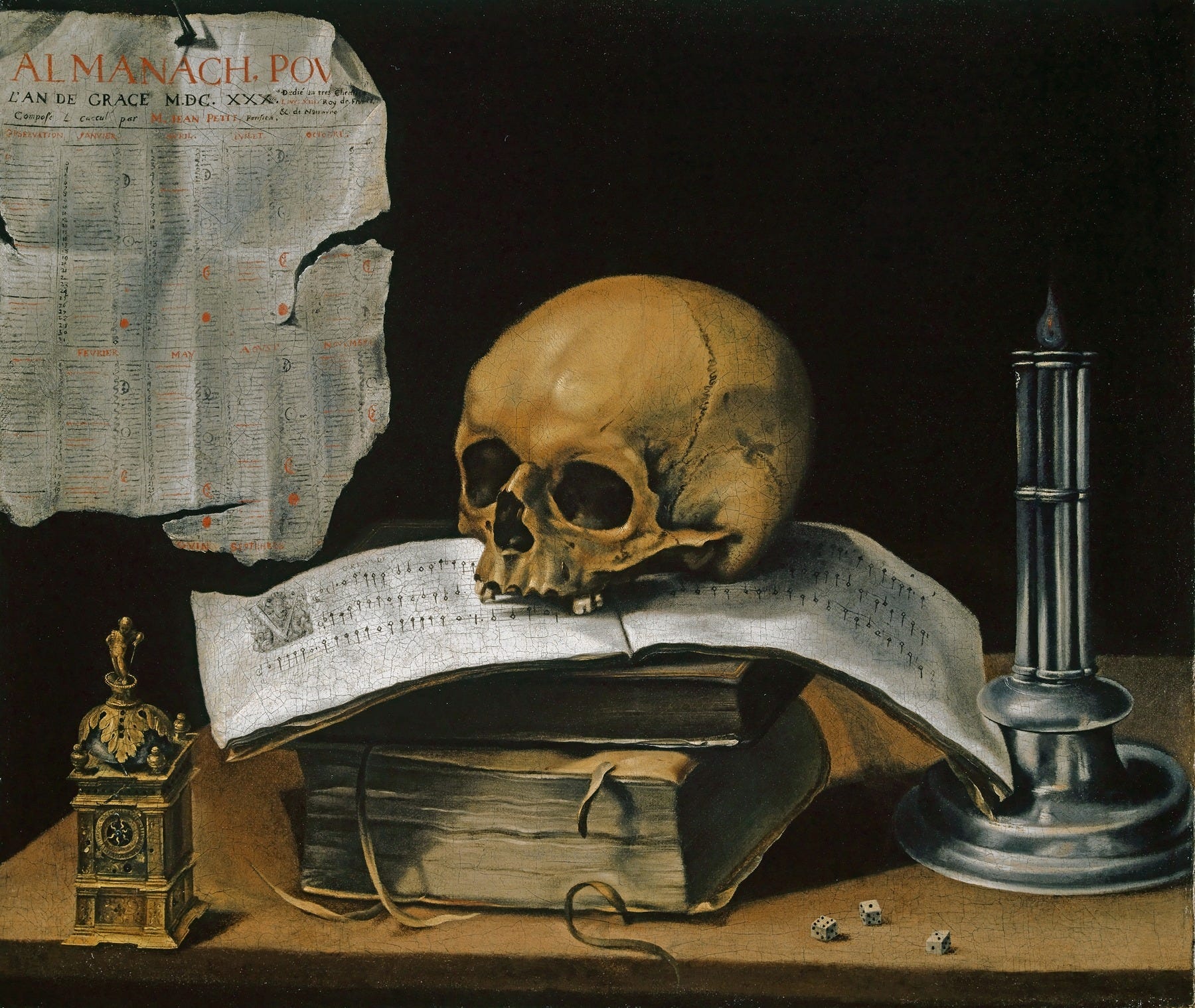
It had something dead (the skull) and it had language (well, books). Perfect! Welcome to the Society. I cropped it to something that would look clear enough at a small size, and Bob’s your uncle! The Substack was now “branded” and I could focus on writing.
I adapted that Twitter thread style when writing the first articles. It started growing at a good pace. But, really quickly, the format evolved. At the start, I was really concerned with word count, trying to hit — if I can remember it right — 600 words. And I don’t think I succeeded even once.
But, nevertheless, when you have such a tight word count, you often have to write in a really compressed style. And it just doesn’t breathe. It’s not fun. It’s not fun to write, and it’s probably not that fun to read either.
Natasha: It’s a glorified listicle.
Colin: It’s a glorified listicle. What I quickly realized is the format of a Substack post allowed for a lot more ambition.
Natasha: A lot of this came about when we started thinking about whether we should turn on paid subscriptions or not. It almost gave you permission to try more ambitious pieces.
Colin: Right, which I decided ultimately to do. I did want to sort of give some engine of sustainability to this project, because it takes a lot of time to research and write and edit these articles.
Natasha: How long does it take on average to write an article?
Colin: It’s probably 10 to 15 hours. And that’s after getting really efficient with it. So I end up being a busy beaver!
When you’re asking people for money, you want to give them something they can’t get anywhere else. The format I’d adapted from Twitter is essentially a friendlier, more charming version of Wikipedia, with better art. And, especially in the age of AI, obviously, you have to go beyond that because if all you want is a summary of a topic, there are other sources you can easily ask.
With that, the word counts grew and grew and grew and grew. I don’t think I ever went above 6,000 for an article, but I do believe I got there once or twice.
Natasha: There have been a few articles where we had to cut thousands of words.
Colin: I always say, “I’ll use it for another article.” But I never do. I never do.
Natasha: Can you share a little bit about the process of writing a DLS article?
Colin: It begins with the premise. I have a long list of ideas for articles, which are just short phrases like “Great Vowel Shift” or sometimes titles that inspire me to write an article around. I’m not sharing any of those in case someone takes them.
We also meet every two weeks — or whenever inspiration strikes — to play with ideas and plan out the next few issues. We often come up with the best ideas just by joking around, or from having you ask me, “What’s been annoying you lately?”
Once I’ve decided on a topic, I go through my library of sources, mostly books and articles that I’ve accumulated over the years, to verify the factual spine of the article. Sometimes this process takes a long time, but less so now than it used to, as I have my “usual suspects” lined up.
The same few comprehensive handbooks tend to provide the way in to any topic, foremost among them the Cambridge History of the English Language series. You’ll see these show up frequently in the reading lists under the paid posts. Then I follow the citations from there and do a quick literature search to see if there’s been anything interesting written more recently than the CHEL volume or whatever handbook I’m using as my main source.
After that, the article writing is pretty straightforward. I do it in Google Docs so that we can leave each other comments. As I write, I try, as much as possible, to synthesize and draw connections between topics, so that I’m delivering something beyond a summary of a few books or papers. Then, once I’ve finished the first draft, I do a self-edit.
Once I think the draft is in a respectable shape, I send it to you so you can make your edits and suggestions. As we’ve worked together more and more, this process has taken less and less time, as I’ve internalized the “voice of Natasha” into my writing process.
Beyond working on the text itself — things like structure, word choice, clarity of storytelling — your edits also usually involve requests for “more jazz”, which is code for having more fun with the writing, and adding style and personality. I find I can only do this kind of writing from about 9–12am, however, so the “jazz edit” typically happens the day after the main edits.
Then we get the post into Substack and hope people enjoy it!
Natasha: I think one of the things that really made us realise ‘oh there is an audience for this’ was when we had our first viral piece.
Colin: Yes! It was The invention that ruined English writing, which covered the fact that the printing press came to England right as the Great Vowel Shift was getting started. As a result, the spelling system of English got frozen in its pre-Great Vowel Shift state.
That article was still, I think, fairly compressed. I remember someone criticized it for being oversimplified, which, yes, it is, because it’s a thousand-word article on the internet.
Natasha: But you did something which was quite unique at the start.
Colin: Yes. I started off with a little bit of fiction. This is something that I love to do because I find it so fun. These little vignettes are meant to immerse you in the world of whatever period that I’m describing in the piece, to give a little bit of sensory detail: How would it have looked? How would it have felt? How would it have smelled? Maybe not always that last one, since that might put you off your meal in a lot of cases.
But I try to engage a little bit more of the reader than the sort of abstract appreciation for language and how it changes throughout time. I want to show you a little bit of character. I always try to include some conflict in those scenes as well.
Sometimes I’ll try to make it funny. This is where the Barleygrow characters come in. It’s a whole lineage; there’s a Barleygrow in every generation who can pompously weigh in on language.
Experimenting with fiction was something that few online explainers do. And I think it sets Dead Language Society apart. I don’t always do it because it tends to bloat the word count. But, then again, I don’t really care about that anymore. So if people are patient enough to read through it, then I’ll write it.
Natasha: I think it’s added joy to your writing experience.
Colin: If it’s not fun to write, it won’t be fun to read.
Natasha: Can you speak a little bit about how we’ve developed our approach to the type of content we’ve been publishing?
Colin: One thing we have done over 2026 is get more disciplined about the topics we write about and how they’re framed. I think there was a period where, much to your chagrin, I was writing a lot of stuff that required a decent amount of technical vocabulary to understand — not as excessively as back in 2022 or 2023, but these pieces required more investment.
I’m in two minds because I don’t want to stop doing slightly more technical pieces altogether. But I think I’m trying to get a bit smarter about just how much investment I’m asking for from the reader.
Natasha: Bar my personal dislike of learning about the technicalities of grammar (in English or any language!), I think these pieces were still very interesting and definitely had an audience. I think the challenge has always been finding a balance between the more technical topics (and the topics you find interesting as a linguist) and your ultimate goal of reaching as wide an audience as possible to share your love of historical linguistics. And those two things can be in tension.
Colin: The articles that interest me most as a writer as the ones where I learn something while writing them. When I’m writing about something I understand really well already, the piece can feel a bit dead. I do still find some interest in the technique of writing articles like these, but the fun is in figuring out how to portray these well-understood topics elegantly and clearly. But I can tell — and I suspect readers can tell — that the article wasn’t driven by a spark of curiosity.
This quest for finding the living spark, more than anything, drives me to more technical topics. I want to take readers to the limits of what we know, and show how linguists are still debating some issues; that requires some technical investment to explain. So that’s the tension.
There is a way through it, though: even the well-understood topics have their mysteries. Linguists can’t even agree on a definition of language, for heaven’s sake! So chasing the curiosity and limiting the technical language can coexist.
Natasha: And the funny thing is, we’ve been terrible at predicting what topics will connect most with an audience! So one thing we’ve learned is that it’s important to make sure they’re topics you’re excited to write about.
Colin: Yes, there’s occasionally a moment of hubris when I finish an article and think, “This one is going to do well,” and then it performs… just about average. I thought more people would have been keen to read about Shakespeare, for example. Nor did I expect people to respond so well to my language learning article from January, since it’s outside my normal “beat”.
Natasha: Your articles on individual letters or lost letters are particularly popular.
Colin: We are fascinated by spelling. And English gives us a lot to work with; we have a famously strange spelling system. I had some success earlier this year with an article that argued that the English spelling system isn’t as illogical as people think.
Whenever you can tell someone, “Here are the hidden rules that you didn’t know existed,” people really want to know about that. People don’t want to be caught out as not knowing something they should. And then they want to be able to repeat that experience with people they meet where they’re in the position to tell others about the hidden rules.
I think that’s human. It’s like introducing someone to a TV show you love. You put it on, then you sit and you watch them watching it.
Natasha: And is that a big motivator for your content now?
Colin: I want to give people “aha!” moments that they can share with others. It doesn’t have to be me who spreads it to every link in the chain, I’m happy to spread it to the first person. Then they can go out and spread it further.
This means that the ideas do have to be somewhat portable. And portable means you don’t have to have a huge technical vocabulary in order to understand it and then explain it. It has to be something that has an existence independent of jargon.
Natasha: One of the other things that we’ve been thinking a lot about is how to be more creative with some of these posts. Because you’re a very creative guy, and you really enjoy writing fiction. And some of these posts end up doing very well.
Colin: The biggest one by far has been How far back in time can you understand English?
I got the idea for that by watching Simon Roper on YouTube. Simon Roper is a great phonetician, who is able to brilliantly reproduce historical English. He did a popular video where he demonstrated how English sounded through different eras.
And, whereas the pronunciation of English has changed slowly in some eras and then really quickly in others, the writing of English has changed slowly in some eras and really quickly in others. So I thought it would be interesting to do that same experiment with text.
My first thought was to take authentic texts from different eras and show readers what they look like. But then I realized, for some eras, there are so few, and they might not show what I wanted to highlight.
So I said, I’ll have to write something myself. And I wrote a weird horror short story where a blogger goes to this seaside town in England. And the town’s a lot weirder — in almost a Lovecraftian sense — than he thought. And with every few paragraphs, the language of the article goes back a hundred years.
Not only the language, but the spelling, the typography, and the writing conventions. So what starts off written as a 2000s blog becomes a 17th-century diary and, eventually, a medieval chronicle. And the discovery of what’s going on in this town unfolds as he goes on, caught in this time warp.
That article seems really to have connected with people, which is great because it’s the most fun thing that I’ve written for Dead Language Society. And the fact that it’s the most fun thing for me and it’s the most fun thing for others bodes well for us all.
Natasha: It was also a moment of connection for a lot of people because they were able to experience these different eras of English writing, but also to talk to other people in the comments about far back in time they could go.
And you had a great explanation of the text afterwards. If it had been just a collection of quotes, I don’t think it would have connected in the same way.
Having known you for so long, it’s just a very “you” piece of work. It’s really lovely to see because we’ve worked so hard at injecting more “Colin” into the work. It was something that you were hesitant to do for quite a while.
Colin: I’m naturally an introverted person. And I hadn’t imagined that my thoughts in particular would be of interest to people. I thought the topics, the stories of the past — those would be of interest to people. But, I thought, what do they care what I think about it?
But I’ve eventually been able to bring myself into the story a bit, I hope in an unintrusive way, to help people find a way in. When Dante is going through hell, he has Virgil there to guide him. He wouldn’t have been able to do it on his own.
Hopefully my articles aren’t quite so hellish, but we’re still also going into the underworld, so to speak. We’re going into what is buried, what is past. And you need a guide who isn’t silent and stone-faced, like the Ghost of Christmas Yet to Come, simply pointing and saying nothing. I think it’s much nicer if your guide has a little bit of personality and acts as your friend.
Natasha: How do you feel you’ve developed as a writer?
Colin: A lot of the development in my writing practice is chronicled by the articles that we’ve done on prose style. The paragraph article is a good example, as is the prose cadence article, which is actually one of the articles that I enjoyed writing the most. I examined how clauses and sentences ended rhythmically in different historical periods and traced the thinking about cadence back to ancient Greece and Rome.
That is a conscious part of my writing. I pay very close attention to rhythm because I try to read out loud everything that I write. There are certain ways to end sentences that just work better than others.
I’ve also learned from the process of being edited. It’s like deliberate practice. The edits help me see where I need to improve and, consciously or unconsciously, my attention is drawn to doing that thing better next time.
I think I’ve improved the most at the overall structure of articles at the scale I’m writing at. We used to have to move things around a lot more. What works at 500 words doesn’t work at 2000, and what works at 2000 doesn’t work at 5000. And what works at 5000 doesn’t work at book length. So, as much as you might like to hope it’s this fractal structure that’s always the same at every level, it just isn’t.
You make different demands on readers at different scales, and you have to put different things in place to support readers. If you’re crossing a small stream, you can just put a wood plank or some stones over it. If you want to build the Golden Gate Bridge, you’re going to need some serious support. It’s similar with prose.
I think I’ve also gotten better endings. That was something I struggled with a lot at the start, because I thought, “Ok, I’m done! Can I please just exit this article now? I’ve finished what I wanted to say.” I think I’ve gotten better at those.
I’ve also gotten better at introductions. At the beginning, I was of the opinion, and there’s still a voice within me that feels this way, “Why do we have to faff around? Let’s just talk about what we want to talk about!”
And you would always say, “No, you need to lead people in.” You can’t just assume that people are just going to be right with you up front. Tell them a nice story, relate what you’re going to say to their lives. Answer why people should care about this.
I think I’ve gotten a lot better at that. It’s often easy to write the introductions, and it’s often easy to write the bodies of the pieces themselves, but the transition between the two is challenging. I don’t want it to feel like, “Okay, now the fun’s over. Now it’s time to work.”
It reminds me of how part of being socialized in the professional world is the “blah blah” at the beginning of a meeting. “How’s it going? How’s the weather up by you? It’s cold this year.”
Then you have to transition smoothly into the business portion. You can’t just say “Wow, it’s getting dark so early now! Anyway, where are those reports?”
That principle applies to writing as well.
Natasha: At the heart of it, though, the content is kind of the same as it was in 2022. What’s changed is the packaging.
Colin: The exact same article can sink or swim based on its framing. What goes at the very, very start of the article is an implicit promise you’re making to the reader. Changing that promise can completely change how the rest of the piece is received, even if every single word in the middle remains the same.
Even the precise wording of the title matters a great deal. People like titles that start with question words, for example, like “What”, “How”, and “Why”. Often you can just tack one of those on.
Natasha: Formatting matters as well. We recently wrote an article about paragraphs, which opened up a lot of interesting conversation in the comments. Even if we change nothing else, just adding in more paragraphs fundamentally shifts the reading experience.
Colin: Paragraphing is a way to manage the reader’s experience of the text in the medium where they’re reading it. Because this is on Substack, the medium is almost always a screen. And the way people use screens is different from the way they use printed books.
On Substack and on screens in general, you need shorter paragraphs to replicate the experience of the longer paragraphs in the books. I personally like longer paragraphs — longer than the ones we produce for DLS, but I know that’s not the way that the internet works!
Natasha: Somebody could be reading this while they’re on the loo, right?
Colin: It can be depressing to think that you’re meticulously polishing the rhythm of sentences whose destiny is only to be skimmed, whether on the toilet or elsewhere. But, if you don’t like that, don’t write for the internet.
Natasha: What are the most surprising things that you’ve learned from this whole experience on Substack so far?
Colin: I’m surprised that we’ve found some success with this format, since long explanatory articles that occasionally mix fiction with non-fiction are not common on Substack.
I began DLS using that more social media-based model. But, when we started letting things breathe, adding more beyond-the-basics stuff, there weren’t many other models to go by. We just “used the force” — went with what felt right.
Natasha: What’s next for DLS?
Colin: I would like to continue to experiment with format. There will probably be more experiential stuff like the “How far back” article. The more we can directly show historical language, the more people can have an unmediated experience.
Natasha: It’s the Substack equivalent of going to a living history village.
Colin: Yes, yes, exactly! I want to have even more fun with it. I would like to experiment more.
The desire to experiment is in tension with the fact that I want every issue to be really polished. But experimenting means that sometimes you do something different and you don’t know how to polish it in the same way.
There’s also a big secret project that we’re not going to tell you about now, but it’s going to come out in the next year.
Natasha: Would you have done anything differently?
Colin: When I started off, I was doing one free post a week and then a paid post every other week. That was unsustainable. I would have started as we are doing now, with alternating free and paid posts, and that probably would have saved me some stress.
It is a challenge to keep a weekly publication schedule with the level of quality that we demand from the publication. But I would rather sacrifice cadence than quality.
Natasha: I thought you were going to say “I’d rather sacrifice my sleep than let down my loyal fans.”
Colin: I like the alliteration on that. “I would rather sacrifice my sleep than let down my loyal fans.”
Natasha: The interesting thing about Substack is that, for a lot of readers, the draw is the community. And I think this has been both a very gratifying thing for you, and it’s also been something that has been something of a challenge, right?
Colin: Yeah, I really love the community and the engagement that the articles get. Even when, sometimes, people say mean things, but at the same time, it’s just human nature.
But it’s also very hard to manage as an introvert, especially as the readership has grown. I want to do more than I can do. And so if anyone’s reading and I haven’t replied to you, I’m sorry. I still appreciate all that you do.
Natasha: And you’ve very much enjoyed the ability to do book clubs.
Colin: These have been a lot of fun: we’ve taken great texts, read them at home in translation, and then come together to do some close reading of the original. I also gave little mini-lectures here and there about the historical and cultural context.
Our first was Beowulf, in the second half of 2025, and then we did Sir Gawain and the Green Knight earlier this year. I think Owl and the Nightingale will be up next. No promises on the timeline though — research for the book is taking lots of my reading time these days.
Natasha: Oh, and speaking of owls…
The Dead Language Society owl in our new logo needs a name!
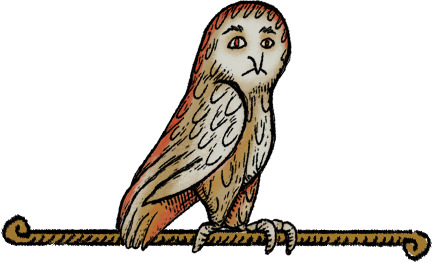
Just look at his mouth! Look at his little eyes! So think it over, sleep on it if you have to. Then, please write your suggestions in the comments and we’ll choose the cleverest one!
Thank you for reading and for supporting the Dead Language Society! There’s so much more to come that we can’t wait to share with you. Until next Wednesday!
Colin & Natasha
How about we commemorate one of English’s lost letters and call it Yog the Owl?
Really enjoyed this, Colin, especially your point about giving readers 'aha!' moments they can share with others.
For the owl, how about Athene, after the ancient Greek goddess of wisdom, whose emblem was an owl?