

I’m surprised that a war has never begun over a point of grammar.
Wars have begun over a pig, a bucket, and an ear, but so far never grammar.
Which, as silly as it may sound, is more surprising than you may think. Language is simultaneously public and private property, which makes it particularly prone to conflict.
A language exists as knowledge in our individual minds — so my English feels like mine and no one else’s — but at the same time it’s also a means of communication and a way of signalling that you belong, which makes English feel like a shared project that we all have a stake in.
When someone uses a bit of grammar you don’t approve of, it can feel like they’re endangering that shared project. But when someone doesn’t approve of your grammar, it can feel like a personal insult. Conflict seems inevitable.
And much to the dismay of grammarphobes the world over, grammar is inescapable: it’s not just the choice of one word or another, but a fundamental part of the logic of the language itself.
Luckily, disputes over grammar haven’t yet escalated to the point of international conflict. But wars of words are relatively common, especially where the choice of variant has become associated with different national identities.
Verb forms seem especially prone to these kinds of disputes: think of British got vs. American gotten, British dived vs. American dove, and British sneaked vs. American snuck.
This last form, snuck, is still controversial, even among American writers.
As late as 2010, the Paris Review‘s blog could still draw fire for using snuck. Although no injuries were reported, I wonder if the conflict might have been avoided altogether if the anti-snuck side knew just what the word represented: a living fossil from an ancestor of English, one spoken before the birth of Socrates.
You’re reading The Dead Language Society, where 50,000+ readers explore the hidden history of the English language. I’m Colin Gorrie: PhD linguist and your guide through 1,500 years of linguistic history.
This is the second instalment of A Deep History of English, a series that traces the story of the English language through the mysteries that remain in Modern English. Read it from the beginning here.
I publish every Wednesday. Paid subscribers get every issue, the full archive, and the content I’m most proud of: practical guides to reading historical texts yourself, honest takes on how language really works, and live book clubs where we read texts like Beowulf and (currently) Sir Gawain and the Green Knight.
In spite of continued anti-snuck ire, snuck seems to be winning. When the American Heritage Dictionary asked its usage panel (consisting of a group of 200 prominent writers) in 1988, two thirds disapproved of snuck. But when they asked the same question again to the panel convened in 2008, three quarters approved.1
Although its rise to respectability has been quick in recent years, snuck was long considered a provincial, inelegant, or unsophisticated alternative to sneaked.
The more regular past tense form sneaked does have the advantage of age: it’s the form used when sneak first appeared in the written record, which it does relatively late: around the year 1600.
Snuck is indeed a relative newcomer to the language. The first attestation the Oxford English Dictionary gives for snuck dates back to 1887, although it almost certainly circulated in speech before then. The OED reports that it first appeared in a New Orleans newspaper called The Lantern, and retained its regional associations for the first part of its life.
Along with that regional stamp, snuck had all the usual connotations of innovative grammar: it was informal, and therefore unsuitable for use in writing.
That lasted for a while: but snuck eventually escaped the American South, made its way into print, and, as the AHD’s Usage Panel attests, into the canons of acceptable use as well, even if there were a few dissenters remaining in 2010.
It’s not common for a new irregular verb to be born. As we saw in the previous instalment of this series, irregular verbs tend to be fossils, remnants of older layers of the language which linger on because the words are too common to clean up.
That’s not the case with snuck. It can’t be an ancient fossil because even the word sneak itself is modern: its first attestation is younger than some of Shakespeare’s plays. In fact, sneak is first attested in none other than Shakespeare (Henry IV, Part I, 1598), although the word probably existed before it was written down.
Instead, snuck is more like the newest member of a very ancient club. The verb sneak just looked enough like one of the members that the doorman waved it through.
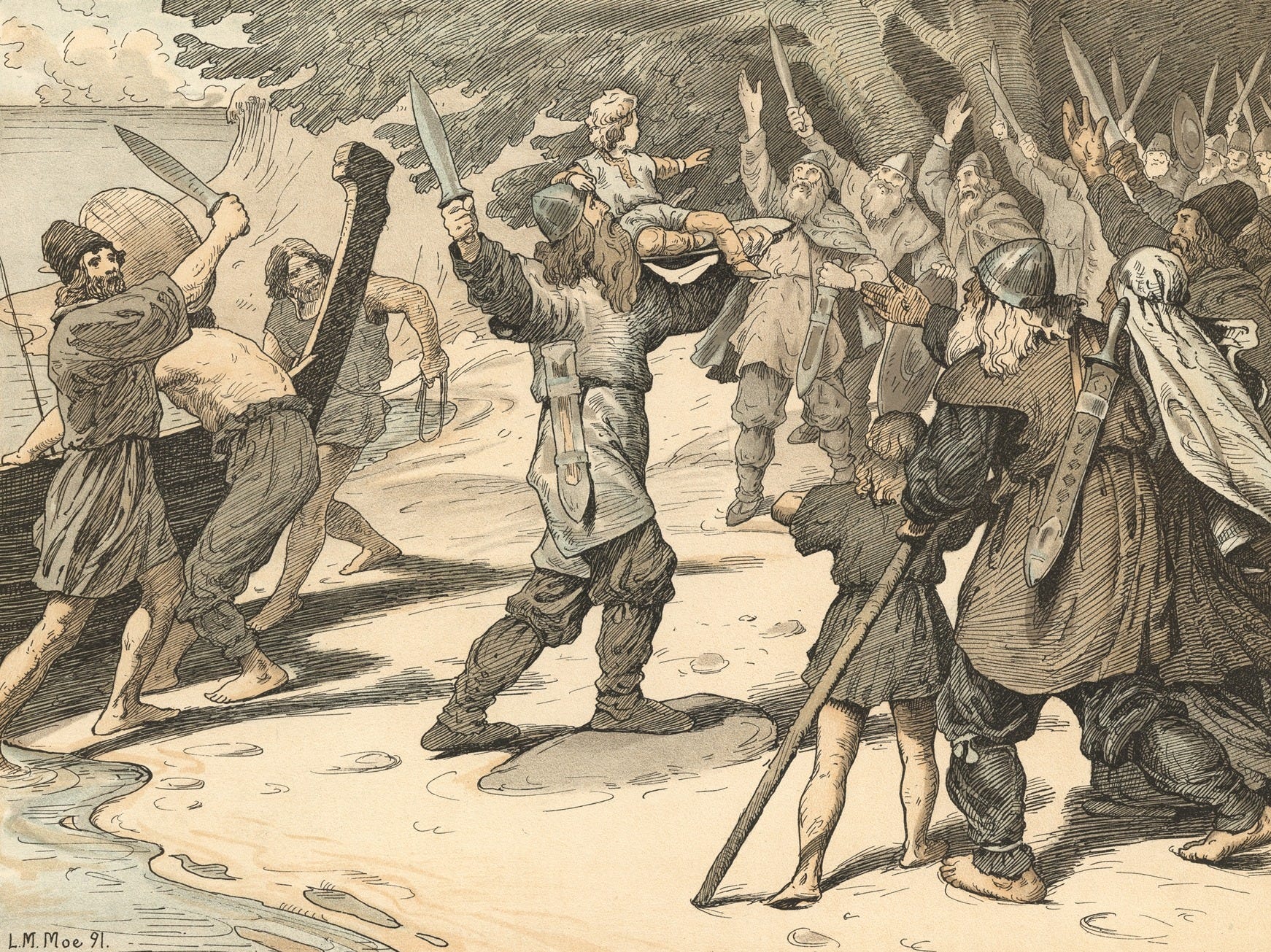
The rules of this exclusive club date back two thousand years or more, to a time when an ancestor of English was spoken in the forests around the Baltic Sea.
Established, 500 BC
We don’t know what these peoples would have called themselves, or even if they would have had an idea that they were all part of an overarching group. We give them the name Germanic, which is a linguistic designation: we work backwards from their language, which we call Proto-Germanic.
Like Proto-Indo-European (PIE) before it, Proto-Germanic has been given this name because it is the ancestor of the Germanic family of languages, which includes German, unsurprisingly, but also Dutch, the Scandinavian languages, and, most importantly for our story, English.
Because these early Germanic peoples didn’t leave us any writing — or nearly any, depending on how you date the earliest runic inscriptions — we must reconstruct their language as we did their Indo-European ancestors.
So when we write their words, such as *harjaz ‘army’ or *berhtaz ‘bright,’ we add an asterisk in front, just as we did for the PIE words in Part 1 of this series. This indicates that the word has been reconstructed rather than attested in writing.2
You can draw a clean line of descent back from English as it is spoken today, all the way to this Proto-Germanic language. There’s no clean break where Proto-Germanic, or some intermediate language, decisively ends and English begins. Equally, there was no single moment we can identify when PIE became Proto-Germanic.
Nevertheless, there are conventional dates we give to Proto-Germanic: 500 BC–AD 200. The earlier boundary is set by the dating of one particular sound shift which divides PIE from Proto-Germanic: the change of PIE *k into Proto-Germanic *h.3
The story involves cannabis.
As Herodotus (c. 484–425 BC) tells us, the Scythians — his vague term for northern peoples — had recently introduced the cannabis plant to the Greeks. If these Scythians were in fact the speakers of Proto-Germanic or a close relative, their language could not have gone through that *k to *h sound shift by the time they gave cannabis to the Greeks: otherwise, the Greeks would have heard something more like hannapis.4
A Proto-Germanic word sounding like *hannapis did undoubtedly exist later on, however: we know this because it gave us, through the Old English intermediary hænep, our modern word hemp.
Although there are details in this argument some might quibble with — were the Scythians really the same peoples who spoke Proto-Germanic? — the dating of 500 BC is generally accepted as close enough to be useful.
On the other end, the year AD 200 is derived from the first appearance of writing in Germanic languages: the famous runic inscriptions. These are generally short phrases on objects such as combs and brooches; first appearing in the late 2nd century AD, they show languages beginning to diverge from one another.5
Although the Proto-Germanic language was descended from Proto-Indo-European, the speakers of Proto-Germanic lived very differently from their linguistic ancestors.
Instead of the treeless plains of the steppe, they inhabited the forests and marshy lowlands around the Baltic and the North Sea, in places we now call Jutland, southern Sweden, and the coast of northern Germany.
They were settled rather than nomadic: they raised cattle, sheep, and pigs. They lived in longhouses with the family at one end and the cattle at the other, likely to share heat through the long winters. They grew oats, wheat, and barley in small fields which they fertilized with manure from the same cattle they shared quarters with.6
Much of what we know about these Germanic peoples of the north comes from their interactions with the Roman Empire, their mighty neighbours to the south.
The Romans represented both threat and opportunity: they could be partners in trade or opponents on the battlefield, depending on the day. The Roman army represented a place where a young warrior from the north could make a good living. As a result of these interactions, it was Roman writer Tacitus who gives us the first written account of the Germanic peoples.
In his book Germania, written AD 98, Tacitus describes a warlike society, one organized around institutions such as the extended family and the war-band. It was a society which took oaths and hospitality very seriously. Although Tacitus saw these early Germanic peoples through a distorted lens, much of what he described has been corroborated by later evidence.
It’s also from the Romans that we start to hear the voices of these peoples, albeit in distorted form.
Tacitus, for example, gives us the names by which some of these Germanic tribes and confederations called themselves. There are some familiar names if you know your European geography: Suebi (compare Swabia, a region in Germany), Frisii (Friesland), Chatti (Hesse), among many others. These names, filtered through Roman ears, are some of our earliest evidence of Proto-Germanic words.
But we get far more evidence for what Proto-Germanic was like by looking at the languages that came after, among them English. As a result, the sounds, grammar, and vocabulary of the Proto-Germanic language is fairly well understood.
It’s in Proto-Germanic that the club was founded that snuck sneaked into.
Why it’s easier to become weak than strong
Every Germanic language makes a distinction between two different types of verbs. They’re classified based on how they form the past tense.
Some verbs — most verbs — add a suffix. In English, this suffix is usually spelled -ed. So dance becomes danced, attack becomes attacked, and prognosticate becomes prognosticated. These are called the weak verbs.
Others change something on the inside: sing becomes sang, wind becomes wound, ride becomes rode. These are the strong verbs, and the vowel-changing pattern itself has a name: ablaut, German for ‘vowel alternation.’
This opposition between weak and strong verbs is unique to the Germanic family. In every Germanic language, there is a group of more or less regular verbs that form the past tense by adding a suffix like -ed.
This is called the dental suffix, because the d-sound in -ed is formed near the teeth, as are the other variants of this suffix in English and other Germanic languages, such as -t as in English dealt, the -de in Swedish kallade ‘called,’ and the -te in German werkte ‘worked (on a handicraft).’7
Of the two types, the strong verbs are much older. They preserve a pattern for expressing the different tenses of verbs — a pattern that has its roots in PIE, but which died out in almost all the descendant languages.
But ablaut lived on in Germanic. In fact, it became even more prominent there. Germanic languages took the ablaut patterns present in PIE verbs and streamlined it, creating a system of different verb classes.
A verb class is simply a group of verbs which all work in the same way. In Proto-Germanic, the different verb classes each had a particular pattern of alternating vowels.
It’s easiest to see how it works by looking at an English example, but all Germanic languages work more or less the same way: one class of English strong verbs marks the present tense with an i-vowel and the past tense with an o-vowel: ride/rode, drive/drove, write/wrote. These verbs form a class because they all express their past tense forms in exactly the same way: by replacing i with o.8
The weak verbs, on the other hand, were an innovation peculiar to the Germanic family. Because weak verbs are present in every Germanic language, linguists have concluded that weak verbs must have been there in their common ancestor, Proto-Germanic.
This newer family of weak verbs was much more regular than the older strong verbs, and, as a result, were much easier to learn. And so, as English developed over the centuries, the proportion of strong verbs has continued to shrink.
New verbs have almost always been formed as weak verbs: for example, the past tense of google is googled, not gogle. Even the absolute number of strong verbs has decreased, since many strong verbs have become weak over time (until the 16th century, we used to say I holp rather than I helped).9
So snuck is truly a rarity: a new strong verb.
Weak verbs becoming strong is extremely rare, although it does occur from time to time, as in the case of snuck. Other examples of verbs with weak-to-strong transformations in their past are dig, wear, ring (a bell), and — also controversial — dive, which all had weak verb forms before they acquired dug, wore, rang, and dove.
To understand why it’s easier to become weak than strong, we need to explore one of the most powerful — and hardest to predict — forces in language change: analogy.
Brang, bote, wope
The human mind learns language as a mixture of memorized facts and rules that can be applied in many situations.
For example, the fact that man has the plural men is a fact a learner of English must memorize. But the fact that dog has the plural form dogs can be learned as a rule, because — unless otherwise specified — English nouns form their plural by adding -s.
This simple plural rule — plural = singular + -s — began its life as the special plural ending of one type of noun. But it ended up taking on a life of its own, and gradually took over every noun in the language.
Veterans of standardized tests will recognize the process by which this occurred. The SAT in particular is famous for its “analogy questions,” which require you to apply a relationship between one pair of items to another pair, like this: “Hand is to glove as foot is to _______.” (shoe)
Analogy in language change works in much the same way: when speakers need to form the plural of, say, the word eye, they may perform an analogy: singular dog is to plural dogs as singular eye is to plural ______ (eyes).
Originally, the plural of eye was eyen; the reason it’s not eyen anymore is analogy.
The reason analogy is such a powerful force in language change is that learning things by rule saves mental effort. Analogy allows us to extend rules beyond the words they originally applied to.
When a word is common enough, it tends to resist analogy: we hear it so often that there’s not much effort expended to memorize it. This is why, as we saw in Part 1, it’s precisely the most common verbs in a language that are irregular.
But any irregularity present in less common verbs tends to get removed by analogy: this is why strong verbs have tended to become weak over time. The regular way of forming the past tense — the weak verb way, by adding -ed — exerts a gravitational pull in the minds of a language’s speakers, pulling formerly strong verbs into its orbit.
But strong verbs are not entirely irregular either. There are islands of regularity within the strong verbs, such as the i~o pattern we identified earlier: ride/rode, drive/drove, and write/wrote.
This rule, too, has its own gravitational pull, albeit a weak one. But it was strong enough to drag in the verb strive, from Old French estriver ‘compete,’ which is a rare example of a borrowed word becoming a strong verb.
Strive became a strong verb, with past tense strove, on analogy to drive and its past tense drove. Another one that sneaked — snuck? — by the bouncer.
We see the same thing happen with children. A child who has learned that sing has the past-tense form sang may surprise you by saying she brang her teddy bear to the picnic.10 The strong verb pattern in sing/sang has taken on a life of its own, and, by analogy, a non-standard verb bring/brang emerges.
Now, the verb bring is itself irregular, albeit a different kind of irregular: bring/brought is in fact a weak verb in origin, which you can tell from the -t ending denoting the past tense.
But the kind of irregularity in bring/brought is more irregular than sing/sang, because the i~a alternation in sing/sang occurs in other verbs. Sing/sang forms a group with sink/sank, ring/rang, swim/swam, and others.
It’s this semi-regularity that analogy latches on to. And this is the source of snuck: although the precise ea~u alternation we see in sneak/snuck is not found elsewhere in English, a phonetically very close alternation i~u is found in dig/dug and stick/stuck.
The similarity between sneak and stick, although not exact, was enough to allow sneak to join the strong verb club. There was enough of an island of regularity around verbs like dig and stick for the forces of analogy to “regularize” sneak/sneaked.
There’s an irony here: analogy usually produces regularity, but, in producing snuck, it made sneak less regular than it had been before.
Why sneak and not some other verb? That is likely to remain a mystery. But snuck seems to be here to stay, at least in North America.11 It’s no danger to the shared project that is the English language.
If anything, it’s part of what makes English the language it is. Despite all the imported words that English picked up over the years, the Germanic heritage of English remains a living force. It’s strong enough to invent new strong verbs thousands of years after the system of strong verbs was first established in Proto-Germanic.
The grammatical pattern that took shape 2500 years ago in longhouses on the shores of the Baltic Sea lived on in 19th-century New Orleans, and it lives on today. Perhaps it will even claim another verb: drug for dragged still hovers outside the threshold of literary respectability, but that’s nothing a future war of words can’t solve.
Works Cited
Bybee, Joan L., and Dan I. Slobin (1982). “Rules and schemas in the development and use of English past tense.” Language 58: 265–289.
Haselgrove, Colin, Katharina Rebay-Salisbury, and Peter S. Wells, eds. (2023). The Oxford Handbook of the European Iron Age.
Smith, Jeremy J. (2007). Sound Change and the History of English.
Todd, Malcolm (2004). The Early Germans.
Xu, Fei, and Steven Pinker (1995). “Weird past tense forms.” Journal of Child Language 22: 531–556.
American Heritage Dictionary, 5th ed., usage note for sneak.
If you happen to be named Herbert, now you know where your name comes from: *harjaz + *berhtaz = *Hariberhtaz, which would have originally meant ‘army bright.’
This is part of a larger sound change called Grimm’s Law, after Jacob Grimm, the linguist and (more famously) folklorist.
The Proto-Germanic change of *b to *p is part of the same sound shift that changed *k to *h (Grimm’s Law). The historical Scythians were an Iranian-speaking people, not a Germanic-speaking people, but Herodotus is not precise and uses the term to describe various northern peoples. See Smith (2007) for details.
A 2023 find, the Svingerud stone, may push the runic record earlier still, as early as the 1st century AD, although the dating is still uncertain.
Todd (2004), Haselgrove et al. (2023).
Some Germanic languages, such as Yiddish and Afrikaans, have largely stopped using the past tense proper, and have formed new ways of expressing past time. But these languages have historically had the weak vs. strong distinction in verbs, and have formed the two types of verbs in the same way. The same distinction can be found, even in these languages, between the past participles of weak vs. strong verbs, which are formed in much the same way as the past tense: by the addition of a dental suffix or by a change in the internal vowel of the verb.
In Proto-Germanic, this alternation was between *ī and *ai.
In some American dialects, you could still hear holp in the 20th century. It may even be said today. If you know someone who says it, let me know.
Bybee & Slobin (1982) documented child forms like brang (and also bote from bite, wope from wipe) in their original corpus study; Xu & Pinker (1995) found that all children produce such forms, in roughly 0.2% of opportunities — rare, but universal.
English speakers outside North America, let us know in the comments if snuck has established itself on your shores as well.
"snuck" is not uncommon here in England. It has a distinct jocular air in my experience; people use it because it sounds funny. I think most people if pushed would say it was technically "wrong", though. Not unlike occasional similarly jocular use of "thunk" as the past tense of "think".
For some reason "dove" for "dive" is much rarer; I basically never encounter it except from US sources, despite it being wholly established in the US, while "snuck" is only most of the way there.
As well as “snuck” actually being quite common in Britain, I feel I must also mention that in British English (especially Northern English), “bring” *does* have an irregular form along the described lines: “brung”.
https://en.wiktionary.org/wiki/brung